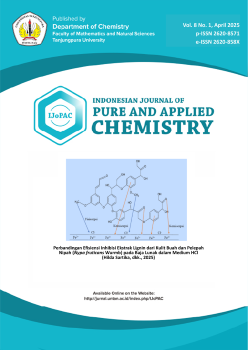
COMPARATIVE OF INHIBITORY EFFICIENCY OF LIGNIN EXTRACT OF NIPAH (Nypa fruticans Wurmb) PEEL AND FROND ON MILD STEEL IN HCl MEDIUM
DOI:
https://doi.org/10.26418/indonesian.v8i1.83186Abstract
Lignin extract from nipah fruit skin and nipah frond (Nypa fruticans Wurmb) was effectively extracted and used as a corrosion inhibitor on mild steel samples. The corrosion inhibition efficiency of lignin extract in 1 N HCl solution was determined by the weight loss method and surface morphology analysis using an optical microscope. The measurement results showed that the highest efficiency was obtained at the concentration of lignin extract from fruit skin (ELBN) and nipah frond (ELPN) of 82.16 and 78.36%. The adsorption of lignin extract on the surface of mild steel follows the Langmuir isotherm adsorption and includes mixed adsorption leading to chemical adsorption.References
Umoren, S. A., Solomon, M. M., Obot, I. B., and Suleiman, R. K. (2018). Comparative studies on the corrosion inhibition efficacy of ethanolic extracts of date palm leaves and seeds on carbon steel corrosion in 15% HCl solution. Journal of Adhesion Science and Technology, 32(17), 1934–1951.https://doi.org/10.1080/01694243.2018.1455797
Ibisi, N. E., Okoroafor, D. O., and Amuta, C. C. (2017). Comparative Study of Mild Steel Corrosion Inhibition of Piper Guineense Leaves Extract and Vernonia Amygdalina Leaves Extract in Concentrated Corrosive Medium. IOSR Journal of Applied Chemistry,10(05),70–78.https://doi.org/ 10.9790/5736-1005027078
Wan, S., Wei, H., Quan, R., Luo, Z., Wang, H., Liao, B., and Guo, X. (2022). Soybean extract firstly used as a green corrosion inhibitor with high efficacy and yield for carbon steel in acidic medium. Industrial Crops and Products,187.https://doi.org /10.1016/j.indcrop.2022.115354
Salleh, S. Z., Yusoff, A. H., Zakaria, S. K., Taib, M. A. A., Abu Seman, A., Masri, M. N., Mohamad, M., Mamat, S., Ahmad Sobri, S., Ali, A., and Teo, P. Ter. (2021). Plant extracts as green corrosion inhibitor for ferrous metal alloys: A review. In Journal of Cleaner Production (Vol. 304). Elsevier Ltd.https://doi.org/10.1016/j.jclepro.2021.127030
Yetri, Y., Emriadi, E., Jamarun, N., and Gunawarman. (2015). Corrosion inhibitor of mild steel by polar extract of Theobroma cacao peels in hydrochloric acid solution. Asian Journal of Chemistry, 27(3),875–881. https://doi.org/10.14233/ ajchem.2015.17173
Zhang, L., Larsson, A., Moldin, A., and Edlund, U. (2022). Comparison of lignin distribution, structure, and morphology in wheat straw and wood. In Industrial Crops and Products (Vol. 187). Elsevier B.V. https://doi.org/10.1016/j.indcrop.2022.115432
Hayuni, S, N., Stiadi, Y., and Emriadi, (2022). Pemanfaatan Ekstrak Lignin dari Kulit Jengkol (Pithecellobium jiringa) sebagai Inhibitor Korosi Baja Lunak dalam Medium HCl, Jurnal Kimia Unand, 11(2), 14-21.
Rahayu, P. P., Sundari, C. D. D., and Farida, I. (2018). Corrosion inhibition using lignin of sugarcane bagasse. IOP Conference Series: Materials Science and Engineering,434(1). https://doi.org/10.1088/1757899X/434/1/012087
Shahmoradi, A. R., Talebibahmanbigloo, N., Javidparvar, A. A., Bahlakeh, G., and Ramezanzadeh, B. (2020). Studying the adsorption/inhibition impact of the cellulose and lignin compounds extracted from agricultural waste on the mild steel corrosion in HCl solution. Journal of Molecular Liquids, 304. https://doi.org/10 1016/j.molliq.2020.112751
Chavan, S., and Gaikwad, A. (2021). Extraction and recovery of lignin derived phenolic inhibitors to enhance enzymatic glucose production. Biomass and Bioenergy, 144. https://doi.org/10.1016/j.biombioe.2020.105897
Gao, C., Zhao, X., Fatehi, P., Dong, X., Liu, K., Chen, S., Wang, S., and Kong, F. (2021). Lignin copolymers as corrosion inhibitor for carbon steel. Industrial Crops and Products,168.https://doi.org/10.1016/j.indcrop.2021.113585
Iloamaeke, I. M., Onuegbu, T. U., Umeobika, U. C., and Onyema, C. T. (2013). A Comparative Study of Vitex Doniana And Pterocarpus Soyauxi As Corrosion Inhibitors Of Mild Steel In HCl Medium. Journal of Atoms and Molecules, 3(2), 509
Anggita Gusniardi, V., Elfira Putri, S., and Emriadi. (2023). Corrosion Inhibitor from Sambang Darah Leaves Extract (Excoecaria cochinchinensis L.) on Mild Steel in HCl. Chempublish Journal,7(2) ,64–72.https://doi.org/10.22437/chp.v7i2. 29254
Gusti, D. R., Emriadi, E., and Efdi, M. (2022). Thermodynamic and Adsorption Properties of Flavonoid Rutin from Cassava (Manihot esculenta) Leaves as a Corrosion Inhibitor on the Mild Steel in Sulfuric Acid Solution. Defect and Diffusion Forum, 416, 183–190. https://doi.org/10.4028/p-fk32yz
Umoren, S. A., Solomon, M. M., Obot, I. B., and Suleiman, R. K. (2018). Comparative studies on the corrosion inhibition efficacy of ethanolic extracts of date palm leaves and seeds on carbon steel corrosion in 15% HCl solution. Journal of Adhesion Science and Technology, 32(17), 1934–1951.https://doi.org/10.1080/01694243.2018.1455797
Emriadi, Untari, P., and Efdi, M. (2021). Leave extract of syzygium malaccenseas green inhibitor of mild steel in acidic medium. Rasayan Journal of Chemistry, 14(1), 569–577. https://doi.org/10.31788/RJC. 2021.1415836
Sartika, H., Suryati, Stiadi, Y., and Emriadi. (2024). Sifat Adsorptif dan Termodinamika Ekstrak Lignin dari Pelepah Nipah (Nypa fruticans Wurmb) untuk Korosi Baja Lunak dalam Medium HCl. Jurnal Fisika Unand, 13(4), 784-791.
Devikala, S., Kamaraj, P., Arthanareeswari, M., and Pavithra, S. (2019). Green Corrosion inhibition of mild steel by Asafoetida extract extract in 3.5% NaCl. Materials Today: Proceedings, 14, 590-601.
Downloads
Published
Issue
Section
License
Copyright (c) 2025 Emriadi Emriadi, Hilda Sartika, Nailatul Zahrah Pradiwi, Yeni Stiadi

This work is licensed under a Creative Commons Attribution 4.0 International License.
Authors who publish with this journal agree to the following terms: 1. Authors retain copyright and grant the journal the right of first publication, with the work simultaneously licensed under a Creative Commons Attribution License that allows others to share the work with an acknowledgement of the work's authorship and initial publication in this journal. 2. Authors are able to enter into separate, additional contractual arrangements for the non-exclusive distribution of the journal's published version of the work (e.g., post it to an institutional repository or publish it in a book), with an acknowledgement of its initial publication in this journal. 3. Authors are permitted and encouraged to post their work online (e.g., in institutional repositories or on their website) prior to and during the submission process, as it can lead to productive exchanges, as well as earlier and greater citation of published work (see The Effect of Open Access).