SINTESIS NANOPARTIKEL PERAK MENGGUNAKAN EKSTRAK DAUN PAKIS (Stenochlaena sp.) SEBAGAI BIOREDUKTOR
DOI:
https://doi.org/10.26418/indonesian.v8i3.86094Abstract
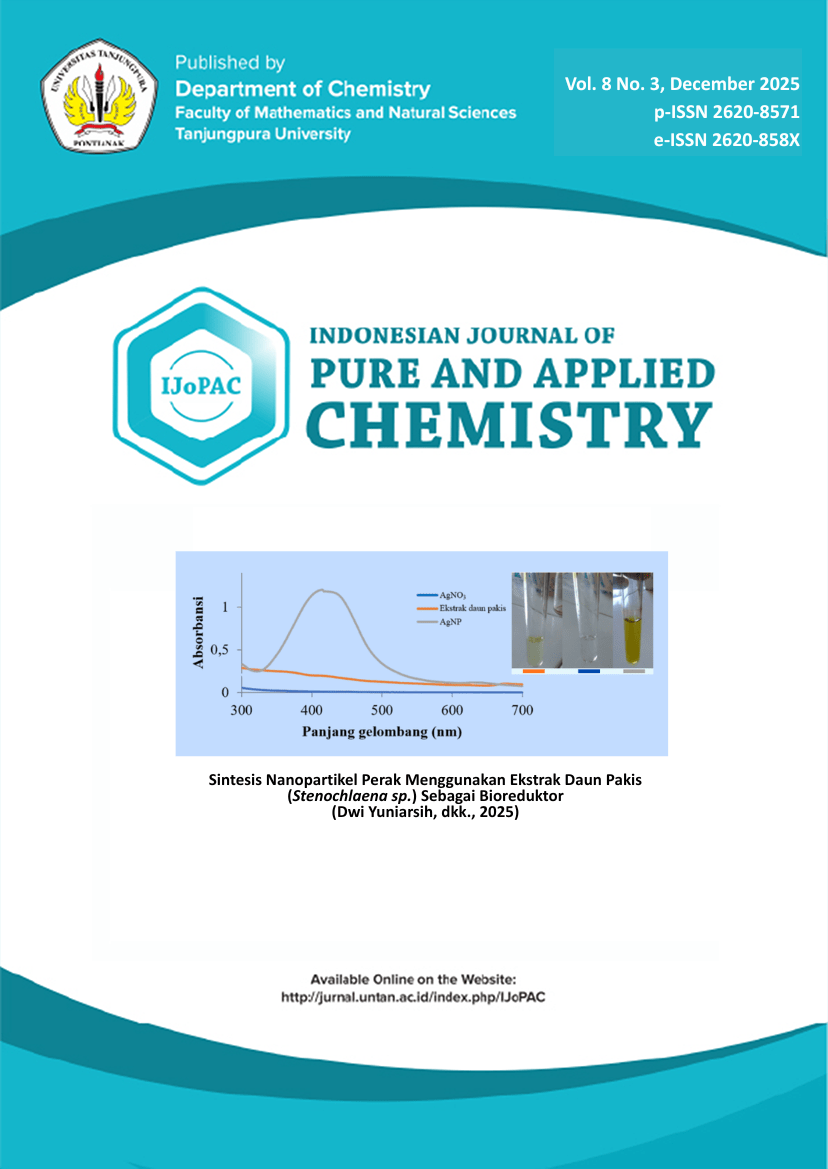
The use of biological reductants has been identified as a more environmentally friendly approach in nanoparticle synthesis than the use of chemical reductants, which can produce hazardous waste. The aims of this study were synthesize silver nanoparticles using fern leaf extract (Stenochlaena sp.) as a bioreductor and stabilizing/protecting agent, as well as to test the stability of the resulting silver nanoparticles and perform characterization. Synthesis of silver nanoparticles involves the reaction of a silver nitrate solution with a fern leaf extract solution in boiling water. Stability of the silver nanoparticles as observed over a period of one month indicated a decline in stability. FTIR spectrum analysis demonstrated indicating a direct involvement of the extract in the reduction process as well as the presence of Ag-O bonds in the FTIR spectrum of silver nanoparticles. TEM analysis revealed that the size of the silver nanoparticles ranged from 3 to 16 nanometers, with a relatively spherical morphology. PSA demonstrated that the silver nanoparticles had a zeta potential value of +12.7 mV. This study offers insight into the potential of fern leaf extract as a bioreductor in the synthesis of silver nanoparticles and the physical chemical characteristics of the resulting nanoparticles.References
Tran, Q.H., and Le, A.T. 2013. Silver Nanoparticles: Synthesis, Properties, Toxicology, Applications and Perspectives. Advances in Natural Sciences: Nanoscience and Nanotechnology, 4(3), 033001.
Pulit, J., Banach, M. and Kowalski, Z. (2013). Chemical reduction as the main method for obtaining nanosilver. Journal of Computational and Theoretical Nanoscience, 10(2), 276–284.
Priya, R. S., Geetha, D. and Ramesh, P. S. (2016). Antioxidant activity of chemically synthesized AgNPs and biosynthesized Pongamiapinnata leaf extract mediated AgNPs – A comparative study. Ecotoxicology and Environmental Safety, 134, 308–318.
Ceri, B., Lovadi, I., and Linda, R. 2014. Keanekaragaman Jenis Paku-Pakuan (Pteridophyta) di Mangrove Muara Sungai Peniti Kecamatan Segedong Kabupaten Pontianak. Jurnal Protobiont. 3(2): 240-246.
Stephanie, C. 2015. Karakterisasi Simplisia dan Skrining Fitokimia serta Uji Aktivitas Antioksidan Ekstrak Etanol Herba Kelakai (S. Palustris (Burm. f.) Bedd). Universitas Sumatera Utara.
Elemike, E.E., Onwudiwe, D.C., Ekennia, A.C. and L.Katata-Seru. (2017). Phytosynthesis of Silver Nanoparticles Using Aqueous Leaf Extracts of Lippia Citriodora: Antimicrobial, Larvicida and Photocatalytic Evaluations. Res. Chem. Int, 17(6), 1-14.
Syamsul, E.S., Hakim, Y.Y. and Nurhasnawati, H. 2019. Penetapan Kadar Flavonoid Ekstrak Daun Kelakai (Stenochlaena palustris (Burm. f.) Bedd.) dengan Metode Spektrofotometri UV-Vis. Jurnal Riset Kefarmasian Indonesia, 1(1), 11-20.
Gusrizal, G., Santosa, S.J., Kunarti, E.S. and Rusdiarso, B. (2016). Dual Function of p-Hydroxybenzoic Acid as Reducing and Capping Agent in Rapid and Simple Formation of Stable Silver Nanoparticles. International Journal of ChemTech Research, 9(8): 472-482.
Oktavianus, C. (2020). Sintesis Nanopartikel Perak dengan Reduktor Ekstrak Daun Buas-Buas (Premna serratifolia Linn.) dan Uji Aktivitasnya Sebagai Antibakteri. Tesis. Universitas Tanjungpura, Pontianak.
Gusrizal, G., Santosa, S.J., Kunarti, E.S. and Rusdiarso, B. (2018). Two highly Stable Silver Nanoparticles: Surface Plasmon Resonance Spectra Study os Silver Nanoparticles Capped with m-Hydroxybenzoic Acid and p-Hydroxybenzoic Acid. Molekul, 13(1): 30-37.
Agoes, G. (2007). Teknologi Bahan Alam. Bandung: ITB.
Fadliah. (2017). Sintesis Nanopartikel Perak Reduktor Asam Orto Hidroksi Benzoat dan Studi Kemunngkinan Aplikasinya pada Enhanced Oil Recovery. Jurnal Petro, VI(2), 38-42.
Junaidi, A. B., Zanah, N., and Sunardi. (2019). Kajian Pengaruh Rasio Mol Glukosa dan Polietilena Glikol 6000 dengan AgNO3 Terhadap Efektivitas Sintesis Nanopartikel Perak dan Stabilitasnya Pada Saat Penyimpanan. Sains dan Terapan Kimia, 13(2), 80-88.
Ningrum, I.R.W. (2022). Sintesis Nanopartikel Emas Menggunakan Kulit Jeruk Sunkist (Citrus sinensis) dan Aplikasinya Untuk Elektroda Sensor Hidrokuinon Dalam Krim Kosmetik. Yogyakarta : Universitas Islam Indonesia FMIPA Kimia
Ahmad, M.B., Tay, M.Y., Shameli, K., Hussein, M.Z. and Lim, J.J. (2011). Green Synthesis and Characterization of Silver/Chitosan/Polyethylene Glycol Nanocomposites Without any Reducing Agent. International Journal of Molecular Sciences, 12(8), 4872-4884.
Abdillah, H., Baharits, M., Abidin, R. and Biantoro, F. R. (2022). Sintesis Pernis Nanopartikel Perak Anti Mikroba dengan Bioreduktor Daun Kelor (Moringa Olifiera). Jurnal Kimia dan Rekayasa, II(2), 84-93.
Elumalai, E. K., Prasad, P. C., Nagajyothi and David, E., 2011, A Bird’s Eye ViewonBiogenic Silver Nanoparticles and their Application. Pelagia ResearchLibrary, 2(2): 88-97.
Khosi’atun. (2016). Biosintesis Nanopartikel Perak dengan Reduktor Ekstrak Kulit Pisang Kepok (Musa paradisiacal Linn.) dan Laju Pembentukannya. Skripsi. Universitas Negeri Semarang.
La Tapa, F., Suryanto, E. and Momuat, L. I. (2019). Biosintesis Nanopartikel Perak Menggunakan Ekstrak Empelur Batang Sagu Baruk (Arenga microcarpha) Dan Aktivitas Antioksidannya. Chemistry Progress, 9(1), 8-13.
Asysyafiiyah, L. (2022). Sintesis Karakterisasi dan Aplikasi Nanopartikel Perak dengan Minyak Atsiri Daun Cengkeh (Syzigium aromaticum L.) Sebagai Material Anti Lichen Pada Batuan. Yogyakarta: Universitas Islam Indonesia FMIPA Kimia .
Masakke, Y., Sulfikar and Rasyid, M. (2015). Biosintesis Partikel-nano Perak Menggunakan Ekstrak Metanol Daun Manggis (Garcinia mangostana I.). Jurnal Sainsmat, 4(1), 28-41.
Zayed, M.F., Mahfoze, R.A., El-Kousy, S.M. and Al-Ashkar, E.A. (2020). In-vitro Antioxidant and Antimicrobial Activities of Metal Nanoparticles Biosynthesized using Optimized Pimpinella anisum Extract. Colloid and Surfaces A: Physicochemical and Engineering Aspects, 585, 124167.
Nidhin, M., Indumathy, R., Sreerram, K. and Nair, B. (2008). Synthesis of Iron Oxde Nanoparsize Distribution on Polysaccaride Templates. Bulletin of Material Science, 31, 93-96.
Manosalva, N., Tortella, G., Cristina, D.M., Schalchli, H., Seabra, A.B., Duran, N. and Rubilar, O. (2019). Green Synthesis of Silver Nanoparticles: Effect of Synthesis Reaction Parameters on Antimicrobial Activity. World J. Microbio. Biotechnol , 35, 1-9.
Mohanraj, V. and Chen, Y. (2006). Nanoparticles-A Review . J Pharmaceut Res, 5(1), 561-573.
Honary, S. and Zahir, F. (2013). Effect of Zeta Potential on The Properties of Nano-Drug Delivery Systems - A Review (Part 1). Tropical Journal of Pharmaceutical Research, 12(2), 255-264.
Akbari, B., Tavandashti, M.P. and Zandrahimi, M. (2011). Particle Size Characterization of Nanoparticle-A Practicalapproach. Iran J Mater Sci Eng, 8(2), 48-56.
Downloads
Published
Issue
Section
License
Copyright (c) 2025 Dwi Yuniarsih, Gusrizal Gusrizal, Andi Hairil Alimuddin

This work is licensed under a Creative Commons Attribution 4.0 International License.
Authors who publish with this journal agree to the following terms: 1. Authors retain copyright and grant the journal the right of first publication, with the work simultaneously licensed under a Creative Commons Attribution License that allows others to share the work with an acknowledgement of the work's authorship and initial publication in this journal. 2. Authors are able to enter into separate, additional contractual arrangements for the non-exclusive distribution of the journal's published version of the work (e.g., post it to an institutional repository or publish it in a book), with an acknowledgement of its initial publication in this journal. 3. Authors are permitted and encouraged to post their work online (e.g., in institutional repositories or on their website) prior to and during the submission process, as it can lead to productive exchanges, as well as earlier and greater citation of published work (see The Effect of Open Access).