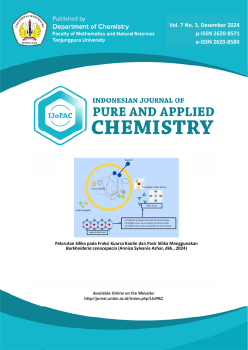
PELARUTAN SILIKA PADA FRAKSI KUARSA KAOLIN MENGGUNAKAN Burkholderia cenocepacia
DOI:
https://doi.org/10.26418/indonesian.v7i3.91962Abstract
Dissolution of silica (SiOâ‚‚) from its insoluble form to a soluble form is crucial for enhancing its availability as precursor material. This study aimed to compare the effectiveness of silica dissolution by the bacterium Burkholderia cenocepacia producing organic acids (citrate, oxalate, acetate) and potassium hydroxide (KOH). Variations in incubation times using Burkholderia cenocepacia at 24, 96, and 192 hours were applied to samples of quartz-kaolin fractions and silica sand. The concentration of dissolved silica was measured using ICP-OES. The results showed maximum dissolution by B. cenocepacia in quartz-kaolin at 0.8493 mg/L (96 hours) and silica sand at 0.8638 mg/L (24 h). The dissolved silica from this procedure can be further processed for applications in agriculture as a nutrient for plants to overcome biotic and abiotic stress.References
Zargar, S. M., Mahajan, R., Bhat, J. A., Nazir, M., & Deshmukh, R. (2019). Role of silicon in plant stress tolerance: Opportunities to achieve a sustainable cropping system. 3 Biotech. 9(73), 1-16.
Richmond, K. E., & Sussman, M. (2003). Got silicon? The non-essential beneficial plant nutrient. Current Opinion in Plant Biology, 6(3), 268-272.
Savant, N. K., Korndorfer, G. H., Datnoff, L. E., & Snyder, G. H. (1999). Silicon nutrition and sugarcane production: A review. Journal of Plant Nutrition, 22(12), 1853-1903.
Wahyuni, N., Cita, & Zahara, T. A. (2012). Analisis whiteness kaolin asal Mandor pada variasi temperatur pemanasan. POSITRON. 2(2), 15-20.
Kiprop, S., Onchiri, R. O., & Gathimba, N. (2024). Mechano-physical properties and microstructure of colloidal nanosilica-incorporated volcanic ash-based geopolymer mortar after exposure to elevated temperatures. International Journal of Engineering Trends and Technology. 72(5), 66-85.
Vasanthi, N., Saleena, L. M., & Raj, S. A. (2018). Silica solubilization potential of certain bacterial species in the presence of different silicate minerals. Silicon, 10(2), 267-275.
Santi, L. P., & Goenadi, D. H. (2017). Solubilization of silicate from quartz mineral by potential silicate solubilizing bacteria. Menara Perkebunan, 85(2), 96-104.
Agung, G. F., Hanafi, R. M., & Mardina, P. (2013). Ekstraksi silika dari abu sekam padi dengan pelarut KOH. Konversi, 2(1), 28-31.
Maulini, Wahyuni, N., Destiarti, L., & Rahmalia, W. (2018). Pemanfaatan pasir dari kaolin Capkala terlapis mangan dioksida untuk menurunkan kadar ion fosfat dalam larutan. Jurnal Kimia Khatulistiwa, 7(4), 51-59.
Hathaway, B. J., & Underhill, A. E. (1960). Some reactions of anhydrous perchloric acid and anhydrous nitric acid. Journal of the Chemical Society (Resumed), 133, 648-654.
Naat, J. N., Neolaka, Y. A., Lawa, Y., Lestarani, D., Parera, L. A., Adu, D., & Paloga, L. (2020). Studi pH dan waktu kontak optimum adsorpsi ion Mn (II) menggunakan adsorben silika kitosan dengan pemanfaatan silika yang bersumber dari pasir alam. Prosiding Seminar Nasional Pendidikan dan Sains Kimia (SNP-SK) FKIP-Undana, 3(1), 121-128.
Raturi, G., Sharma, Y., Rana, V., Thakral, V., Myaka, B., Salvi, P., & Deshmukh, R. (2021). Exploration of silicate solubilizing bacteria for sustainable agriculture and silicon biogeochemical cycle. Plant Physiology and Biochemistry, 166, 827-838.
Sheng, X. F., Zhao, F., He, L. Y., Qiu, G., & Chen, L. (2008). Isolation and characterization of silicate mineral-solubilizing Bacillus globisporus Q12 from the surfaces of weathered feldspar. Canadian Journal of Microbiology, 54, 1064–1068.
Walter, L. M., & Morse, J. W. (1984). Reactive surface area of skeletal carbonates during dissolution: Effect of grain size. Journal of Sedimentary Research, 54(4), 1081-1090.
Ayini, U., & Dewi, T. C. (2014). Efek antibakteri ekstrak daun mimba (Azadirachta indica A. Juss) terhadap bakteri Vibrio algynoliticus secara in vitro. Biosaintifika: Journal of Biology & Biology Education, 6(1), 67-75.
Downloads
Published
Issue
Section
License
Copyright (c) 2025 Annisa Sylvania Azhar, Nelly Wahyuni, Endah Sayekti

This work is licensed under a Creative Commons Attribution 4.0 International License.
Authors who publish with this journal agree to the following terms: 1. Authors retain copyright and grant the journal the right of first publication, with the work simultaneously licensed under a Creative Commons Attribution License that allows others to share the work with an acknowledgement of the work's authorship and initial publication in this journal. 2. Authors are able to enter into separate, additional contractual arrangements for the non-exclusive distribution of the journal's published version of the work (e.g., post it to an institutional repository or publish it in a book), with an acknowledgement of its initial publication in this journal. 3. Authors are permitted and encouraged to post their work online (e.g., in institutional repositories or on their website) prior to and during the submission process, as it can lead to productive exchanges, as well as earlier and greater citation of published work (see The Effect of Open Access).