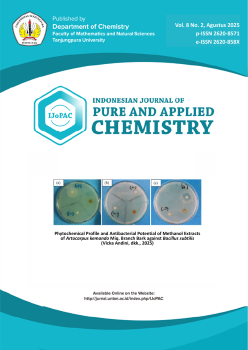
PHYTOCHEMICAL PROFILE AND ANTIBACTERIAL POTENTIAL OF METHANOL EXTRACTS OF Artocarpus kemando MIQ. BRANCH BARK AGAINST Bacillus subtilis
DOI:
https://doi.org/10.26418/indonesian.v8i2.92461Abstract
Artocarpus kemando Miq., a member of the Moraceae family, is found in tropical regions of Indonesia, including Karang Anyar, South Lampung. This study aimed to qualitatively analyze the phytochemical content and evaluate the antibacterial activity of the methanol extract of Pudau branch bark against Bacillus subtilis. The extraction was performed using the maceration method with methanol as the solvent. Phytochemical screening was conducted in triplicate and revealed the presence of alkaloids, flavonoids, terpenoids, and saponins, while steroids were absent. Antibacterial activity was assessed in triplicate using the paper disc diffusion method, with results showing moderate activity of the extract, indicated by an average inhibition zone diameter of 10.33 mm. Statistical analysis using one-way ANOVA revealed a significant difference in the average inhibition zone diameters among the treatment groups (methanol extract, negative control, and positive control) with a p-value of 0.000. Tukey HSD post hoc analysis confirmed that the methanol extract exhibited significantly higher antibacterial activity than the negative control, but significantly lower than the standard antibiotic amoxicillin (22.67 mm). These results highlight the potential of A. kemando Miq. Branch bark extract is a natural antibacterial agent, although its efficacy remains lower than the standard antibiotic (amoxicillin).References
Lathiff, S. M., Arriffin, N., and Jamil, S. (2021). Phytochemicals, pharmacological and ethnomedicinal studies of Artocarpus: A scoping review. Asian Pacific Journal of Tropical Biomedicine, 11(11), 469–480. doi: 10.4103/2221-1691.328054.
A. K. Buddhisuharto, H. Pramastya, M. Insanu, and I. Fidrianny, “An updated review of p Buddhisuharto, A. K., Pramastya, H., Insanu, M., and Fidrianny, I. (2021). An updated review of phytochemical compounds and pharmacology activities of artocarpus genus. Biointerface Research in Applied Chemistry, 11(6), 14898–14905. doi: 10.33263/BRIAC116.1489814905.
Chaurasia, S., and Pandey, A. (2023). Phytochemistry and Pharmacology of Genus Artocarpus: A Review on Current Status of Knowledge. Russian Journal of Bioorganic Chemistry, 49, 481–514. https://doi.org/10.1134/S1068162023030081
Indrianingsih, A.W., Styaningrum, P., Suratno, Windarsih, A., Suryani, R., Noviana, E., and Itoh, K. (2024). The effect of extraction method on biological activity and phytochemical content of Artocarpus heterophyllus (jackfruit) leaves extract concurrent with its principal component analysis. Process Biochemistry, 143, 135–147. doi: 10.1016/j.procbio.2024.04.034.
Kouotou, M. JR. N, Nsangou, M. F., Kenmogne, S. B., Tcho, A. T., Peyeino, J. H., Sikam, K. G., Ichiren, V.S.M., Happi, E.N., Songue, J.L., and Toze, F. A. A. (2024). Maghamesin, a new prenylated flavanone from artocarpus heterophyllus lam. (moraceae). Natural Product Research, 1–10. https://doi.org/10.1080/14786419.2024.2372664
Soifoini, T., Donno, D., Jeannoda, V., Rakoto, D. D., Msahazi, A., Farhat, S. M. M., Oulam, M. Z., and Beccaro, G. L. (2021). Phytochemical composition, antibacterial activity, and antioxidant properties of the artocarpus altilis fruits to promote their consumption in the comoros islands as potential health-promoting food or a source of bioactive molecules for the food industry. Foods, 10(9). doi: 10.3390/foods10092136.
Vázquez-González, Y., Ragazzo-Sánchez, J. A., & Calderón-Santoyo, M. (2020). Characterization and antifungal activity of jackfruit (Artocarpus heterophyllus Lam.) leaf extract obtained using conventional and emerging technologies. Food Chemistry, 330, 127211. doi: 10.1016/j.foodchem.2020.127211.
Liyanaararchchi, G.D., Perera, A.S., Samarasekera, J.K.R.R., Mahanama, K.R.R., Hemalal, K.D.P., Dlamini, S., Perera, H.D.S.M., Alhadidi, Q., Shah, Z.A., and Tillekeratne, L.M.V. (2022). Bioactive constituents isolated from the Sri Lankan endemic plant Artocarpus nobilis and their potential to use in novel cosmeceuticals. Industrial Crops & Products, 184, 115076. doi: 10.1016/j.indcrop.2022.115076.
Surbakti, E.C.M., Hasibuan, P.A.Z., Satria, D., Sitorus, P., Dalimunthe, A., and Waruwu, S.B. (2025). Analysis of artocarpin content and hepatoprotective activity of ethanol extract of mobe (Artocarpus lacucha Buch-Ham.) leaves on the liver of rats induced by paracetamol. Phytomedicine Plus, 5, 100747. https://doi.org/10.1016/j.phyplu.2025.100747.
Seo, E. K., Lee, D., Young, G. S., Chai, H. B., Navarro, H. A., Kardono, L. B. S., Rahman, I., Cordell, G. A., Farnsworth, N. R., Pezzuto, J. M., Kinghorn, A. D., Wani, M. C., dan Wall, M. E. (2003). Bioactive prenylated flavonoids from the stem bark of Artocarpus kemando. Archives of Pharmacal Research, 26(2), 124–127. doi: 10.1007/bf02976656.
Aprilianti, P. 2019. Konservasi ek-situ Artocarpus spp. di Kebun Raya Bogor sebagai sarana edukasi buah khas di Indonesia. Jurnal Biologi UGM, 145–153.
Sa’Diah, K., Yuwono, S. D., Qudus, H. I., Yandri, and Suhartati, T. (2020). Isolation, Characterization, Modification of Artocarpin Compound from Pudau Plant (Artocarpus kemando Miq.) and Bioactivity Antibacterial Assay of Artocarpin Compound and Their Modification Result. IOP Conference Series: Earth and Environmental Science, 537(1). doi: 10.1088/1755-1315/537/1/012047.
Iqbar, Djufri, Darusman, Rahmadani, Anjelia, V., Bessania, M. A., and Syaukani. (2024). Termite attack on succession forest plants at Soraya Research Station, Leuser Ecosystem, Sumatra. IOP Conference Series: Earth and Environmental Science, 1359(1). doi: 10.1088/1755-1315/1359/1/012120.
Gardner, E. M., and Zerega, N. J. C. (2021). Taxonomic updates to Artocarpus subgenus Artocarpus (Moraceae) and allied taxa with a particular focus on the species native to Singapore. Gardens’ Bulletin Singapore, 73(2), 309–374. doi: 10.26492/gbs73(2).2021-08.
Solihah, S. M., Wardani, F. F., dan Rahayu, S. (2014). Variasi struktur dan komposisi pohon pada petak-petak cuplikan vegetasi di kawasan Gunung Sekincau Bukit Barisan Selatan, Lampung Barat. Buletin Kebun Raya, 17(2), 79–90.
Nursanti, Adriadi, A., and Astuti, D. P. (2023). Ekologi Serdang (Livistona sp.) di Kecamatan Sekernan dan Kecamatan Mendahara Ulu. Biospecies, 16(2), 34-45. doi: 10.22437/biospecies.v16i2.21623.
Suhartati, T., Fatimah, N., Yandri, Y., Kurniawan, R., Bahri, S., and Hadi, S. (2021). The anticancer, antimalarial, and antibacterial activities of moracalkon a isolated from Artocarpus kemando Miq. Journal of advanced Pharmacy Education and Research, 11(4), 105–110. doi: 10.51847/9NHxpCqzU.
Suhartati, T., Andini, V., Ramadhan, I., Yandri, Y., and Hadi, S. (2022). Cytotoxicity test and antibacterial assay on the compound produced by the isolation and modification of artonin E from Artocarpus kemando Miq. Chemical Sciences for the New Decade: Volume 1: Organic and Natural Product Synthesis, 1, doi: 105–122.10.1515/psr-2021-0140.
Suhartati, T., Prihatin, A. S., Kurniati, A. N., Ropingi, H., Yandri, Y., and Hadi, S. (2024a). Cycloartobiloxanthone, a Flavonoid with Antidiabetic, Antibacterial and Anticancer Activities from Artocarpus kemando Miq. Emerging Science Journal, 8(1), 43–60. doi: 10.28991/ESJ-2024-08-01-04.
Suhartati, T., Andriyani, N., Yandri, Y., and Hadi, S. (2024b). Xanthoangelol, geranilated chalcone compound, isolation from pudau leaves (Artocarpus kemando Miq.) as antibacterial and anticancer. Sustainable Chemistry Research: Chemical and Biochemical Aspects. 121-136.
Suhartati, T., Irawan, A., Ropingi, H., Yandri, and Hadi, S. (2024c). Antidiabetic and antibacterial activities of artocarpin: a flavonoid compound isolated from the root wood of the Pudau plant (Artocarpus kemando Miq.). Pure and Applied Chemistry, 96(3), 389-398.
Li, H., Guo, Z., Xu, M., Zhao, J., and Xu, D. (2024). Molecular mechanism of miRNA mediated biosynthesis of secondary metabolites in medicinal plants. Plant Physiology and Biochemistry, 208, 108524. doi: 10.1016/J.PLAPHY.2024.108524.
Huang, W., Wang, Y., Tian, W., Cui, X., Tu, P., Li, J., Shi, S., and Liu, X. (2022). Biosynthesis Investigations of Terpenoid, Alkaloid, and Flavonoid Antimicrobial Agents Derived from Medicinal Plants. Antibiotics, 11(10). doi: 10.3390/antibiotics11101380.
Burman, S., and Chandra, G. (2022). A study on antibacterial efficacy of different extracts of Artocarpus chama fruits and identification of bioactive compounds in the most potent extract. Jordan Journal of Pharmaceutical Sciences, 15(1), 70–81. doi: 10.35516/jjps.v15i1.293.
Tambun, R., Alexander, V., and Ginting, Y. (2021). Performance comparison of maceration method, soxhletation method, and microwave-assisted extraction in extracting active compounds from soursop leaves (Annona muricata): A review. IOP Conference Series: Materials Science and Engineering, 1122(1), 012095. doi: 10.1088/1757-899x/1122/1/012095.
Ghaffar, N., and Perveen, A. (2024). Solvent polarity effects on extraction yield, phenolic content, and antioxidant properties of Malvaceae family seeds: a comparative study. New Zealand Journal of Botany, 63(4), 627–637. doi: 10.1080/0028825X.2024.2392705.
Chavez-Esquivel , G., Cervantes-Cuevas , H., Ybieta-Olvera, L.F., Briones, M.T.C., Acosta, D., and Cabello, J. (2021). Antimicrobial activity of graphite oxide doped with silver against Bacillus subtilis, Candida albicans, Escherichia coli, and Staphylococcus aureus by agar well diffusion test : Synthesis and characterization. Materials Science & Engineering C, 123, 111934. doi: 10.1016/j.msec.2021.111934.
Harish, Kumari, S., Parihar, J., Akash, Kumari, J., Kumar, L., Debnath, M., Kumar, V., Mishra, R.K., Gwag, J.S., Singhal, R., Mukhopadhyay, A.K., and Kumar, P. (2022). Synthesis, Characterization, and Antibacterial Activity of Calcium Hydroxide Nanoparticles Against Gram-Positive and Gram-Negative Bacteria. ChemistrySelect Research, 7, e202203094. doi: 10.1002/slct.202203094.
Adem, Y., Yesuf, K, Getachew, S., and Derbie, K. (2024). Phytochemical property and antimicrobial activity of Ficifolius A. Rich root extract: Advancing Ethiopian indigenous wart curing medicinal plant. Heliyon, 10(11), e31921. doi: 10.1016/j.heliyon.2024.e31921.
Shaikh, J. R., and Patil, M. (2020). Qualitative tests for preliminary phytochemical screening: An overview. International Journal of Chemical Studies, 8(2), 603–608. doi: 10.22271/chemi.2020.v8.i2i.8834.
Putri, D. K., Idiawati, N., and Sofiana, M. S. J. (2022). Kandungan fitokimia dan nilai sun protection factors (SPF) pada ekstrak metanol Hypnea pannosa, Turbinaria decurrens, dan Caulerpa serrulata. (Phytochemical content and value of sun protection factors (SPF) in methanol extracts of Hypnea pannosa, Turbinar. Indonesian Journal of Pure and Applied Chemistry, 5(2), 65. doi: 10.26418/indonesian.v5i2.49170.
Hudzicki, J. (2016). Kirby-Bauer Disk Diffusion Susceptibility Test Protocol Author Information. American Society For Microbiology, 1–13.
Wibowo, M. A., Sari, N. K., Ardiningsih, P., and Jayuska, A. (2023). Daya hambat ekstrak daun mangrove (Rhizophora apiculata) asal pesisir Sukadana terhadap bakteri Escherichia coli (inhibition the leaf extract of Rhizophora apiculata from the sukadana coast against Escherichia coli). Indonesian Journal of Pure and Applied Chemistry, 6(3), 114. doi: 10.26418/indonesian.v6i3.69965.
Puspita, J. N., Kurniatuhadi, R., and Rahmawati. (2021). The Antibacterial Activity of Thermoactinomyces sp. (H24) Extract Against Escherichia coli and Staphylococcus aureus. Indonesian Journal of Medical Laboratory Science and Technology, 3(1), 56–63. doi: 10.33086/ijmlst.v3i1.1700.
Sulaiman, M., Jannat, K., Nissapatorn, V., Rahmatullah, M., Paul, A.K., Pereira, M.D., Rajagopal, M., Suleiman, M., Butler, M.S., Break, M.K.B., Weber, J., Wilairatana, P., and Wiart, C. (2022). Antibacterial and Antifungal Alkaloids fromAsian Angiosperms: Distribution, Mechanisms of Action, Structure-Activity, and Clinical Potentials. Antibiotics, 11, 1146. doi: 10.3390/ antibiotics11091146.
Liu, X., Xin, J., Sun, Y., Zhao, F., Niu, C., and Liu, S. (2024). Terpenoids from Marine Sources: A Promising Avenue for New Antimicrobial Drugs. Marine Drugs. 22, 347. doi: 10.3390/md22080347.
Alvarez-MartÃnez, F.J., Barraj´on-Catal´an, E., Herranz-L´opez, M., and Micol, V. (2021). Antibacterial plant compounds , extracts and essential oils : An updated review on their effects and putative mechanisms of action. Phytomedicine, 90, 153626. doi: 10.1016/j.phymed.2021.153626.
Li, J. and Monje-galvan, V. (2023). In Vitro and In Silico Studies of Antimicrobial Saponins : A Review. Processes, 11, 2856. doi: 10.3390/pr11102856.
Yan, Y., Li, X., Zhang, C., Lv, L., Gao, B., and Li, M. (2021). Research Progress on Antibacterial Activities and Mechanisms of Natural Alkaloids : A Review. Antibiotics, 10, 318. doi: 10.3390/antibiotics10030318.
Downloads
Published
Issue
Section
License
Copyright (c) 2025 Vicka Andini, Yoravika Dwiwibangga, Etriyanto Arman, Mega Elfia

This work is licensed under a Creative Commons Attribution 4.0 International License.
Authors who publish with this journal agree to the following terms: 1. Authors retain copyright and grant the journal the right of first publication, with the work simultaneously licensed under a Creative Commons Attribution License that allows others to share the work with an acknowledgement of the work's authorship and initial publication in this journal. 2. Authors are able to enter into separate, additional contractual arrangements for the non-exclusive distribution of the journal's published version of the work (e.g., post it to an institutional repository or publish it in a book), with an acknowledgement of its initial publication in this journal. 3. Authors are permitted and encouraged to post their work online (e.g., in institutional repositories or on their website) prior to and during the submission process, as it can lead to productive exchanges, as well as earlier and greater citation of published work (see The Effect of Open Access).