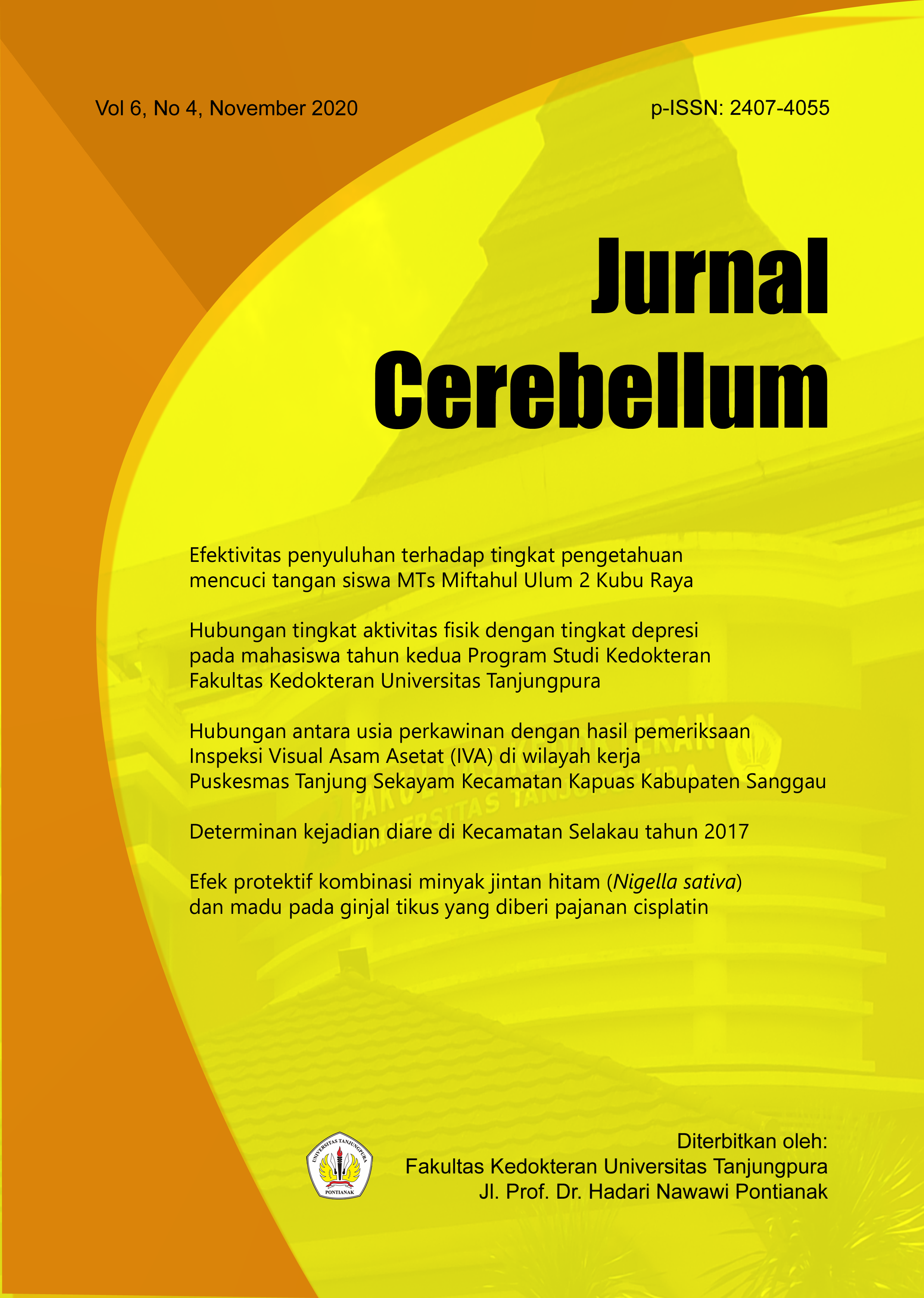
Efek protektif kombinasi minyak jintan hitam (Nigella sativa) dan madu pada ginjal tikus yang diberi pajanan cisplatin
DOI:
https://doi.org/10.26418/jc.v6i4.47803Keywords:
antioksidan, minyak jintan hitam, madu, cisplatin, sinergismeAbstract
Latar belakang: Cisplatin merupakan agen antikanker dengan berbagai efek samping, terutama nefrotoksisitas. Minyak jintan hitam (MJH) dan madu (M) merupakan bahan alam kaya akan antioksidan dan memiliki efek nefroprotektif. Penelitian ini bertujuan untuk mengetahui efek nefroprotektif kombinasi minyak jintan hitam dan madu pada tikus yang dipajan cisplatin. Metode: Penelitian ini menggunakan 30 tikus yang dibagi menjadi 10 kelompok, yaitu kelompok kontrol (K), kelompok tunggal MJH dosis I (1 mL/kgBB) (P1), MJH dosis II (2 mL/kgBB) (P2), M dosis I (3,7 mL/kgBB) (P3), M dosis II (7,4 mL/kgBB) (P4), kelompok kombinasi MJH dosis I dan M dosis I (P5), MJH dosis I dan M dosis II (P6), MJH dosis II dan M dosis I (P7), MJH dosis II dan M dosis II (P8) serta kelompok cisplatin (C). Minyak jintan hitam dan madu diberikan selama 21 hari. Pada hari ke-18, semua kelompok, kecuali kelompok kontrol, diberi cisplatin 8 mg/kgBB secara intraperitoneal. Hasil: Terdapat perbedaan bermakna pada skor tubulus proksimal normal semua kelompok perlakuan (kecuali P3) dibandingkan dengan kelompok cisplatin (p<0,05). Kombinasi minyak jintan hitam dan madu menghasilkan efek yang sinergis (CI = 0,234, 0,537, 0,863, 0,586). Kesimpulan: Kombinasi minyak jintan hitam dan madu menghasilkan efek protektif yang sinergis terhadap jaringan ginjal tikus yang diberi pajanan cisplatin.
References
Al-Kharusi N, Babiker HA, Al-Salam S, Waly MI, Nemmar A, Al-Lawati I, et al. Ellagic acid protects against cisplatin-induced nephrotoxicity in rats: a dose-dependent study. Eur Rev Med Pharmacol Sci. 2013;17(3):299–310.
Terada Y, Inoue K, Matsumoto T, Ishihara M, Hamada K, Shimamura Y, et al. 5-Aminolevulinic acid protects against cisplatin-induced nephrotoxicity without compromising the anticancer efficiency of cisplatin in rats in vitro and in vivo. PloS One. 2013;8(12):e80850.
Kilic U, Kilic E, Tuzcu Z, Tuzcu M, Ozercan IH, Yilmaz O, et al. Melatonin suppresses cisplatin-induced nephrotoxicity via activation of Nrf-2/HO-1 pathway. Nutr Metab. 2013;10(1):7.
Hacker NF, Gambone JC, Hobel CJ, editors. Hacker & Moore’s essentials of obstetrics & gynecology. Sixth edition. Philadelphia, PA: Elsevier; 2016. 497 p.
He M, Xue Z, Li J, Zhou B. Breviscapine inhibits high glucose-induced proliferation and migration of cultured vascular smooth muscle cells of rats via suppressing the ERK1/2 MAPK signaling pathway. Acta Pharmacol Sin. 2012;33(5):606–14.
Ahmad A, Husain A, Mujeeb M, Khan SA, Najmi AK, Siddique NA, et al. A review on therapeutic potential of Nigella sativa: A miracle herb. Asian Pac J Trop Biomed. 2013;3(5):337–52.
Dollah MA, Parhizkar S, Izwan M. Effect of Nigella sativa on the kidney function in rats. Avicenna J Phytomedicine. 2013;3(2):152–8.
Erboga M, Kanter M, Aktas C, Sener U, Fidanol Erboga Z, Bozdemir Donmez Y, et al. Thymoquinone ameliorates cadmium-induced nephrotoxicity, apoptosis, and oxidative stress in rats is based on its anti-apoptotic and anti-oxidant properties. Biol Trace Elem Res. 2016;170(1):165–72.
Hosseinian S, Rad AK, Hadjzadeh M-A-R, Roshan NM, Havakhah S, Shafiee S. The protective effect of Nigella sativa against cisplatin-induced nephrotoxicity in rats. Avicenna J Phytomedicine. 2016;6(1):44–54.
Farooqui Z, Ahmed F, Rizwan S, Shahid F, Khan AA, Khan F. Protective effect of Nigella sativa oil on cisplatin induced nephrotoxicity and oxidative damage in rat kidney. Biomed Pharmacother. 2017;85:7–15.
Ibrahim A, Eldaim MAA, Abdel-Daim MM. Nephroprotective effect of bee honey and royal jelly against subchronic cisplatin toxicity in rats. Cytotechnology. 2016;68(4):1039–48.
Palipoch S, Punsawad C. Biochemical and histological study of rat liver and kidney injury induced by Cisplatin. J Toxicol Pathol. 2013;26(3):293–9.
Chou TC. Theoretical basis, experimental design, and computerized simulation of synergism and antagonism in drug combination studies. Pharmacol Rev. 2006;58(3):621–81.
El-Kholy WM, Hassan HA, Nour SE, Elmageed ZEA, Matrougui K. Hepatoprotective effects of Nigella sativa and bees’ honey on hepatotoxicity induced by administration of sodium nitrite and sunset yellow. FASEB J. 2009;23:733.
Ameen NMA, Altubaigy F, Jahangir T, Mahday IA, Mohammed EA, Musa OAA. Effect of Nigella sativa and bee honey on pulmonary, hepatic and renal function in Sudanese in Khartoum state. J Med Plants Res. 2011;5(31).
Hadi MY, Mohammed GJ, Hameed IH. Analysis of bioactive chemical compounds of Nigella sativa using gas chromatography-mass spectrometry. J Pharmacogn Phytother. 2015;8(2):8–24.
Farhadi F, Karimi G, Mashayekhi-Sardoo H, Shoae-Hagh P, Mashayekhi-Sardoo A. A review on toxicological properties of thymoquinone a natural broad spectrum ingredient. Res J Pharmacogn. 2017;106.
Ngoi V. Effect of processing treatment on antioxidant, physicochemical and enzymatic properties of honey (Trigona spp.). Tunku Abdul Rahman Univ. 2016 Sep;
Rahma S, Natsir R, Kabo P. Pengaruh antioksidan madu dorsata dan madu rigona terhadap penghambatan oksidasi LDL pada mencit hiperkolestrolemia. JST Kesehat. 2014;4(4):377–84.
Oddo LP, Heard TA, Rodriquez MA. Composition and antioxidant activity of Trigona carbonaria honey from Australia. J Med Food. 2008;11(4):789–94.
Mohamed M, Sulaiman SA, Jaafar H, Sirajudeen KNS. Antioxidant protective effect of honey in cigarette smoke-induced testicular damage in rats. Int J Mol Sci. 2011;12(9):5508–21.
Kamilatussaniah, Yuniastuti A, Iswari R. Pengaruh suplementasi madu kelengkeng terhadap kadar TSA dan MDA tikus putih yang diinduksi timbal (Pb). J MIPA. 2015;38(2):108–14.
Mut-Salud N, Ãlvarez PJ, Garrido JM, Carrasco E, Aránega A, RodrÃguez-Serrano F. Antioxidant intake and antitumor therapy: Toward nutritional recommendations for optimal results. Oxid Med Cell Longev. 2016;2016:6719534.
Mohamad S, Ibrahim NH, Yusof H. Blood pressure and lipid lowering effects of nigella sativa seeds and honey mixture. IOSR J Nurs Health Sci. 2014;3(5):89–96.
Chen D, Liu X, Yang Y, Yang H, Lu P. Systematic synergy modeling: understanding drug synergy from a systems biology perspective. BMC Syst Biol [Internet]. 2015;9(1). Available from: http://www.biomedcentral.com/1752-0509/9/56.
Downloads
Published
Issue
Section
License
Copyright (c) 2020 Jurnal Cerebellum

This work is licensed under a Creative Commons Attribution-NonCommercial-ShareAlike 4.0 International License.

Jurnal Cerebellum is licensed under a Creative Commons Attribution-NonCommercial-ShareAlike 4.0 International License.
You are free to:
- Share "” copy and redistribute the material in any medium or format
- Adapt "” remix, transform, and build upon the material
- The licensor cannot revoke these freedoms as long as you follow the license terms.
Under the following terms:
Attribution "” You must give appropriate credit, provide a link to the license, and indicate if changes were made. You may do so in any reasonable manner, but not in any way that suggests the licensor endorses you or your use.
NonCommercial "” You may not use the material for commercial purposes.
ShareAlike "” If you remix, transform, or build upon the material, you must distribute your contributions under the same license as the original.
- No additional restrictions "” You may not apply legal terms or technological measures that legally restrict others from doing anything the license permits.
Notices:
- You do not have to comply with the license for elements of the material in the public domain or where your use is permitted by an applicable exception or limitation.
- No warranties are given. The license may not give you all of the permissions necessary for your intended use. For example, other rights such as publicity, privacy, or moral rights may limit how you use the material.
