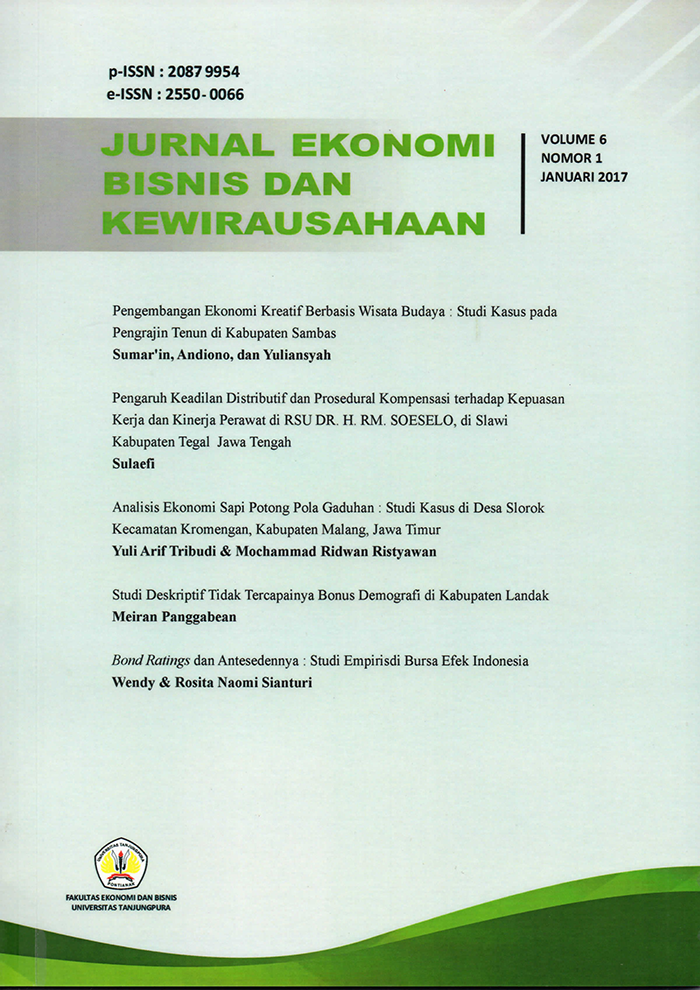
Pengaruh Keadilan Distributif dan Prosedural Kompensasi terhadap Kepuasan Kerja dan Kinerja Perawat di RSU DR. H. RM. SOESELO di Slawi, Kabupaten Tegal, Jawa Tengah
DOI:
https://doi.org/10.26418/jebik.v6i1.20723Abstract
This research examines the organizationa justice include distributive justice compensation and pocedural justicecompensation to employess performance both directly and indirectly influenced by job satisfaction. The population inthis study were all nurse employees in RSU DR. H. RM. SOESELO in Slawi, Tegal District are totaling 142 people.Data were collected by survey method is to provide a list of questionnaires directly to the resp4.ondent. Data analysistechniques in this study using analysis of SEM (Structural Equation Modeling) program operated by AMOS 21. Theresults showed that distributive justce compensation significant positive effect on job satisfaction, procedural justicecompensation significant positive effect on job satisfaction, distributive justice compensation are not significsantly toemployees performance, procedural justice compensation are not significantly to employees performance, jobsatisfaction significant positive effect on employees performace, job satisfaction as a mediating influence ofdistributive justice compensation and procedural justice compensation to employees performance.
References
Clayton, S., & Opotow, S. (2003). Justice and Identity: changing perspectives on what is fair. Personality and Social Psychology Review, 7(4), 298-310.
Colquitt, J. A., Conlon, D. E., Wesson , M. J., Porter, C. & Ng, K. Y. (2001). Justice at the millennium: a meta-analytic review of 25 years of organizational justice research. Journal of Applied Psychology, 86(3), 425-445.
Colquitt, J. A. (2001). On the dimensionality of organizational justice: a construct validation of measure. Journal of Applied Psychology, 86(3), 386-400.
Folger, R., & Konovsky, M. A. (1989). Effect of procedural and distributive justice on reaction to pay raice decisions. Academic of Management Journal. 32(1), 115-130.
Hair, J. F., Anderson, R. E., Tatham, R. I., & Black ,W. C. (1998). Multivariate Data Analysis. New Jersey: Prentice-Hall, Inc.
Jogiyanto, H. M. (2004). Metodologi Penelitian Bisnis: Salah Kaprah dan Pengalaman-Pengalaman. Yogyakarta: BPFE Universitas Gajah Mada.
Kinicki, A., & Fulgate, M. (2013). Organizational Behaviour. 5th Edition. McGraw Hill Education.
Lind, E. A., & Tyler, T. R. (1988). The Social Psychology of Procedural Justice. New York: Planum.
Masterson, S. S., Lewis, K., Goldman, B. M., & Taylor, M. S. (2000). Integrating Justice and social exchange: the differing effects of fair procedures and treatment on work relationships. Academy of Management Journal, 43(4), 738-748.
McFarlin, D. B., & Sweeney, P. P. (1992). Distributive and Procedural justice as predictors of satisfaction with personal and organizational outcomes. Academy of Management Journal. 35(3), 626-637.
Roberts, G. E., & Reed, T. (1996). Performance appraisal participation, goal setting and feedback. Review of Public Personnel Administration, Fall, 29-60.
Skarlicky, D. P., & Folger, R. (1997). Retalition in the work place: the role of distributitive, procedural and interactional justice. Journal of Applied Psychology, 82(3), 434-443.
Sweeney, P. D., & McFalin, D. B. (1993). Woekers’ evaluation of the “Ends†and the “Meansâ€: an examination of four models of distributive and procedural justice. Organizational Behavior and Human Decision Processes, (55), 23-4.
Tang, T. L., & Baldwin, L. J. (1996). Distributive and procedureal justice as related to satisfaction and commitment. Sam Advanced Management Journal, 25-31.
Taylor, M. S., Tracy, K. B., Renald, M. K., Harrison, J. K. & Carrol, S. J. (1995). Due process in performance appraisal: a quasi-experiment in procedural justice. Administrative Science Quarterly. 40, 495-523.
Thibaut, J., & Walker, L. (1978). A theory of procedure. California Law Review. 66, 541-566.
Tjahjono, H. K. (2011). The configuration pattern distributive and procedural justice and its consequences to satisfaction. International Journal of Information and Management Sciences, 22(1), 87-103.
Tjahjono, H. K. (2014). The fairness of organization’s performance appraisal, social capital, and the impact toward affective commitment. International Journal of Administrative Sciences & Organization, 21(3), 173-179.
Tyler, T. R. (1994). Psychology models of the justice motive: Antecedents of distributive and procedural justice. Journal of Personality and Social Psychology, 67(5), 850-863.
Tyler, T. R., & Blader, S. L. (2003). The group engagement model: procedural justice, social identity and cooperative behavior. Personality and Social Psychology Review, 7(4), 349-361.
Viswesvaran, C., & Ones, D. S. (2002). Examining the contruct of the organizational justice: A Meta-Analytic evaluation of relation with work attitudes and behaviors. Journal of Business Ethics, 38, 193-203.