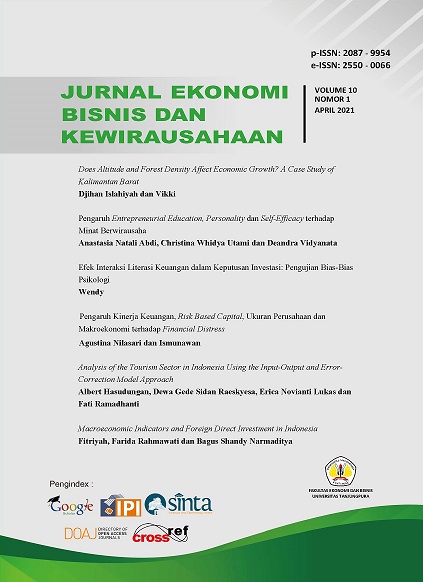
EFEK INTERAKSI LITERASI KEUANGAN DALAM KEPUTUSAN INVESTASI: PENGUJIAN BIAS-BIAS PSIKOLOGI
DOI:
https://doi.org/10.26418/jebik.v10i1.43403Keywords:
bias psikologi, keuangan keperilakuan, keputusan investasi, literasi keuangan, efek interaksiAbstract
ABSTRACT
This research aims to analyze psychological biases that occur when investors make risky investment decisions. There are five behavioral factors analyzed (herding, overconfidence, disposition effect, conservatism, and availability). Financial literacy is used as moderator in analyzing the effect of those bahaviors towards risky investment decisions. This research examines four econometric equations in explaining financial literacy as a moderator. Interaction effect testing is carried out using moderating variable regression. The results show that psychological biases occur in making risky investment decisions. Herding behavior, overconfidence, disposition effect, and conservatism show a positive effect, while availability does not show a significant effect. Testing on the interaction model finds that financial literacy is able to reduce these psychological biases. This finding also explains the managerial implications that investors with high levels of financial literacy have the potential to experience relatively low psychological biases compared to investors with limited levels of financial literacy. In terms of limitations, this research uses a questionnaire survey that has not been able to reveal aspects of investor behavior in a comprehensive manner. In addition, the number of respondents who are more dominated by beginner investors also adds to the limitations in carrying out the generalization.
ABSTRAK
Riset ini bertujuan untuk menganalisis bias-bias psikologi yang terjadi ketika pemodal mengambil keputusan investasi berisiko. Terdapat lima faktor perilaku yang dianalisis, yaitu perilaku herding, overconfidence, disposition effect, conservatism, dan availability. Literasi keuangan digunakan sebagai pemoderasi dalam menganalisis pengaruh faktor-faktor keperilakuan tersebut terhadap keputusan investasi berisiko. Riset ini menguji empat persamaan ekonometrika dalam menjelaskan peran literasi keuangan sebagai pemoderasi. Pengujian efek interaksi dilakukan dengan menggunakan regresi variabel moderasi. Hasil analisis menunjukkan bahwa bias-bias psikologi terjadi dalam pengambilan keputusan investasi berisiko. Perilaku herding, overconfidence, disposition effect, dan conservatism menunjukkan pengaruh positif terhadap pengambilan keputusan investasi berisiko, sementara bias availability tidak menunjukkan pengaruh yang bermakna dalam riset ini. Pengujian pada model interaksi menemukan bahwa literasi keuangan mampu mereduksi bias-bias psikologi tersebut. Temuan ini sekaligus menjelaskan implikasi manajerial bahwa pemodal dengan tingkat literasi keuangan yang baik berpotensi mengalami bias-bias psikologi yang relatif lebih rendah dibandingkan pemodal dengan tingkat lietrasi keuangan yang terbatas. Dari sisi keterbatasan, riset ini menggunakan survei kuesioner yang belum mampu mengungkap aspek perilaku pemodal secara komprehensif. Selain itu, jumlah responden yang lebih didominasi oleh pemodal pemula juga menambah keterbatasan dalam melakukan generalisasi hasil penelitian.
References
Addinpujoartanto, N. A., & Darmawan, S. (2020). Pengaruh Overconfidence, Regret Aversion, Loss Aversion, dan Herding Bias terhadap Keputusan Investasi di Indonesia. Jurnal Riset Ekonomi dan Bisnis, 13(3), 175–187.
Alâ€Tamimi, H. A. H. (2009). Financial Literacy and Investment Decisions of UAE Investors. The Journal of Risk Finance.
Atkinson, A., & Messy, F.-A. (2013). Promoting Financial Inclusion through Financial Education: OECD/INFE Evidence, Policies and Practice.
Bakar, S., & Yi, A. (2016). The Impact of Psychological Factors on Investors’ Decision Making in Malaysian Stock Market: A Case of Klang Valley and Pahang. Procedia Economics and Finance, 35, 319–328. https://doi.org/10.1016/S2212-5671(16)00040-X
Barber, B. M., & Odean, T. (2001). Boys Will Be Boys: Gender, Overconfidence, and Common Stock Investment. The Quarterly Journal of Economics, 116(1), 261–292.
Budiarto, A., & Susanti. (2017). Pengaruh Financial Literacy, Overconfidence, Regret Aversion Bias, dan Risk Tolerance terhadap Keputusan Investasi (Studi pada investor PT. Sucorinvest Central Gani Galeri Investasi BEI Universitas Negeri Surabaya). Jurnal Ilmu Manajemen (JIM), 5(2).
Cartwright, E. (2018). Behavioral economics (Third Edit). Routledge.
Chen, H., & Volpe, R. P. (1998). An Analysis of Personal Financial Literacy Among College Students. Financial Services Review, 7(2), 107–128.
De Bondt, W. F. M., & Thaler, R. (1985). Does The Stock Market Overreact? The Journal of Finance, 40(3), 793–805.
Elmadiani, C. (2020). Pengaruh Emotional Contangion, Availaibity Bias, Overconfidence, Loss Aversion dan Herding Terhadap Pengambilan Keputusan Investasi Saham di Kota Batam. Disertasi. Universitas Internasional Batam.
Filip, A., Pochea, M., & Pece, A. (2015). The Herding Behaviour of Investors in The CEE Stocks Markets. Procedia Economics and Finance, 32, 307–315.
Giesler, M., & Veresiu, E. (2014). Creating The Responsible Consumer: Moralistic Governance Regimes and Consumer Subjectivity. Journal of Consumer Research, 41(3), 840–857.
Gill, S., Khurshid, M. K., Mahmood, S., & Ali, A. (2018). Factors Effecting Investment Decision Making Behavior: The Mediating Role of Information Searches. European Online Journal of Natural and Social Sciences, 7(4), pp-758.
Hayat, A., & Anwar, M. (2016). Impact of Behavioral Biases on Investment Decision; Moderating Role of Financial Literacy. https://ssrn.com/abstract=2842502 or http://dx.doi.org/10.2139/ssrn.2842502
Kartini, K., & Nugraha, N. F. (2015). Pengaruh Illusions of Control, Overconfidence dan Emotion terhadap Pengambilan Keputusan Investasi pada Investor di Yogyakarta. Asian Journal of Innovation and Entrepreneurship, 4(2), 114–122.
Khairunizam, & Isbanah, Y. (2019). Pengaruh Financial Literacy dan Behavioral Finance Factors terhadap Keputusan Investasi (Studi terhadap Investor saham Syariah pada Galeri Investasi Syariah UIN Sunan Ampel Surabaya). Jurnal Ilmu Manajemen (JIM), 7(2).
Khalid, R., Javed, M. U., & Shahzad, K. (2018). Impact of Behavioral Biases on Investment Decision Making with Moderat-ing Role of Financial Literacy. Jinnah Business Review, 6(2), 34–41.
Lakshman, M. V, Basu, S., & Vaidyanathan, R. (2013). Market-Wide Herding and The Impact of Institutional Investors in The Indian Capital Market. Journal of Emerging Market Finance, 12(2), 197–237.
Lusardi, A., & Mitchell, O. S. (2013). The economic importance of financial literacy: Theory and evidence (Working Paper No. 18952). National Bureau of Economic Research.
Moradi, M., Mostafaei, Z., & Meshki, M. (2013). A Study on Investors’ Personality Characteristics and Behavioral Biases: Conservatism Bias and Availability Bias in The Tehran Stock Exchange. Management Science Letters, 3(4), 1191–1196.
OJK. (2016). Survei Nasional Literasi dan Inklusi Keuangan. Jakarta: Otoritas Jasa Keuangan.
Ouarda, M., El Bouri, A., & Bernard, O. (2013). Herding Behavior Under Markets Condition: Empirical Evidence on The European Financial Markets. International Journal of Economics and Financial Issues, 3(1), 214.
Pompian, M. M. (2011). Behavioral finance and wealth management: How to Build Investment Strategies That Account for Investor Biases (Vol. 667). John Wiley & Sons.
Pradhana, R. W. (2018). Pengaruh Financial Literacy, Cognitive Bias, dan Emotional Bias terhadap Keputusan Investasi (Studi pada Investor Galeri Investasi Universitas Negeri Surabaya). Jurnal Ilmu Manajemen (JIM), 6(3).
Pradikasari, E., & Isbanah, Y. (2018). Pengaruh Financial Literacy, Illusion of Control, Overconfidence, Risk Tolerance, dan Risk Perception terhadap Keputusan Investasi pada Mahasiswa di Kota Surabaya. Jurnal Ilmu Manajemen (JIM), 6(4).
Qadri, S. U., & Shabbir, M. (2014). An Empirical Study of Overconfidence and Illusion of Control Biases, Impact on Investor’s Decision Making: An Evidence from ISE. European Journal of Business and Management, 6(14), 38–44.
Rau, H. A. (2014). The Disposition Effect and Loss Aversion: Do Gender Differences Matter? Economics Letters, 123(1), 33–36.
Sachan, A., & Chugan, P. K. (2020). Availability Bias of Urban and Rural Investors: Relationship Study of the Gujarat State of India. Journal of Behavioural Economics, Finance, Entrepreneurship, Accounting and Transport, 8(1), 1–6.
Santaâ€Clara, P., & Valkanov, R. (2003). The Presidential Puzzle: Political Cycles and The Stock Market. The Journal of Finance, 58(5), 1841–1872.
Summers, B., & Duxbury, D. (2012). Decision-Dependent Emotions and Behavioral Anomalies. Organizational Behavior and Human Decision Processes, 118(2), 226–238.
Tversky, A., & Kahneman, D. (1992). Advances in Prospect Theory: Cumulative Representation of Uncertainty. Journal of Risk and Uncertainty. https://doi.org/10.1007/BF00122574
Yao, J., Ma, C., & He, W. P. (2014). Investor Herding Behaviour of Chinese Stock Market. International Review of Economics & Finance, 29, 12–29.