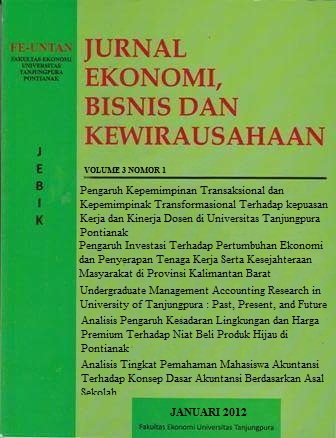
Pengaruh Kepemimpinan Transaksional dan Kepemimpinan Transformasional Terhadap Kepuasan Kerja dan Kinerja Dosen Universitas Tanjungpura Pontianak
DOI:
https://doi.org/10.26418/jebik.v3i1.9886Abstract
The central theme of this research is that the job satisfaction and the lecturers"™ performance are increasing because of the roles of transactional and the transformational leadership. The purpose of this research is to examine and analyze the influence of these two leadership styles in University of Tanjungpura with main focus on the study of Human Resources Management. This research employs survey design in the form of verification research. The sampling design used in this research is stratified random. From 987 lecturers in University of Tanjungpura, 60 respondents (lecturers) are drawn as samples from nine faculties and participate in this research. The data are obtained from the collected questionnaires and they are analyzed by using path analysis. The results have shown that (1) the transactional leadership has a insignificantly positive influence on the lecturer"™s job satisfaction, (2) the transactional leadership has a insignificantly positive influence on the lecturer"™s work performance, (3) the transformational leadership has a significantly positive influence on the lecturer"™s job satisfaction, (4) the transformational leadership has a significantly influence on the lecturer"™s work performance, and (5) the job satisfaction has a significantly positive influence on the lecturer"™s work performance.
References
Ainsworth, Murray, Smith, N., and Millership, A. (2002). Managing performance managing people: Understanding and improving team performance. Printed in Australia by Griffin Press.
Bagia, I. Wayan. (2005). Pengaruh Modal Intelektual dan Kepuasan Kerja terhadap Kinerja pada Pegawai Pemerintah Daerah Kabupaten di Propinsi Bali. Disertasi. Program Pascasarjana Universitas Padjadjaran, Bandung.
Bartram, T. and Casimir, G. (2007). The relationship between leadership and follower in-role performance and satisfaction with the leader. Leadership and Organization Development Journal, 28 (1), 4-19.
Bass, B.M. (1985). Leadership and performance beyond expectations. New York: Free Press.
Bass, B.M. (1990). Bass and stogdill’s handbook of leadership: Theory, research, and managerial application. Third Edition. New York: Free Press.
Bontis, et al. (2011). Improving service delivery. investigating the role of information sharing, job characteristics, and employee satisfaction. The Learning Organization, 18(3), 239-250.
Bycio, P., Hackett, R.D. and Allen, J.S. (1995). Further assessments of bass’s (1985) conceptualization of transactional and transformational leadership. Journal of Applied Psychology, 80(4), 468-478.
Choo, Freddie and Kim B. Tan. (1997). A study of relations among disagreement in budgetary performance evaluation style, job related tension, job satisfaction and performance. Behavior Research in Accounting, 9, 199-218.
Curphy, G.J. (1992). An empirical investigation of the effects of transformational and transactional leadership on organizational climate, attrition, and performanve. Impact of Leadership, Center for Creative Leadership, 177-187.
Komardi, D. (2009). pengaruh kepemimpinan transformasional dan transaksional serta motivasi kerja terhadap kinerja dan kepuasan individual karyawan dalam organisasi perusahaan industri telekomunikasi. Jurnal Aplikasi Manajemen, 7 (1), 53-61.
Dionne, S. D., Yammarino, F. J., Atwater, L. E., & Spangler, W. D. (2004). Transformational leadership and team training and performance. Journal of Organizational Change Management, 17, 177–193.
Erkutlu, H. (2008). The impact of transformational leadership on organizational and leadership effectiveness. Journal of Management Development, 27 (7), 708-726.
Gibson, J.L., Ivancevich, J.M., and Donnelly, J.H. (1996). Organization Behavior-Structure-Process. Seventh Edition. Boston. Erwin Homewood.
Gibson, J.L., Ivancevich, J.M., and Donnelly, J.H. (1997). Organisasi: Perilaku – Struktur – Proses. Penerbit: Binarupa Aksara.
Griffith, J. (2004). Relation of principal transformational leadership to school staff job satisfaction, staff turnover and school performance. Journal of Educational Administration, 42(3), 333-356.
Howell, J.M. and Avolio, B.J. (1993). Transformational leadership, transactional leadership, locus of control, and support for innovation: key predictors of consolidated-business-unit performance. Journal of Applied Psychology, Vol.78.No.6: 891-902.
Howell, J. M., & Hall-Merenda, K. E. (1999). The ties that bind: The impact of leader–member exchange, transformational and transactional leadership, and distance on predicting follower performance. Journal of Applied Psychology, 84, 680–694.
Iaffandano, M.T. and Muchinsky, P.M. (1998). Job satisfaction and performance: a meta analysis. Psychological Bulletin, 9, 251-273.
Judge, T.A. and Bono, J.E. (2000). Five-factor model of personality and transformational leadership. Journal of Applied Psychology, 85 (5), 751-765.
Keller, R.T. (1992). Transformational leadership and the performance of research and development project groups. Journal of Management, 18, 489-501.
Kirkpatric, S.A., and Locke, E.A. (1996). Direct and indirect effects of three core charismatic leadership components on performance and attitudes. Journal of Applied Psychology, 81, 36-51.
Koh, W.L., Steers, R.M. and Terborg, J.R. (1995). The effect of transformational leadership on teacher attitudes and student performance in Singapore. Journal of Organizational Behavior, 16, 319-333.
Kondalkar. (2007). Organizational Behaviour. New Delhi. New Age International Limited Publishers.
Kreitner, R. and Kinicki, Angelo. (2010). Organizational Behavior. Ninth Edition. New York. McGraw-Hill /Irwin, a business unit of The McGraw-Hill Companies, Inc.
Loveman, G.W. (1998). Employee satisfaction, employee performance, and customer loyalty: an empirical examination of the service profit chain in retail banking. Journal of Service Research, 1 (1), 18-31.
Luthans, F. (2002). Organizational behavior. Ninth Edition. New York. McGraw-Hill Higher Education.
Malik, M.E. Nawab, S. Naeem, B. and Danish, R.Q. (2010). Job satisfaction and organizational commitment of university teachers in public sector of Pakistan. International Journal of Business and Management, 5 (6), 17-26.
Mangkunegara, A. P. (2004). Manajemen sumber daya perusahaan, Cetakan Pertama. Bandung: Rosda.
Marsalius S.T dan Rita Andarika. (2004). Hubungan antara persepsi gaya kepemimpinan transformasional dan transaksional dengan kepuasan kerja karyawan. Jurnal Psyche, 1 (1), 35-49.
McShane, S.L. and Von Glinow, M.A. (2003). Organizational behavior emerging realities for the workplace revolution. 2nd Edition. McGraw-Hill Higher Education.
Milkovich, George T. and Boudreau, John W,. (1997). Human resources management. Eighth Edition. Times Mirror Higher Education Group Inc.
Muenjohn, N. dan Armstrong, A. (2008). Evaluating the Structural Validity of the Multifactor Leadership Quetionnaire (MLQ), Capturing the Leadership Factors of Transformational-Transactional Leadership. Contemporary Management Research, 4 (1), 3-14.
Nawawi, Hadari. (2003). Manajemen sumber daya manusia untuk bisnis yang kompetitif. Yogyakarta. Gadjah Mada University Press.
Nazir, Mohammad, (2005). Metode penelitian. Cetakan Keempat. Jakarta. Galia Indonesia.
Pawar, B.S. and Eastman, K.K. (1997). The nature and implications of contectual influences on transformational leadership: a conceptual examination. Academy of Management Review, 22 (1), 80-109.
Podsakoff, P.M., MacKenzie, S.B. and Bommer, W.H. (1996). Transformational leader behaviors and substitutes for leadership as determinans of employee satisfaction, commitment, trust, and organizational citizenship behaviors. Journal of Management, 22 (2), 259-298.
Riduwan dan Kuncoro, E.A. (2008). Cara menggunakan dan memaknai analisis jalur (path analysis). Bandung: Penerbit Alfabeta.
Riduwan. (2009). Skala pengukuran variabel-variabel penelitian. Bandung: Penerbit Alfabeta.
Rivai, Veithzal. (2004). Manajemen sumber daya manusia untuk perusahaan: Dari teori ke praktik. Jakarta. PT RajaGrafindo Persada.
Robbins, Stephen P. (2008). Perilaku organisasi. 10th Edition. Prentice Hall International Inc.
Sarros, J. C. and Santora, J.C. (2001). The Transformational-transactional leadership model in practice. Leadership and Organization Development Journal, 22 (8), 383-393.
Shamir, B. House, R., and Arthur, M.B. (1993). The motivational effects of charismatic leadership: a self-concept based theory. Organizational Science, 4(4), 577-594.
Singarimbun, Masri dan Effendi, Sofian. 1995. Metode Penelitian Survey. Jakarta: PT. Pustaka LP3ES Indonesia.
Solimun, (2011). Penguatan Confirmatory Research Aplikasi Analisis Multivariat: SEM dan PLS. Malang: Fakultas MIPA dan Program Pascasarjana Universitas Brawijaya.
Sosik, J.J., Avolio, B.J. and Kahai, S.S. (1997). Effects of leadership style and anonymity on group potency and effectiveness in a group decision support system environment. Journal of Applied Psychology, 82, 89-103.
Sugiono. (2004). Metode Penelitian Administrasi. Edisi ke 11. Bandung: Penerbit Alfabeta.
Suharto, Babun. (2005). Pengaruh kepemimpinan transaksional dan transformasional terhadap kepuasan dan kinerja bawahan pada Sekolah Tinggi Agama Islam Negeri di Jawa Timur. Disertasi. Program Pascasarjana Universitas Airlangga, Surabaya.
Usman, H. (2009). Manajemen: Teori, Praktik, dan Riset Pendidikan. Edisi Ketiga. Jakarta: Penerbit PT. Bumi Aksara.
Utomo, Kabul Wahyu. (2001). Kecenderungan kepemimpinan transaksional dan transformasional dan hubungannya dengan organizational citizenship behavior, komitmen dan kepuasan kerja (studi pada kantor pemerintah daerah tingkat ii kabupaten Kebumen propinsi Jawa Tengah. Tesis. Program Pascasarjana Universitas Gadjah Mada, Yogyakarta.
Waldman, D.A., Bass,B.M. and Einstein, W.O. (1987). Leadership and outcomes of performance appraisal processes. Journal of Occupational Psychology, 60, 177-186.
Wen Chi, N. and Ying Pan, S. (2011). A multilevel investigation of missing links between transformational leadership and task performance: The mediating roles of perceived person-job fit and person-organization fit. Journal of Business Psychology.
Wibowo. (2007). Manajemen Kinerja. Jakarta, PT. Raja Grafindo Persada.
Wood, J., Wallace, J., Zeffane, R.M., Hunt, S. and Osborn. (2001). Organizational Behavior A Global Perspective. John Wiley & Sons Australia Ltd.
Yukl, G. (1994). Leadership in organizations. Third Edition. New Jersey. Prentice-Hall, Inc. Englewood Cliffs.
Yukl, G. (1998). Kepemimpinan dalam organisasi. Edisi Ketiga. Edisi Bahasa Indonesia. Jakarta: Prenhallindo.