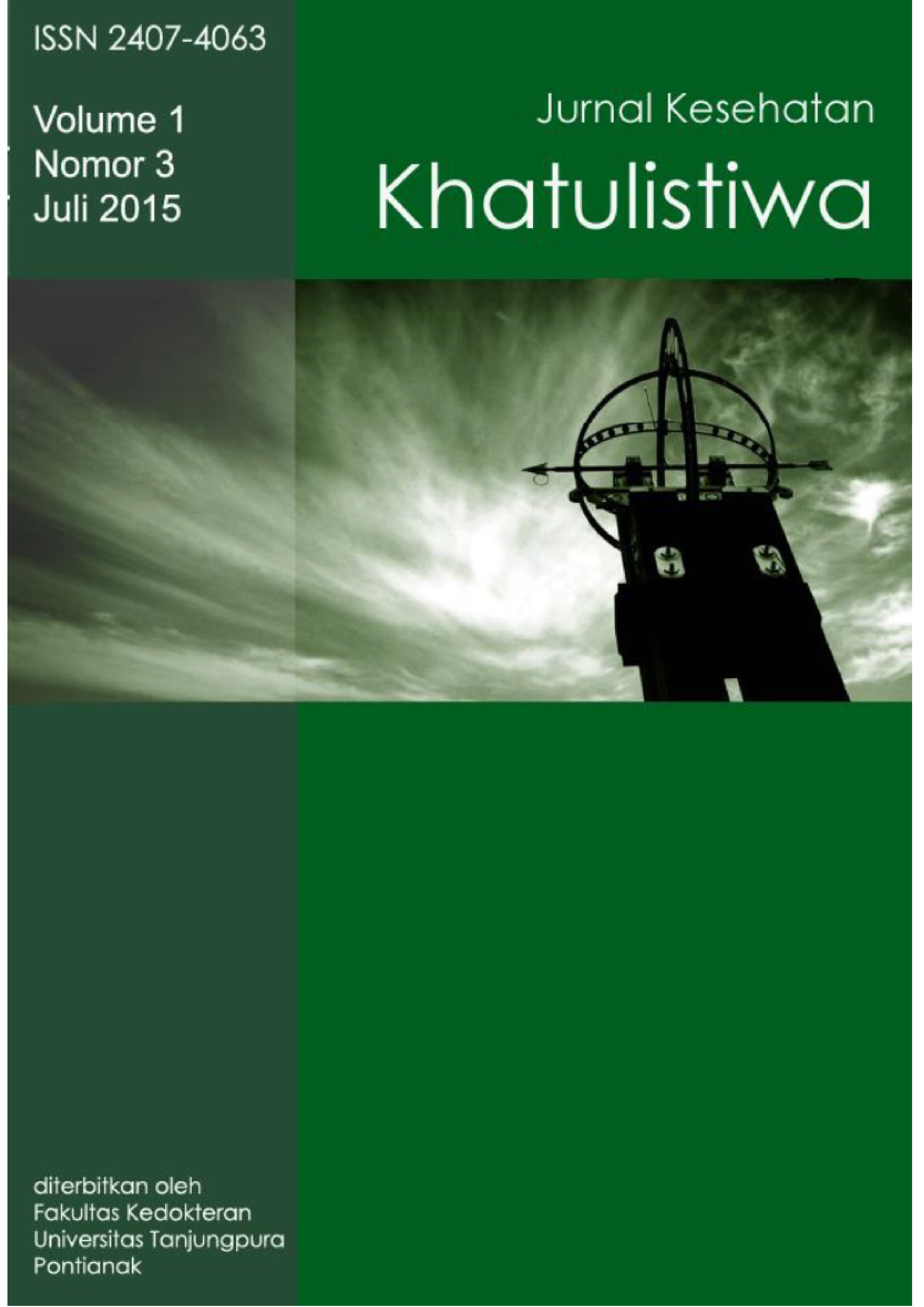
Hubungan antara kepribadian dan tingkat gejala depresi pada mahasiswa tahun kedua Program Studi Pendidikan Dokter Fakultas Kedokteran Universitas Tanjungpura
DOI:
https://doi.org/10.26418/jurkeswa.v1i3.43002Keywords:
depresi, kepribadian, Big Five, BDI, BFIAbstract
Latar belakang: Pengalaman akademik yang berat pada mahasiswa kedokteran dapat menyababkan mahasiswa mengalami gangguan psikologis seperti depresi, hal ini dapat dipengaruhi oleh kepribadian. Metode: Penelitian analitik dengan desain penelitian potong lintang
menggunakan kuesioner Beck Depression Inventory(BDI) dan kuesioner Kepribadian Big Five Inventory (BFI). Penelitian dilakukan di Fakultas Kedokteran Universitas Tanjungpura Pontianak. Sebanyak 71 mahasiswa angkatan 2014 menjadi sampel dalam penelitian ini. Hasil penelitian diuji dengan uji statistik Regresi Berganda dengan bantuan program SPSS 20.0. Hasil: Berdasarkan tingkat gejala depresi didapatkan sebanyak 22 orang (30,99%) dari mahasiswa Program Studi Pendidikan Dokter memiliki gejala depresi, sebanyak 13 orang (18,31%) memiliki tingat gejala depresi ringan, sebanyak 8 orang (11,27%) memiliki gejala depresi sedang dan untuk gejala depresi berat 1 orang (1,41%). Berdasarkan analisis regresi berganda didapatkan kepribadian yang paling kuat mempengaruhi tingkat gejala depresi adalah tipe kepribadian neurotcisim (R = .229), di mana tipe kepribadian ini berkontribusi sebanyak 22,9% dalam tingkat gejala depresi. Kesimpulan: Terdapat hubungan yang bermakna antara dimensi kepribadian neuroticism berkontribusi terhadap tingkat gejala depresi padaMahasiswa Tahun Kedua Program Studi Pendidikan Dokter Fakultas Kedokteran Universitas Tanjungpura.
References
Sadock BJ, Sadock VA, Kaplan&Sadock Buku Ajar Psikiatri Klinis Ed 2. EGC: Jakarta. 2010.
Depkes RI. Riset Kesehatan Dasar tahun 2013. Jakarta: Badan Penelitian dan Pengembangan Kesehatan; 2013, h 125.
Bootzin RR, Bower GH, Crocker J, Hall E. Psychology today. Seventh edition. New York: Mc Graw Hill Inc. 1991: h 606-23.
Kaplan HI, Sadock BJ, Grebb JA. Kaplan Sadock Sinopsis Psikiatri Ilmu Pengetahuan Perilaku Psikiatri Klinis.Binarupa Aksara Publisher: Tangerang. 2010.
Mastuti, Endah. Analisis Faktor Alat Ukur Kepribadian Big
Five Adaptasi dari IPIP) pada Mahasiswa Suku Jawa. Jurnal Psikologi INSAN, 7(3), 2005: h 264-276.
Goldberg, L.R. An Alternative “Description of Personalityâ€. The Big Five Factor Structure. Journal of Personality and Social Psychology; 1990. vol 59. h 277-302.
Meenakshi, K. Abhay M., Smrutiranjan, N., dkk. Assessment of Stressors in Medical Students And Its Relationship with The Self-Rated Depression; A Study Conducted in Rural Tertiary Hospital And Teaching Institute of Central India. Int J
Cur Rev volume 6. Issue 19. Agustus 2014. h 5.
GivensJL. Tjia J. Depressed medical student’s use of mental health services and barriers to use. Acad Med 2002. H 918-21
Ahmed, Isra, Banu, Haseena, Al-Fageer, Reem, et al. Cognitive emotions: Depression and anxety in medical students
and staff. Journal of Critical Care ELSEVIER. 2009. h 6.
Saravanan, Coumaravelou, Ray Wilks,.Medical Student’s Experience of and Reaction to Stress: Hindawi Publishing Corporation, The Scientific World Journal, Volume 2014. h 1.
Goebert D, Thompson D, Takeshita J. Depressive symptoms in medical students and residents: a multischool study. Acad
Med 2009; 84: 236-41.
Hadianto, Henry. Prevalensi dan Faktor Faktor Risiko yang Berhubungandengan Tingkat GejalaDepresipadaMahasiswa
Program Studi Pendidikan Dokter Fakultas Kedokteran Universitas Tanjungpura. [skripsi]. Pontianak: UniversitasTanjungpura. 2014. h 51
Yasin AS, Dzulkifli MA. Difference in depression, anxiety, and stress between low and high-achieving students. J Sustain
Sci Manage; 6(1): 169-78.
Dyrbye LN, Thomas MR, Shanafelt TD. Systemic review of depression, anxiety and other indicators of psychological distress among U.S. and Canadian medical students. Acad Med 2006; 81: 354-73.
Takahasi Michio, Yukihiko Shirayama, Katsuma Muneoka, Masatoshi Suzuki, Sato Koichi, Kenji Hashimoto. Low Openness on the Revised NEO Personality Inventory as Risk Factor for Treatment resistant Depression.Volume 8. Issue 9. PLOS ONE (http:Plosone.org). Sept. 2013.
Feist, Jess dan Feist, J. Gregory. Theories of Personality. Alih Bahasa. (2006). Santoso. Yogyakarta: Pustaka Pelajar. 2008
Goel, D., & Khan, I. Predictive Role of Personality on Conflict Management Strategies of Individuals in IT Sector:
Indian Perspective. National Conference on Emerging Challenges for Sustainable Business, 2012. 600-622.
Bienvenu, O. J., Samuels, J. F., Costa, P. T., Reti, I. M., Eaton, W. W., &Nestadt, G. Anxiety and depressive disorders and the five-factor model of personality: A higher- and lowerorder personality trait investigation in a community sample. Depression and Anxiety:Pubmed, 2004. 20, 92-97.
Brown, T. A. Temporal course and structural relationships among dimensions of temperament and DSM-IV anxiety and
mood disorder constructs. Journal of Abnormal Psychology, 2007. 116, 313-328.
Brown, T. A., Chorpita, B. F., & Barlow, D. H. Structural relationships among dimensions of the DSM-IV anxiety and
mood disorders and dimensions of negative affect, positive affect, and autonomic arousal.Journal of Abnormal Psychology,1998. 107, 179-192.
Brown, T. A., & Barlow, D. H. A proposal for a dimensional classification system based on the shared features of the DSMIV anxiety and mood disorders: Implications for assessment and treatment. Psychological Assessment, 2009. 21, 256-271.
Paul T. Costa Jr. Ph.D., Robert R. McCrae Ph.D., Approaches Derived from Philosophy and Psychology, Kaplan&Sadock's Comprehensive Textbook of Psychiatry, 9th Edition. Lippincott
Williams & Wilkins. 2009.
Trull, T. J., & Sher, K. J. Relationship between the five factor model of personality and Axis I disorders in a nonclinical
sample. Journal of Abnormal Psychology, 1994. 103, 350-360.
Downloads
Published
Issue
Section
License
Copyright (c) 2015 Jurnal Kesehatan Khatulistiwa

This work is licensed under a Creative Commons Attribution-NonCommercial-ShareAlike 4.0 International License.
- Share "” copy and redistribute the material in any medium or format
- Adapt "” remix, transform, and build upon the material
- The licensor cannot revoke these freedoms as long as you follow the license terms.
- Attribution "” You must give appropriate credit, provide a link to the license, andindicate if changes were made. You may do so in any reasonable manner, but not in any way that suggests the licensor endorses you or your use.
- NonCommercial "” You may not use the material for commercial purposes.
- ShareAlike "” If you remix, transform, or build upon the material, you must distribute your contributions under the same license as the original.
- No additional restrictions "” You may not apply legal terms or technological measures that legally restrict others from doing anything the license permits.
- You do not have to comply with the license for elements of the material in the public domain or where your use is permitted by an applicable exception or limitation.
- No warranties are given. The license may not give you all of the permissions necessary for your intended use. For example, other rights such as publicity, privacy, or moral rights may limit how you use the material.
