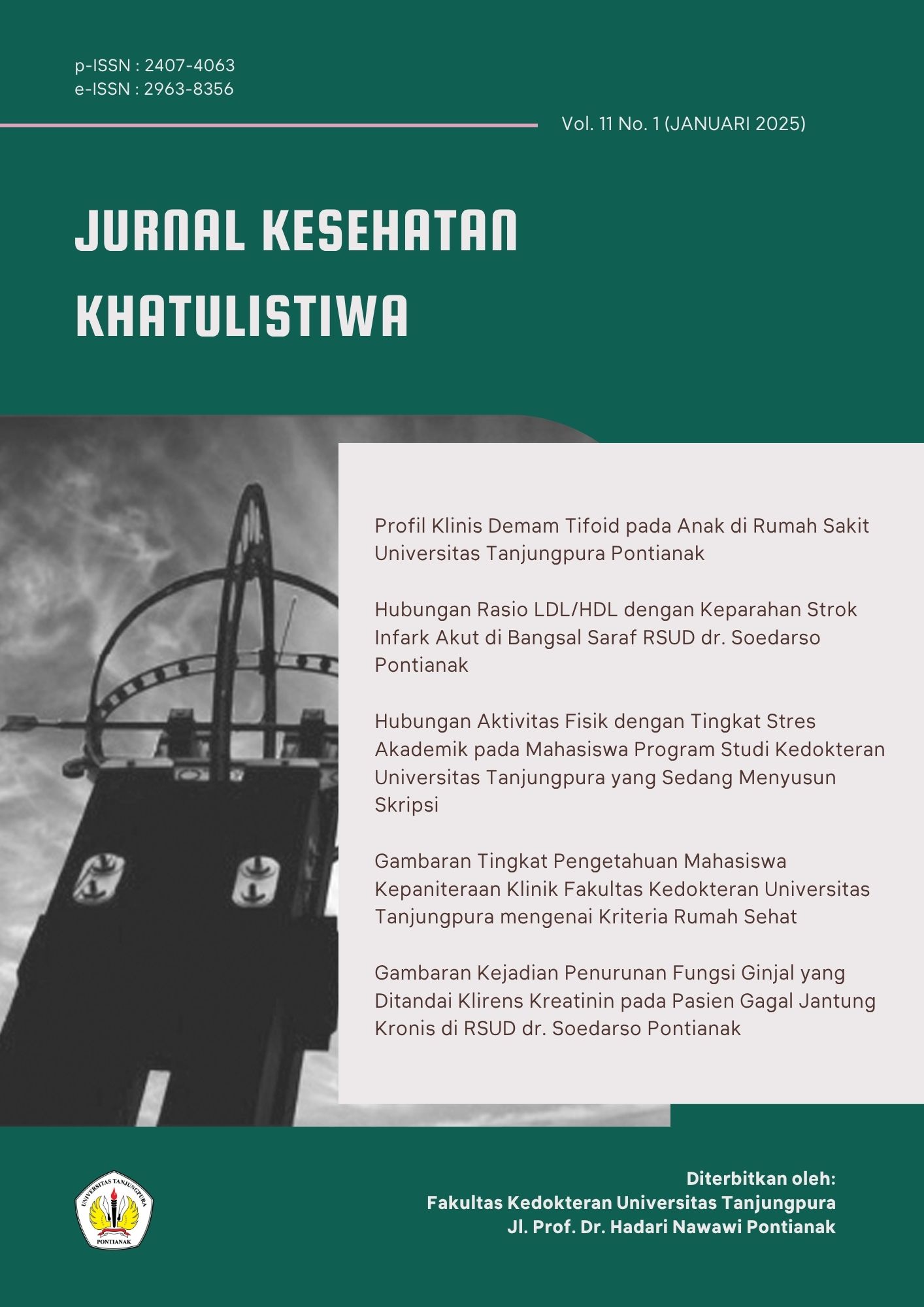
Hubungan Rasio LDL/HDL dengan Keparahan Strok Infark Akut di Bangsal Saraf RSUD Dr. Soedarso Pontianak
DOI:
https://doi.org/10.26418/jurkeswa.v11i1.89461Keywords:
Keparahan Strok, Rasio LDL/HDL, Strok Infark AkutAbstract
Background: Strok adalah defisit neurologis yang berkembang cepat, sering mengakibatkan kematian. Strok infark akut merupakan jenis yang paling umum dan disebabkan oleh penyumbatan pembuluh darah di otak. Rasio LDL/HDL dianggap sebagai faktor risiko penting dalam kejadian strok infark akut. Penelitian ini bertujuan untuk mengevaluasi hubungan antara rasio LDL/HDL dengan keparahan strok infark akut. Methods: Penelitian ini menggunakan metode observasional analitik dengan desain cross-sectional di bangsal saraf RSUD Dr. Soedarso Pontianak. Data LDL, HDL, dan skor NIHSS dari pasien strok infark akut dianalisis. Conclusions: Hasil penelitian menunjukkan hubungan positif yang signifikan antara rasio LDL/HDL dan skor NIHSS, dengan nilai signifikansi (sig.) yaitu 0,00. Rasio LDL/HDL yang tinggi berhubungan dengan peningkatan keparahan strok infark akut. Faktor usia merupakan risiko utama untuk strok, dengan prevalensi lebih tinggi pada kelompok usia di bawah 60 tahun. Insiden strok infark akut lebih tinggi pada pria dibandingkan wanita, disebabkan oleh perbedaan hormonal, faktor risiko kardiovaskular, dan gaya hidup. Pengelolaan rasio LDL/HDL penting dalam menangani pasien strok infark akut, dengan intervensi yang bertujuan menurunkan LDL dan meningkatkan HDL dapat memberikan hasil klinis yang lebih baik setelah strok.References
Kementerian Kesehatan Republik Indonesia (Kemenkes RI). Strok. 2018;
Feigin V. World Stroke Organization (WSO): Global Stroke Fact Sheet 2022. International Journal of Stroke 2022;17(1):18–29.
Chang J. Stroke Classification: Critical Role of Unusually Large von Willebrand Factor Multimers and Tissue Factor on Clinical Phenotypes Based on Novel “Two-Path Unifying Theory†of Hemostasis. Clin Appl Thromb Hemost 2020;
Kementerian Kesehatan Republik Indonesia (Kemenkes RI). Jenis-Jenis Strok. 2018;
Ma X, Lu J, Dong Y. Association between serum lipid levels and the risk of ischemic strok among Chinese females: a meta-analysis. International Journal of Neuroscience 2018;128(4):304–313.
Centers for Disease Control and Prevention (CDC). LDL and HL Cholesterol: “Bad†and “Good†Cholesterol. 2022;
Tsao C. Heart disease and strok statistics—2022 update: a report from the American Heart Association. Circulation 2022;145:153–639.
Zhang Y. Total and high-density lipoprotein cholesterol and strok risk. Strok 2012;43(7):1768–1774.
Robert A. Cholesterol Lowering and Prevention of Strok an Overview. Strok 2019;50:537–541.
Prasetia T. Faktor Risiko Kejadian Stroke Pada Usia ≤45 Tahun di RSD dr. Soebandi Jember Tahun 2017. 2018;
Miftahussurur M. Hubungan status sosial ekonomi tinggi dengan keparahan stroke pada pasien stroke di Rumah Sakit Pusat Otak Nasional Jakarta Indonesia. 2023;
Ilinca A. Ischemic Stroke Genetics: What Is New and How to Apply It in Clinical Practice? Genes 2022;13(1):48.
Kissela B, Khoury J, Alwell K. Age-specific trends in the incidence of stroke. Neurology 2014;82(10):917–923.
Abdu H, Seyoum G. Sex Differences in Stroke Risk Factors, Clinical Profiles, and In-Hospital Outcomes Among Stroke Patients Admitted to the Medical Ward of Dessie Comprehensive Specialized Hospital, Northeast Ethiopia. Degener Neurol Neuromuscul Dis 2022;12:133–144.
Dahl S, Hjalmarsson C, Andersson B. Sex differences in risk factors, treatment, and prognosis in acute stroke. Womens Health (Lond) 2020;16.
Ospel J, Goyal M. Sex and Gender Differences in Stroke and Their Practical Implications in Acute Care. Journal Stroke 2022;
Appelros P. Sex Differences in Stroke Incidence, Prevalence, Mortality, and Disability. 2021;
Banach M, Shekoohi N, Mikhailidis D. Relationship between low-density lipoprotein cholesterol, lipid-lowering agents and risk of stroke: a meta-analysis of observational studies (n = 355,591) and randomized controlled trials (n = 165,988). Arch Med Sci 2022;18(4):912–929.
Amarenco P, Kim J, Labreuche J, Investigators TS to T. A Comparison of Two LDL Cholesterol Targets after Ischemic Stroke. N Engl J Med 2020;382(1):9.
Luo Y, Li J, Zhang J. Kolesterol HDL rendah berkorelasi dengan stroke iskemik akut dengan diabetes mellitus. Lipid Kesehatan Dis 2014;13:171.
Hu Y, Song M, Wu D. The association between HDL-C and stroke in the middle-aged and elderly: A cross-sectional study. Brain Behav 2023;13(3):e2901.
Alkhairi Y, Alanazi T, Alsaeed O. Differences of Lipid Profile Among Ischemic and Hemorrhagic Stroke Patients in a Tertiary Hospital in Riyadh, Saudi Arabia: A Retrospective Cohort Study. Cureus 2022;14(4).
Bruckert E, Labreuche J, Amarenco P. Meta-Analysis of the Effect of Nicotinic Acid Alone or in Combination on Cardiovascular Events and Atherosclerosis. Atherosclerosis 2010;210(2):353–361.
Sacks F, Stone P, Gibson C. Controlled trial of gemfibrozil in patients with low HDL cholesterol and coronary heart disease. VA-HIT: a randomized controlled trial. JAMA 2021;285(12):1585–1592.
Henrion. Cereal B-Glucans: The Impact of Processing and How It Affects Physiological Responses. Nutrients 2019;11(8):1729.
Permatasari O. Pendidikan Kesehatan tentang Asupan Diet Rendah Lemak dan Kolesterol di Puskesmas Gambirsari Surakarta. 2018;
Chiu S, Bergeron N, Williams P. Comparison of The DASH (Dietary Approaches to Stop Hypertension) diet and a higher-fat DASH diet on blood pressure and lipids and lipoproteins: a randomized controlled trial. Am J Clin Nutr 2016;103(2):341–347.
Guasch-Ferré M, Liu X, Malik V. Nut consumption and risk of cardiovascular disease. J Am Coll Cardiol 2017;70(3):251–264.
American College of Cardiology. Stroke: Back to the Basics. 2022;
Heart Association. U.S. stroke rate declining in adults 75 and older, yet rising in adults 49 and younger [Homepage on the Internet]. 2022;Available from: https://newsroom.heart.org
Dharmawita. Angka kejadian strok berdasarkan usia dan jenis kelamin pada strok hemoragik dan non-hemoragik di Instalasi Rawat Inap Neurologi RSUD Dr. H. Abdul Moeloek tahun 2014. Jurnal Medika Malahayati 2019;
Downloads
Published
Issue
Section
License
Copyright (c) 2025 Jurnal Kesehatan Khatulistiwa

This work is licensed under a Creative Commons Attribution-NonCommercial-ShareAlike 4.0 International License.
- Share "” copy and redistribute the material in any medium or format
- Adapt "” remix, transform, and build upon the material
- The licensor cannot revoke these freedoms as long as you follow the license terms.
- Attribution "” You must give appropriate credit, provide a link to the license, andindicate if changes were made. You may do so in any reasonable manner, but not in any way that suggests the licensor endorses you or your use.
- NonCommercial "” You may not use the material for commercial purposes.
- ShareAlike "” If you remix, transform, or build upon the material, you must distribute your contributions under the same license as the original.
- No additional restrictions "” You may not apply legal terms or technological measures that legally restrict others from doing anything the license permits.
- You do not have to comply with the license for elements of the material in the public domain or where your use is permitted by an applicable exception or limitation.
- No warranties are given. The license may not give you all of the permissions necessary for your intended use. For example, other rights such as publicity, privacy, or moral rights may limit how you use the material.
