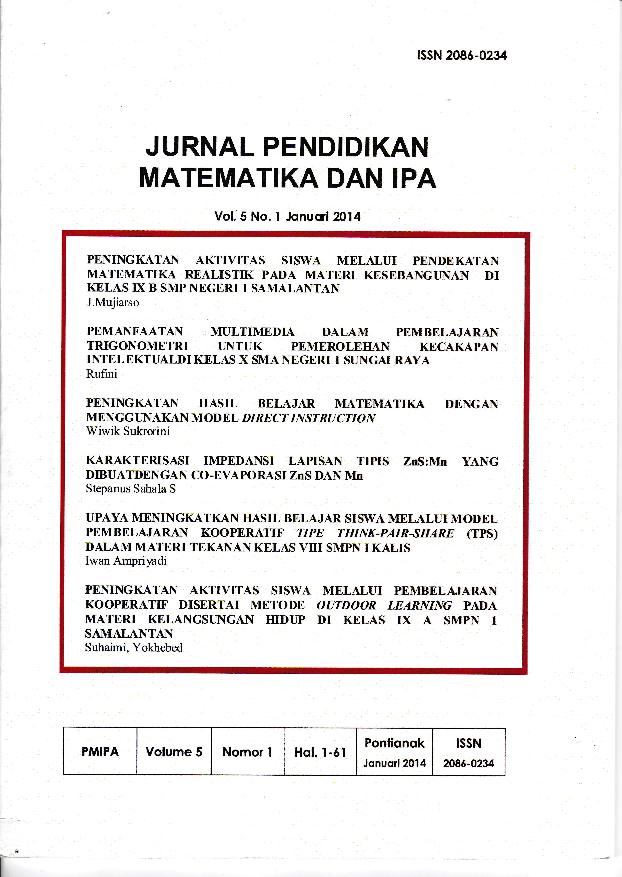
KARAKTERISASI IMPEDANSI LAPISAN TIPIS ZnS:Mn YANG DIBUAT DENGAN CO-EVAPORASI ZnS DAN Mn
DOI:
https://doi.org/10.26418/jpmipa.v5i1.13287Abstract
The aim of this research is to characterize impedance, capasitance and relative permitivity of the characteristics of electric thin film ZnS and ZnS:Mn. This research was started from making thin film with different deposition speed and with thermal co-evaporation method in vakum tubes. The estimation is the characteristics of thin film ZnS impedance and ZnS:Mn was done outside this vacum with various frequency between thousaund to million hertzs, with different deposition speed and the same thickness. Defining impedance of ZnS thin film wich the most optimal frequency would influence capasitance and relative permittivity of the thin film on the characteristics of the electricity. Besides, capasitance and resitance values of ZnS:Mn thin film would change if given different Mn portion on that thin film. From the result of the research, it could be identified as follows. On the area of the thousand to ten thousand Hertz, it was know is that relative permitivity/constante static dielectrics K(0) ZnS:Mn thin film was not the frequency function that it could be regarded as constant like K(o) = 10. The price of capasitance ZnS:Mn was increasing with less Mn amount in that thin film. The price of ZnS:Mn electric resitance is reduced with less Mn amount on that thin film.
Key words: Impedance, thin film ZnS:Mn, co-evaporation.
Downloads
Published
Issue
Section
License
Authors who publish with this journal agree to the following terms:
- Authors retain copyright and grant the journal right of first publication with the work simultaneously licensed under a Creative Commons Attribution 4.0 International License that allows others to share the work with an acknowledgement of the work's authorship and initial publication in this journal.
- Authors are able to enter into separate, additional contractual arrangements for the non-exclusive distribution of the journal's published version of the work (e.g., post it to an institutional repository or publish it in a book), with an acknowledgement of its initial publication in this journal.
- Authors are permitted and encouraged to post their work online (e.g., in institutional repositories or on their website) prior to and during the submission process, as it can lead to productive exchanges, as well as earlier and greater citation of published work (See The Effect of Open Access).

This work is licensed under a Creative Commons Attribution 4.0 International License
