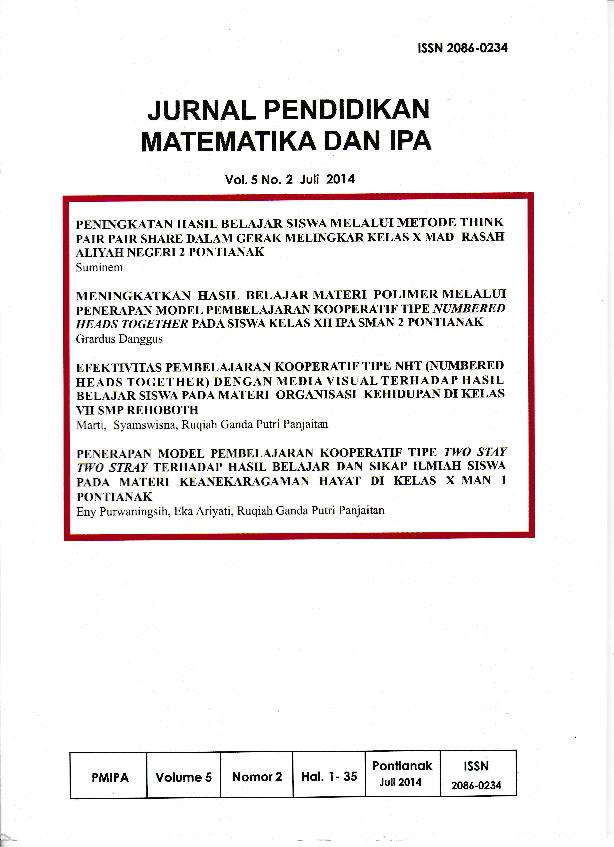
PENINGKATAN HASIL BELAJAR SISWA MELALUI METODE THINK PAIR PAIR SHARE DALAM GERAK MELINGKAR KELAS X MADRASAH ALIYAH NEGERI 2 PONTIANAK
DOI:
https://doi.org/10.26418/jpmipa.v5i2.13333Abstract
In the first cycle implementing cooperative learning TPS the students"™ mastery is as high as 18% of 33 students, the second cycle there is an increase to 48.48%. Because they have not reached minimal passing grade, the cycle is continued to the third cycle with the achievement grade 93.93% which is more than expectation. Therefore, the application of cooperative to study aims to improve students' mastery of learning outcomes in circular motion. The study was conducted on the class XF MAN 2 in even semester, using cooperative learning methods TPS with the helping of peer tutors. The researching forms an action research with 3 cycles. The results showed that polling method with the help of peer tutors can improve student learning outcomes in the thoroughness of the material optical instruments.Keywords: Cooperative polling, peer tutoring assistance.
Downloads
Published
2016-01-14
Issue
Section
Articles
License
Authors who publish with this journal agree to the following terms:
- Authors retain copyright and grant the journal right of first publication with the work simultaneously licensed under a Creative Commons Attribution 4.0 International License that allows others to share the work with an acknowledgement of the work's authorship and initial publication in this journal.
- Authors are able to enter into separate, additional contractual arrangements for the non-exclusive distribution of the journal's published version of the work (e.g., post it to an institutional repository or publish it in a book), with an acknowledgement of its initial publication in this journal.
- Authors are permitted and encouraged to post their work online (e.g., in institutional repositories or on their website) prior to and during the submission process, as it can lead to productive exchanges, as well as earlier and greater citation of published work (See The Effect of Open Access).

This work is licensed under a Creative Commons Attribution 4.0 International License
