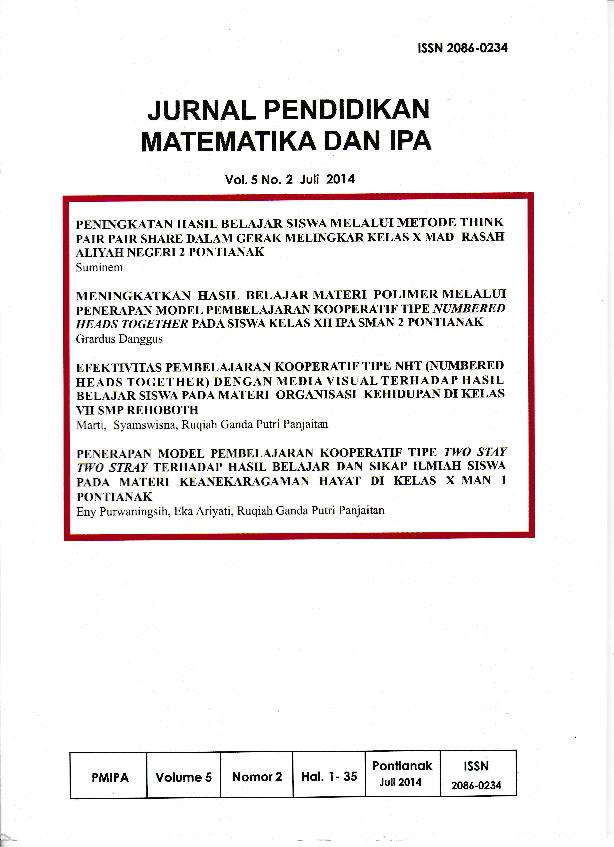
MENINGKATKAN HASIL BELAJAR MATERI POLIMER MELALUI PENERAPAN MODEL PEMBELAJARAN KOOPERATIF TIPE NUMBERED HEADS TOGETHER PADA SISWA KELAS XII IPA SMAN 2 PONTIANAK
DOI:
https://doi.org/10.26418/jpmipa.v5i2.13335Abstract
This research has been conducted to recognize the improvement of the students study achievement in polymer lesson at 12th grade of science program in SMAN 2 Pontianak by the application of cooperative learning model type numbered heads together. The form of this research is Classroom Action Research. The research was conducted in three cycles. The students learn about the meaning and the reaction how the polymer is formed, the classification of polymer, kinds of plastic, the use and the impact of polymer as well. The instruments used are the students"™ test achievement and questioners. Result of this research on the first cycle the percentage of the study completeness is 70,97%, the second cycle is 75% and the third cycle is 84,38%. It can be concluded that there is improvement on the students study result. It is recommended for the teachers to choose cooperative learning model type numbered heads together become one of the learning model alternative in polymer lesson to improve of the students"™ study result.Keywords: Numbered heads together, polymer.
Downloads
Published
2016-01-14
Issue
Section
Articles
License
Authors who publish with this journal agree to the following terms:
- Authors retain copyright and grant the journal right of first publication with the work simultaneously licensed under a Creative Commons Attribution 4.0 International License that allows others to share the work with an acknowledgement of the work's authorship and initial publication in this journal.
- Authors are able to enter into separate, additional contractual arrangements for the non-exclusive distribution of the journal's published version of the work (e.g., post it to an institutional repository or publish it in a book), with an acknowledgement of its initial publication in this journal.
- Authors are permitted and encouraged to post their work online (e.g., in institutional repositories or on their website) prior to and during the submission process, as it can lead to productive exchanges, as well as earlier and greater citation of published work (See The Effect of Open Access).

This work is licensed under a Creative Commons Attribution 4.0 International License
