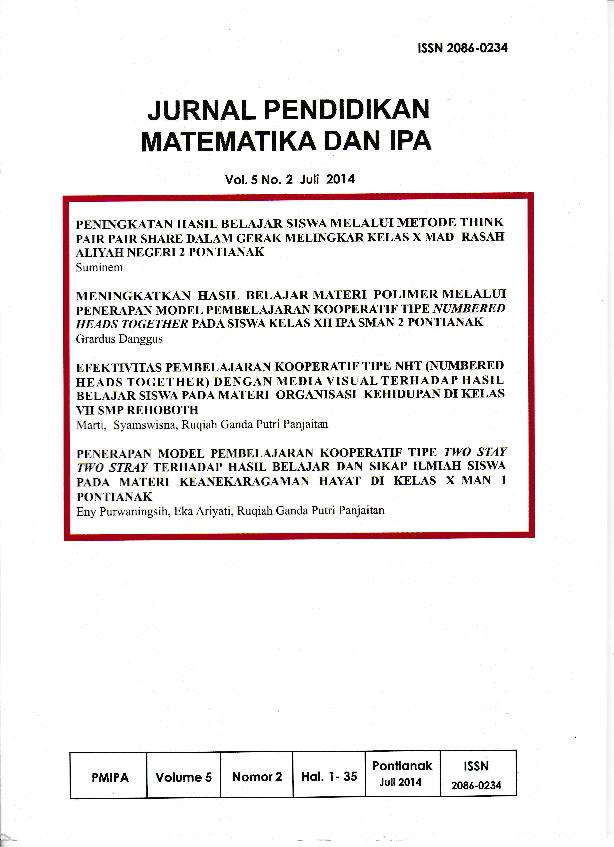
EFEKTIVITAS PEMBELAJARAN KOOPERATIF TIPE NHT (NUMBERED HEADS TOGETHER) DENGAN MEDIA VISUAL TERHADAP HASIL BELAJAR SISWA PADAMATERI ORGANISASI KEHIDUPAN DI KELAS VII SMP REHOBOTH
DOI:
https://doi.org/10.26418/jpmipa.v5i2.13336Abstract
This research is aimed to determine the effectivity of cooperative learning model through Numbered Heads Together (NHT) by visual media on students"™ achievement in material life organization of VII grade SMP Rehoboth. The research is quasi experimental design, with nonequivalen control group design. The research samples are VIIa and VIIb grade. The technique of data collecting is by using random sampling. The average score of the students"™ achievement that has been teach by using Numbered Heads Together (NHT) of cooperative learning model with visual media is 14,89 as higher than the conventional model of 11,29. The t-test in standard 5% shows tcount= 5,023 bigger than its comparation to ttable = 1,679, it means there is a significant difference in the post-test result. The counting of effect size is 1,27 it includes high, so the concluded that Numbered Heads Together (NHT) of cooperative learning model with visual media gave 39,80% of contribution on students"™ achievement.Key words : Numbered heads together, visual media.
Downloads
Published
2016-01-14
Issue
Section
Articles
License
Authors who publish with this journal agree to the following terms:
- Authors retain copyright and grant the journal right of first publication with the work simultaneously licensed under a Creative Commons Attribution 4.0 International License that allows others to share the work with an acknowledgement of the work's authorship and initial publication in this journal.
- Authors are able to enter into separate, additional contractual arrangements for the non-exclusive distribution of the journal's published version of the work (e.g., post it to an institutional repository or publish it in a book), with an acknowledgement of its initial publication in this journal.
- Authors are permitted and encouraged to post their work online (e.g., in institutional repositories or on their website) prior to and during the submission process, as it can lead to productive exchanges, as well as earlier and greater citation of published work (See The Effect of Open Access).

This work is licensed under a Creative Commons Attribution 4.0 International License
