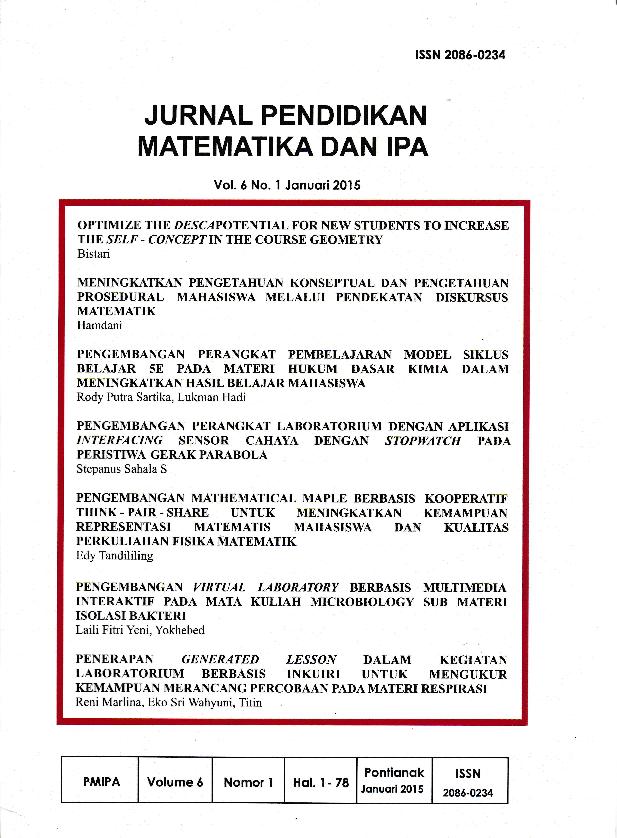
PENGEMBANGAN PERANGKAT LABORATORIUM DENGAN APLIKASI INTERFACING SENSOR CAHAYA DENGAN STOPWATCH PADA PERISTIWA GERAK PARABOLA
DOI:
https://doi.org/10.26418/jpmipa.v6i1.16222Abstract
This research has the objective of knowing the application of light concept as a sensor in the moment of projectile motion using the aplication of light sensor interfacing in stopwatch. The making of light sensor device is with electronic circuits method, while the defeniting the time uses digital stopwatch. Both devices are combined to be instrument of projectile motion experiment. The result of data analysis from the graphic, the distance of the time line the curve, that it is achieved a relationship between the variable and gradient or the degree of the graphic slope of the line is 4,875. From the calculation the gradient got gravitational acceleration (g) that is 9,75 m/s2. Gravitational acceleration that is almost reading the standard gravitational acceleration, that is 9,8 m/s2 and it has only 0,05 m/s2 in difference from the research. It proves that this device can work well and stopwatch can automatically work.
Keywords: Interfacing light sensor, motion projectile.
Downloads
Published
Issue
Section
License
Authors who publish with this journal agree to the following terms:
- Authors retain copyright and grant the journal right of first publication with the work simultaneously licensed under a Creative Commons Attribution 4.0 International License that allows others to share the work with an acknowledgement of the work's authorship and initial publication in this journal.
- Authors are able to enter into separate, additional contractual arrangements for the non-exclusive distribution of the journal's published version of the work (e.g., post it to an institutional repository or publish it in a book), with an acknowledgement of its initial publication in this journal.
- Authors are permitted and encouraged to post their work online (e.g., in institutional repositories or on their website) prior to and during the submission process, as it can lead to productive exchanges, as well as earlier and greater citation of published work (See The Effect of Open Access).

This work is licensed under a Creative Commons Attribution 4.0 International License
