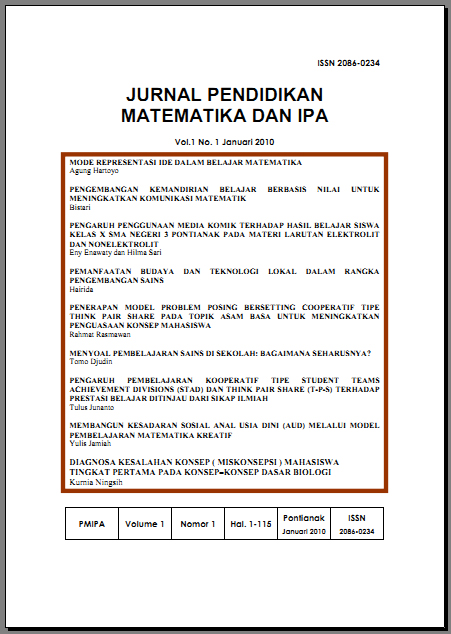
PENGARUH PENGGUNAAN MEDIA KOMIK TERHADAP HASIL BELAJAR SISWA KELAS X SMA NEGERI 3 PONTIANAK PADA MATERI LARUTAN ELEKTROLIT DAN NONELEKTROLIT
DOI:
https://doi.org/10.26418/jpmipa.v1i1.163Abstract
The purposes of the research is to know the effect using media of comic toward student achievement learning in class X SMA Negeri 3 Pontianak for electrolit solution and non electrolit solution. The research uses experiment method and design research is “ Pretest Posttest Control Group Design”. The subject research are student calss XE and XF, using purposive sampling to take the sample. The technique is used to gather the data is student achievement. Based on the data analisis using U-Mann Whitney test, 5 % level signification is found that Z count=-5,56 < Z tabel -1,96, there is the difference students learning achievement between using comic media and praktikum metod. There are 96,97 % student get higger learning achievement and get the KKM. The Effect size is 1,82, means learning using comic media give big effect 46,56 % towards the higger student achievement student class X SMA Negeri 3 Pontianak. The respon 30 students class XE towards learning electrolit solution and non electrolit solution using media of comic is 95,87 %. This is shows that learning using comic media is effective to teach electrolit solution and non electrolit solution in class X SMA Negeri 3 Pontianak.Keywords : electrolit solution and non electrolit solution, comic media, praktikum
Downloads
Published
2010-01-01
Issue
Section
Articles
License
Authors who publish with this journal agree to the following terms:
- Authors retain copyright and grant the journal right of first publication with the work simultaneously licensed under a Creative Commons Attribution 4.0 International License that allows others to share the work with an acknowledgement of the work's authorship and initial publication in this journal.
- Authors are able to enter into separate, additional contractual arrangements for the non-exclusive distribution of the journal's published version of the work (e.g., post it to an institutional repository or publish it in a book), with an acknowledgement of its initial publication in this journal.
- Authors are permitted and encouraged to post their work online (e.g., in institutional repositories or on their website) prior to and during the submission process, as it can lead to productive exchanges, as well as earlier and greater citation of published work (See The Effect of Open Access).

This work is licensed under a Creative Commons Attribution 4.0 International License
