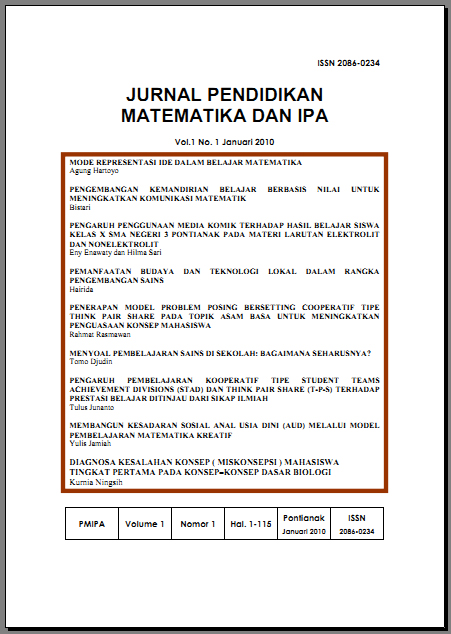
PENERAPAN MODEL PROBLEM POSING BERSETTING COOPERATIF TIPE THINK PAIR SHARE PADA TOPIK ASAM BASA UNTUK MENINGKATKAN PENGUASAAN KONSEP MAHASISWA
DOI:
https://doi.org/10.26418/jpmipa.v1i1.165Abstract
The low student understanding of concepts on the topic due to lack of acid base interaction with the material studied. This study aims to determine the conception of students, student influence and respond to the model after learning problems set Posing think pair share. The sample in this study is the students who attend a course basic chemistry II 2008/2009 school year in chemical education courses totaling UNTAN FKIP 23 people with a form of research design quasy experiment. Data collection techniques used is about the shape of the test and questionnaire response essays. The results showed that there are significant differences abilities before learning concepts with students after learning. The amount of influence of 7.49 with a very high category. Conceptions of students in accordance with the concept of the experts increased by 52.9%. Students respond positively to the learning model of cooperative problem set type possing think pair share.Kata Kunci: Asam basa, Problem Posing, Kooperatif, Think Pair Share.
Downloads
Published
2010-01-01
Issue
Section
Articles
License
Authors who publish with this journal agree to the following terms:
- Authors retain copyright and grant the journal right of first publication with the work simultaneously licensed under a Creative Commons Attribution 4.0 International License that allows others to share the work with an acknowledgement of the work's authorship and initial publication in this journal.
- Authors are able to enter into separate, additional contractual arrangements for the non-exclusive distribution of the journal's published version of the work (e.g., post it to an institutional repository or publish it in a book), with an acknowledgement of its initial publication in this journal.
- Authors are permitted and encouraged to post their work online (e.g., in institutional repositories or on their website) prior to and during the submission process, as it can lead to productive exchanges, as well as earlier and greater citation of published work (See The Effect of Open Access).

This work is licensed under a Creative Commons Attribution 4.0 International License
