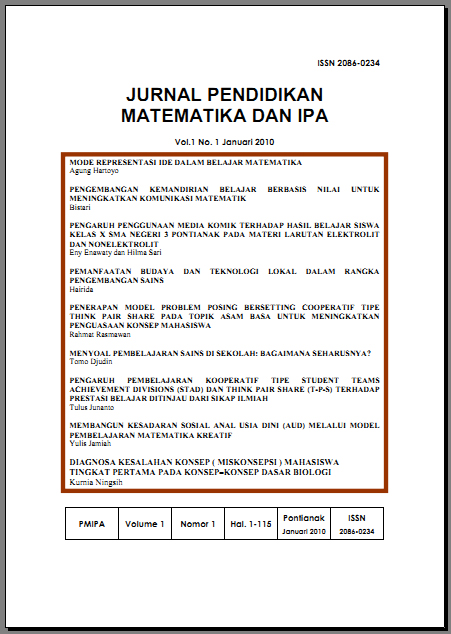
DIAGNOSA KESALAHAN KONSEP ( MISKONSEPSI ) MAHASISWA TINGKAT PERTAMA PADA KONSEPKONSEP DASAR BIOLOGI
DOI:
https://doi.org/10.26418/jpmipa.v1i1.169Abstract
The problems of incorrect concepts (misconception) often occurred in Biology learning, especially the abstract concepts. This research is aimed to find the misconception occurred in basic concept of First Semester Biology Students in Biology Education Study Program. Explorative description is used in this research. The subject of this research is 21 persons that are first year students 2008/2009. Diagnostic-test in multiple choices with reasonable answers is the instruments of this research. The misconception in first semester students in Biology education is the highest in the respiratory system of living organisms as 90,48%. Students that state sticking and implanting includes in vegetative artificial reproduction is about 85,71%, and red and yellow colors in Bougainville flower in corolla and calyx is about 80,95%. The cause of misconception is reading book and the explanation they accept. By the early finding of the misconception occurred in students, it is suggested the teachers that teach Basic Biology or related with the concept; the vegetative artificial reproduction, respiration, photosynthesis, dependency among living organisms, and flower morphology so it can be chosen appropriate and price method/strategy in making the lecturing process.Keyword: Misconception, Basic Concept Biology
Downloads
Published
2010-01-01
Issue
Section
Articles
License
Authors who publish with this journal agree to the following terms:
- Authors retain copyright and grant the journal right of first publication with the work simultaneously licensed under a Creative Commons Attribution 4.0 International License that allows others to share the work with an acknowledgement of the work's authorship and initial publication in this journal.
- Authors are able to enter into separate, additional contractual arrangements for the non-exclusive distribution of the journal's published version of the work (e.g., post it to an institutional repository or publish it in a book), with an acknowledgement of its initial publication in this journal.
- Authors are permitted and encouraged to post their work online (e.g., in institutional repositories or on their website) prior to and during the submission process, as it can lead to productive exchanges, as well as earlier and greater citation of published work (See The Effect of Open Access).

This work is licensed under a Creative Commons Attribution 4.0 International License
