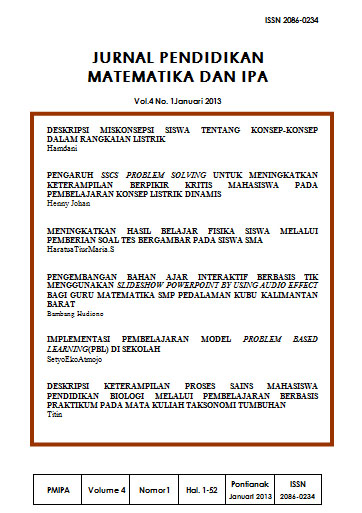
IMPLEMENTASI PEMBELAJARAN MODEL PROBLEM BASED LEARNING (PBL) DI SEKOLAH
DOI:
https://doi.org/10.26418/jpmipa.v4i1.17585Abstract
Penelitian ini bertujuan untuk mengetahui efektivitas model Problem Based Learning (PBL) dalam meningkatkan hasil belajar siswa pada materi pokok pengelolaan lingkungan. Penelitian ini dilakukan di SMP Bhakti Kedungtuban Blora pada semester II tahun akademik 2012/2013. Subjek penelitian ini adalah siswa kelas VII A SMP Bhakti Kedungtuban. Penelitian ini merupakan penelitian tindakan kelas yang dilakukan dalam empat siklus dan setiap siklus terdiri dari tahap perencanaan, tindakan, pengamatan, dan refleksi. Berdasarkan hasil penelitian dan pembahasan dapat disimpulkan bahwa pembelajaran materi pengelolaan lingkungan model Problem Based Learning (PBL) dapat meningkatkan hasil belajar siswa kelas VII A di SMP Bhakti Kedungtuban. Hal tersebut ditunjukkan dengan tercapainya standar ketuntasan belajar pada materi pokok pengelolaan lingkungan yaitu 80% dari seluruh siswa memperoleh nilai hasil belajar ≥75. Dimana 86,75% dari keseluruhan jumlah siswa pada kelas VII A mencapai ketuntasan belajar pada siklus IV.
Kata Kunci: Model Problem Based Learning (PBL)
Downloads
Published
Issue
Section
License
Authors who publish with this journal agree to the following terms:
- Authors retain copyright and grant the journal right of first publication with the work simultaneously licensed under a Creative Commons Attribution 4.0 International License that allows others to share the work with an acknowledgement of the work's authorship and initial publication in this journal.
- Authors are able to enter into separate, additional contractual arrangements for the non-exclusive distribution of the journal's published version of the work (e.g., post it to an institutional repository or publish it in a book), with an acknowledgement of its initial publication in this journal.
- Authors are permitted and encouraged to post their work online (e.g., in institutional repositories or on their website) prior to and during the submission process, as it can lead to productive exchanges, as well as earlier and greater citation of published work (See The Effect of Open Access).

This work is licensed under a Creative Commons Attribution 4.0 International License
