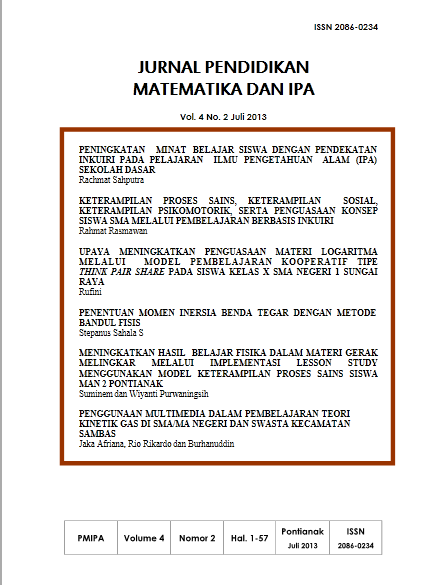
PENGGUNAAN MULTIMEDIA DALAM PEMBELAJARAN TEORI KINETIK GAS DI SMA/MA NEGERI DAN SWASTA KECAMATAN SAMBAS
DOI:
https://doi.org/10.26418/jpmipa.v4i2.17590Abstract
Using Multimedia in Learning Kinetic Gas Theory in SMA / MA Public and Private District of Sambas. This study aims to see changes in student learning outcomes after learning using multimedia by comparing the value of the learning outcomes of the pre-test and post-test. Quasi-experimental methods used in this study with one group pretest-posttest design. Research subjects choose three of four SMA/ MA Public and Private District of Sambas which has a program of Natural Sciences, SMA Negeri 1 Sambas (20 students), MAN Sambas (19 students), and SMA Santo Bonaventura (16 students). Based on the data analysis and discussion, the average percentage of learning outcomes pre-test on Gas Kinetic Theory of 53.68% of the 55 students. While the average percentage of learning outcomes post-test 69.04% of the 55 students. The increase in the average percentage of student learning outcomes in the material Kinetic Theory of Gases using multimedia for 15.37%. The results of calculations using the McNemar test, of the total ten questions occur to improving student learning outcomes Gas Kinetic Theory of matter between before and after learning using multimedia, which calculate the average X2 mean = 9.10 and X2table mean = 3.84 this means that the calculated X2hitung > X2table.
Keywords : Multimedia, kinetic theory of gases.
Downloads
Published
Issue
Section
License
Authors who publish with this journal agree to the following terms:
- Authors retain copyright and grant the journal right of first publication with the work simultaneously licensed under a Creative Commons Attribution 4.0 International License that allows others to share the work with an acknowledgement of the work's authorship and initial publication in this journal.
- Authors are able to enter into separate, additional contractual arrangements for the non-exclusive distribution of the journal's published version of the work (e.g., post it to an institutional repository or publish it in a book), with an acknowledgement of its initial publication in this journal.
- Authors are permitted and encouraged to post their work online (e.g., in institutional repositories or on their website) prior to and during the submission process, as it can lead to productive exchanges, as well as earlier and greater citation of published work (See The Effect of Open Access).

This work is licensed under a Creative Commons Attribution 4.0 International License
