PENINGKATAN HASIL BELAJAR MATEMATIKA DENGAN MENGGUNAKAN MODEL DIRECT INSTRUCTION
DOI:
https://doi.org/10.26418/jpmipa.v5i1.18640Abstract
This study was motivated by the study of matter form roots and rank Numbers are still low.Therefore, the teacher will use the Direct Instruction model of which aim to improve student learning outcomes grade IX SMP 23 Pontianak. The subjects were students of grade IX A second semester of 2013/2014. The study lasted for 2 cycles, where in the first cycle showed an average of 71,60 while the learning outcomes in the second cycle, the average results of study show the score 72.14. The mastery learning of students in the first cycle is only 39% of all student in the class, whereas in the second cycle, mastery learning reaches 57%.Teacher performance assessment by the observer in the first cycle on average 70.95 and the second cycle averaged 72.28. Thus, learning the Direct Instruction model can improve learning outcomes as well as the percentage of mastery learning . Based on the research results, the learning Mathematics Direct Instruction model can be used as an alternative learning strategies that can be implemented in an effort to improve learning outcame.
Keywords: Direct Instruction Model.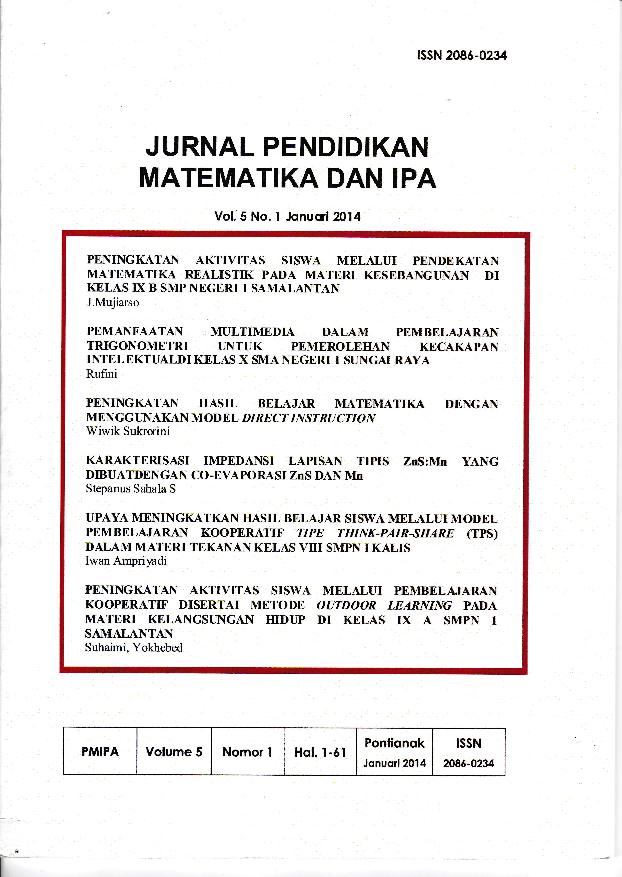
Downloads
Published
Issue
Section
License
Authors who publish with this journal agree to the following terms:
- Authors retain copyright and grant the journal right of first publication with the work simultaneously licensed under a Creative Commons Attribution 4.0 International License that allows others to share the work with an acknowledgement of the work's authorship and initial publication in this journal.
- Authors are able to enter into separate, additional contractual arrangements for the non-exclusive distribution of the journal's published version of the work (e.g., post it to an institutional repository or publish it in a book), with an acknowledgement of its initial publication in this journal.
- Authors are permitted and encouraged to post their work online (e.g., in institutional repositories or on their website) prior to and during the submission process, as it can lead to productive exchanges, as well as earlier and greater citation of published work (See The Effect of Open Access).

This work is licensed under a Creative Commons Attribution 4.0 International License
