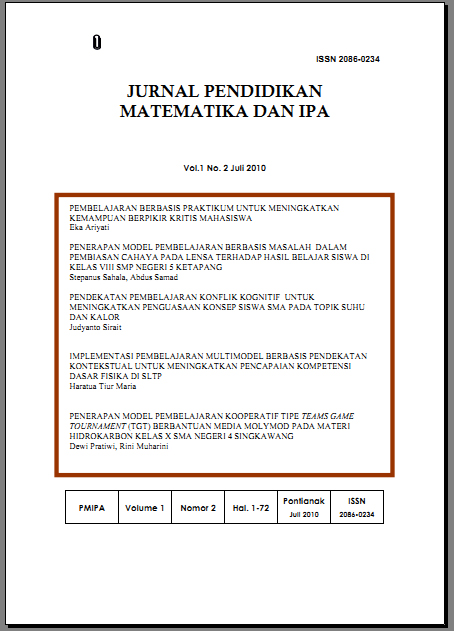
PENERAPAN MODEL PEMBELAJARAN BERBASIS MASALAH DALAM PEMBIASAN CAHAYA PADA LENSA TERHADAP HASIL BELAJAR SISWA DI KELAS VIII SMP NEGERI 5 KETAPANG
DOI:
https://doi.org/10.26418/jpmipa.v1i2.196Abstract
Penelitian ini bertujuan untuk mengetahui penerapan model pembelajaran berbasis masalah dalam pembiasan cahaya pada lensa terhadap hasil belajar siswa di kelas VIII SMP Negeri 5 Ketapang. Bentuk penelitian yang digunakan adalah Quasy Experiment, dengan rancangan Pretest Posttest Control Group Design. Pengambilan sampel yang digunakan dalam penelitian ini adalah dengan teknik Purposive Sampling. Sampel penelitian yaitu kelas VIII B sebagai kelas kontrol dan VIII A sebagai kelas eksperimen. Berdasarkan hasil analisis data diperoleh skor rata-rata hasil belajar siswa yang diajarkan dengan pembelajaran berbasis masalah sebesar 26,75 lebih tinggi dibandingkan dengan pembelajaran konvensional yaitu 20,65. Dari uji U Mann Whitney diketahui Zhitung = -3,97 sedangkan Ztabel = -1,96, artinya terdapat perbedaan yang signifikan antara skor rata-rata hasil belajar siswa pada kelas eksperimen dan kelas kontrol pada taraf 5%. Nilai Effect Size yaitu 1,40 atau tergolong tinggi dan jika dilihat dari standar kurva normal, maka pembelajaran berbasis masalah memberikan kontribusi sebesar 41,92% terhadap hasil belajar siswa.Kata kunci : model pembelajaran berbasis masalah, pembiasan cahaya pada lensa, hasil belajar.
Downloads
Published
2012-03-13
Issue
Section
Articles
License
Authors who publish with this journal agree to the following terms:
- Authors retain copyright and grant the journal right of first publication with the work simultaneously licensed under a Creative Commons Attribution 4.0 International License that allows others to share the work with an acknowledgement of the work's authorship and initial publication in this journal.
- Authors are able to enter into separate, additional contractual arrangements for the non-exclusive distribution of the journal's published version of the work (e.g., post it to an institutional repository or publish it in a book), with an acknowledgement of its initial publication in this journal.
- Authors are permitted and encouraged to post their work online (e.g., in institutional repositories or on their website) prior to and during the submission process, as it can lead to productive exchanges, as well as earlier and greater citation of published work (See The Effect of Open Access).

This work is licensed under a Creative Commons Attribution 4.0 International License
