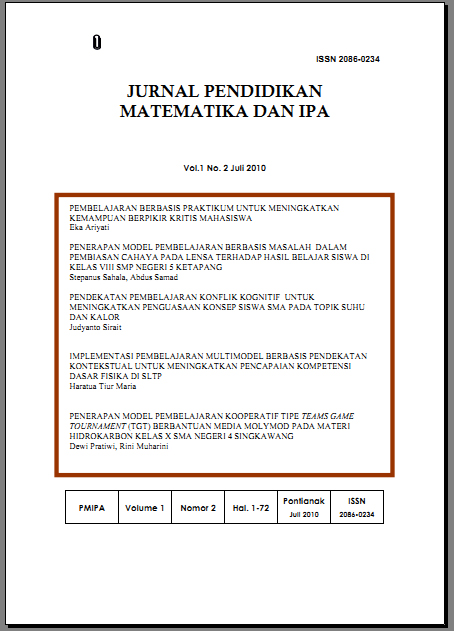
PENDEKATAN PEMBELAJARAN KONFLIK KOGNITIF UNTUK MENINGKATKAN PENGUASAAN KONSEP SISWA SMA PADA TOPIK SUHU DAN KALOR
DOI:
https://doi.org/10.26418/jpmipa.v1i2.197Abstract
The goal of this research is to obtain the gain of student’s conceptual understanding in applied cognitive conflict approach in heat and temperature. Method of the research is experiment that conducted at 10th grade in one of senior high school in Bandung. Cognitive conflict approach was used on experiment group while control group used conventional approach. Data were collected through pretest, posttest, questionaire, and observation sheet. Data was analized statistically by t-test. The result showed that normalized gain of conceptual understanding of experiment group and control group 0.57 , 0.35 respectively. It showed that average of normalized gain of experiment group is higher than that of control group significantly. The conclusion of the research was cognitive conflict approach increase student’s conceptual understanding. Besides that student’s and teacher’s responses gave positively.Key words: cognitive conflict, conceptual understanding
Downloads
Published
2012-03-13
Issue
Section
Articles
License
Authors who publish with this journal agree to the following terms:
- Authors retain copyright and grant the journal right of first publication with the work simultaneously licensed under a Creative Commons Attribution 4.0 International License that allows others to share the work with an acknowledgement of the work's authorship and initial publication in this journal.
- Authors are able to enter into separate, additional contractual arrangements for the non-exclusive distribution of the journal's published version of the work (e.g., post it to an institutional repository or publish it in a book), with an acknowledgement of its initial publication in this journal.
- Authors are permitted and encouraged to post their work online (e.g., in institutional repositories or on their website) prior to and during the submission process, as it can lead to productive exchanges, as well as earlier and greater citation of published work (See The Effect of Open Access).

This work is licensed under a Creative Commons Attribution 4.0 International License
