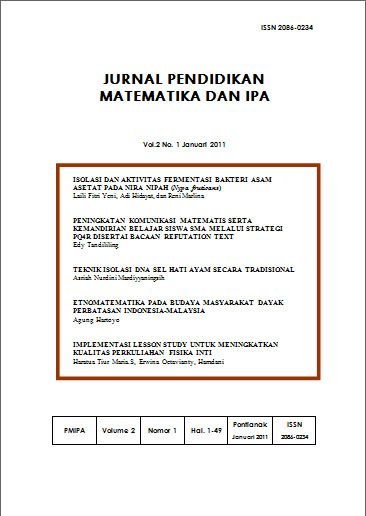
Peningkatan Komunikasi Matematis Serta Kemandirian BelajarSiswa SMA Melalui Strategi PQ4R Disertai Bacaan Refutation Text
DOI:
https://doi.org/10.26418/jpmipa.v2i1.2174Abstract
This study is experiment research with control group pre test- post test design and aimed to examine the influence of PQ4R strategy and Refutation Text, school level, and student’s mathematical prior knowledge toward achievement and enhancement of student’s mathematical communication ability and Self Regulated Learning. Subject of study as much as 241 students of class X from three Public Senior High Schools from high, medium and low school level. Research instrument consist of one set of student’s mathematical communication, and one set of student’s Self Regulated Learning scale. Data analysis use Kosmogorov-Smirnov Test (Tes-Z), Test Leven, Test-t, ANOVA one-way and two-way, Post Hoc Test (Scheffe) and also Chi-Square Test. The study found that learning with PR4R strategy accompanied by Refutation Text Reading give consistent influence compared with conventional learning influence whether is viewed as a whole, based on school level as well as mathematical initial knowledge. In addition, the study also found: (1) there is no interaction between learning (PQ4R) accompanied by Refutation Text reading and conventional) and school level toward (a) student’s mathematical communication and (b) student’s Self Regulated Learning; (2) there is no significant interaction between learning and student’s mathematical prior knowledge toward (a) student’s mathematical communication ability and (b) student’s Self Regulated Learning; and (3) there is association between student’s mathematical communication ability and student’s Self Regulated Learning.
Keywords : PQ4R, refutation text, mathematical communication, self regulated learning
Downloads
Published
Issue
Section
License
Authors who publish with this journal agree to the following terms:
- Authors retain copyright and grant the journal right of first publication with the work simultaneously licensed under a Creative Commons Attribution 4.0 International License that allows others to share the work with an acknowledgement of the work's authorship and initial publication in this journal.
- Authors are able to enter into separate, additional contractual arrangements for the non-exclusive distribution of the journal's published version of the work (e.g., post it to an institutional repository or publish it in a book), with an acknowledgement of its initial publication in this journal.
- Authors are permitted and encouraged to post their work online (e.g., in institutional repositories or on their website) prior to and during the submission process, as it can lead to productive exchanges, as well as earlier and greater citation of published work (See The Effect of Open Access).

This work is licensed under a Creative Commons Attribution 4.0 International License
