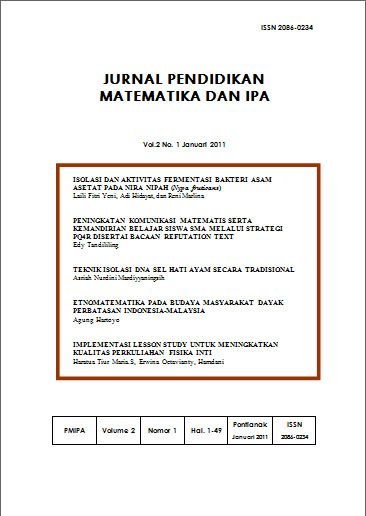
Teknik Isolasi DNA Sel Hati Ayam Secara Tradisional
DOI:
https://doi.org/10.26418/jpmipa.v2i1.2175Abstract
Perkembangan biomolekuler yang cepat menyebabkan pemahaman mengenai konsep DNA perlu ditanamkan sejak awal, terutama pada siswa sekolah menengah. Konsep DNA dapat diajarkan melalui teknik isolasi DNA secara tradisional. Teknik ini dapat dilakukan dengan menggunakan peralatan dan bahan sederhana dan tanpa protokol yang rumit. Tujuan praktek ini adalah menggunakan teknik isolasi DNA secara tradisional dengan menggunakan bahan isolasi DNA berupa hati ayam yang mudah diperoleh, dan enzim protease yang diperoleh dari ektraksi mandiri sel daun pepaya. Pada akhir proses isolasi diperoleh DNA, namun DNA yang didapatkan merupakan gabungan antara DNA hati ayam dan DNA sel daun pepaya. Kesimpulan dari praktek ini adalah teknik isolasi DNA tradisional dapat dilakukan untuk mengisolasi DNA dari sel hati ayam meskipun tidak dapat dibuktikan secara meyakinkan bahwa DNA yang diisolasi itu murni hanya berasal dari DNA inti sel hati ayam.
Kata kunci : teknik isolasi, dna, hati ayam, tradisional
Downloads
Published
Issue
Section
License
Authors who publish with this journal agree to the following terms:
- Authors retain copyright and grant the journal right of first publication with the work simultaneously licensed under a Creative Commons Attribution 4.0 International License that allows others to share the work with an acknowledgement of the work's authorship and initial publication in this journal.
- Authors are able to enter into separate, additional contractual arrangements for the non-exclusive distribution of the journal's published version of the work (e.g., post it to an institutional repository or publish it in a book), with an acknowledgement of its initial publication in this journal.
- Authors are permitted and encouraged to post their work online (e.g., in institutional repositories or on their website) prior to and during the submission process, as it can lead to productive exchanges, as well as earlier and greater citation of published work (See The Effect of Open Access).

This work is licensed under a Creative Commons Attribution 4.0 International License
