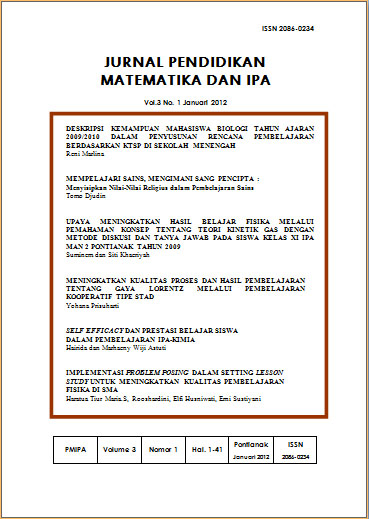
Meningkatkan Kualitas Proses dan Hasil Pembelajaran Tentang Gaya Lorentz Melalui Pembelajaran Kooperatif Tipe STAD
DOI:
https://doi.org/10.26418/jpmipa.v3i1.2205Abstract
Tujuan penelitian tindakan kelas ini untuk meningkatkan kualitas proses dan hasil belajar siswa tentang Gaya Lorentz melalui pembelajaran kooperatif tipe STAD. di SMAN 3 Pontianak terhadap 40 siswa kelas XII IPA. Penelitian berlangsung dalam 3 siklus. Sasaran penelitian difokuskan pada pemahaman konsep dan pemecahan masalah Gaya Lorentz. Tingkat keberhasilan tercapai apabila minimal 70% siswa memperoleh nilai di atas 65.Pengumpulan data dilakukan dengan melakukan pretest dan postest pada akhir siklus. Test pemahaman konsep dan pemecahan masalah dilakukan dalam bentuk uraian terstruktur, Hasil penelitian menunjukkan peningkatan kualitas pembelajaran siswa dalam pemahaman konsep dan kemampuan memecahkan masalah.Dari hasil analisis terjadi kenaikan nilai yang sangat signifikan pada tiap siklus. Berarti melalui pembelajaran kooperatif, kualitas proses dan hasil belajar menjadi lebih baik, karena siswa menjadi lebih aktif untuk mengikuti kegiatan pembelajaran
Kata kunci: kualitas proses dan hasil, pembelajaran kooperatif tipe STAD
Downloads
Published
Issue
Section
License
Authors who publish with this journal agree to the following terms:
- Authors retain copyright and grant the journal right of first publication with the work simultaneously licensed under a Creative Commons Attribution 4.0 International License that allows others to share the work with an acknowledgement of the work's authorship and initial publication in this journal.
- Authors are able to enter into separate, additional contractual arrangements for the non-exclusive distribution of the journal's published version of the work (e.g., post it to an institutional repository or publish it in a book), with an acknowledgement of its initial publication in this journal.
- Authors are permitted and encouraged to post their work online (e.g., in institutional repositories or on their website) prior to and during the submission process, as it can lead to productive exchanges, as well as earlier and greater citation of published work (See The Effect of Open Access).

This work is licensed under a Creative Commons Attribution 4.0 International License
