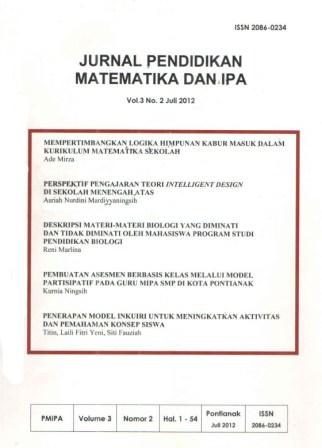
Mempertimbangkan Logika Himpunan Kabur Masuk Dalam Kurikulum Matematika Sekolah
DOI:
https://doi.org/10.26418/jpmipa.v3i2.23760Keywords:
logika, himpunan, tegas, kaburAbstract
Logika klasik/tradisional atau logika tegas yang dipelajari selama ini di sekolah dan di awal masuk universitas, mempunyai nilai kebenaran yang dibagi secara dikotomi (benar/ya atau salah/tidak). Logika tegas ini ternyata belum mencakup fenomena sehari-hari dan alam pikiran manusia. Banyak hal yang menjadi tidak wajar bila dinilai dengan kebenaran yang bersifat dikotomi tersebut. Karena, pada kenyataannya fenomena kehidupan cenderung lebih banyak yang bersifat kontinum, sehingga batas yang tegas menjadi sesuatu yang tidak jelas. Logika himpunan kabur merupakan konsep dasar untuk teori kabur (fuzzy theory) yang hadir untuk melengkapi/menyempurnakan logika klasik. Tulisan ini memberikan beberapa teori dasar sistem kabur dan gagasan mengenai perlunya logika himpunan kabur dimasukkan dalam Kurikulum Matematika sekolah.References
Dubois. D., and Prade. H. (1980). Fuzzy: Sets and Systems: Theory and Applications. London: Academic Press. Inc.
Jang, J.S. Roger, et.al. (1997). Neuro Fuzzy and Soft Computing, New Jersey: Prentice Hall.
Downloads
Published
2012-07-26
Issue
Section
Articles
License
Authors who publish with this journal agree to the following terms:
- Authors retain copyright and grant the journal right of first publication with the work simultaneously licensed under a Creative Commons Attribution 4.0 International License that allows others to share the work with an acknowledgement of the work's authorship and initial publication in this journal.
- Authors are able to enter into separate, additional contractual arrangements for the non-exclusive distribution of the journal's published version of the work (e.g., post it to an institutional repository or publish it in a book), with an acknowledgement of its initial publication in this journal.
- Authors are permitted and encouraged to post their work online (e.g., in institutional repositories or on their website) prior to and during the submission process, as it can lead to productive exchanges, as well as earlier and greater citation of published work (See The Effect of Open Access).

This work is licensed under a Creative Commons Attribution 4.0 International License
