Perspektif Pengajaran Teori Intelligent Design di Sekolah Menengah Atas
DOI:
https://doi.org/10.26418/jpmipa.v3i2.4411Abstract
Teori Intelligent Design (ID) merupakan teori tantangan terhadap teori evolusi yang diperkenalkan pada tingkat sekolah menengah. Tulisan ini mengkritisi mengenai perlunya perspektif pengajaran teori ID yang tepat sehingga mencegah pemberian pesan pembelajaran sains yang keliru, pada tiga ranah yaitu perbedaan fundamental antara teori ID dan evolusi, adanya proporsi pengajaran teori ID yang mendominasi arah penjelasan evolusi dan adanya intervensi agama dalam mendukung pembuktian sains dalam evolusi. Tulisan ini juga mengajukan pola pembelajaran yang menekankan pada kemampuan berpikir kritis dan debat sebagai solusi cara pengajaran teori ID di SMA. Pada akhirnya, dapat disimpulkan bahwa teori ID dapat diajarkan di sekolah dengan membatasi pada paparan saintifik terkait bukti-bukti ilmiah dan menghindari bukti teologis serta dengan mengedepankan kemampuan berpikir kritis dalam menganalisis bukti-bukti saintifik dalam kaitan menerima teori ID atau sebaliknya mempertahankan teori evolusi.
Keyword: Intelligent Design, teori evolusi, perbedaan fundamental, proporsi pengajaran, agama, berpikir kritis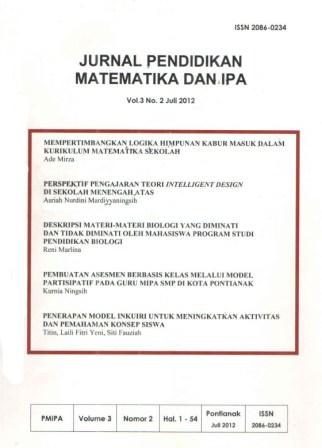
Downloads
Published
Issue
Section
License
Authors who publish with this journal agree to the following terms:
- Authors retain copyright and grant the journal right of first publication with the work simultaneously licensed under a Creative Commons Attribution 4.0 International License that allows others to share the work with an acknowledgement of the work's authorship and initial publication in this journal.
- Authors are able to enter into separate, additional contractual arrangements for the non-exclusive distribution of the journal's published version of the work (e.g., post it to an institutional repository or publish it in a book), with an acknowledgement of its initial publication in this journal.
- Authors are permitted and encouraged to post their work online (e.g., in institutional repositories or on their website) prior to and during the submission process, as it can lead to productive exchanges, as well as earlier and greater citation of published work (See The Effect of Open Access).

This work is licensed under a Creative Commons Attribution 4.0 International License
