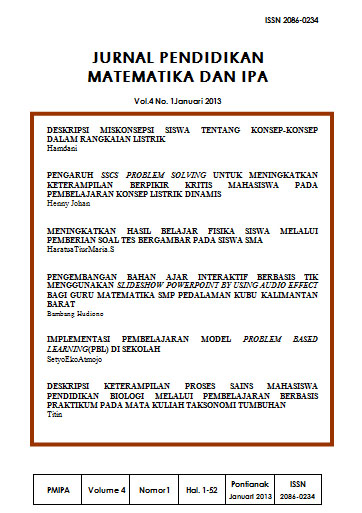
PENGARUH SSCS PROBLEM SOLVING UNTUK MENINGKATKAN KETERAMPILAN BERPIKIR KRITIS MAHASISWA PADA PEMBELAJARAN KONSEP LISTRIK DINAMIS
DOI:
https://doi.org/10.26418/jpmipa.v4i1.6202Abstract
Penelitian dilakukan dengan tujuan untuk memperoleh gambaran mengenai model sscs problem solving untuk meningkatkan kemampuan mahasiswa dalam merumuskan dan memilih criteria pemecahan masalah pada konsep listrik dinamis. Penelitian ini menggunakan metodekuasieksperimendengandesain"The randomized Pretest-Posttest control group design" yang dilaksanakan di semester dua prodi pendidikan fisika fakultas KIP Universitas Bengkulu. Pengumpulan data dilakukan dengan menggunakan tes awal dan tes akhir. Berdasarkan hasil analisis data diperoleh rata-rata N-gain berpikir kritis kelas eksperimen 0,49 dan rata-rata N-gain berpikir kritis kelas kontrol 0.24. N-gain paling tinggi pada indicator berpikir kritis strategi logis yaitu 0.6. N-gain indicator berpikir kritis membuat kesimpulan 0,44 dan N-gain indicator berpikir kritis menerapkan prinsip sebesar 0,42. Hasil analisis menunjukkan bahwa terdapat peningkatan signifikan keterampilan berpikir kritis mahasiswa pada pembelajaran konsep listrik dinamis di kelas eksperimen yang menggunakan model sscs problem solving.
Kata Kunci: model search, solve, create and share (sscs)problem solving, berpikirkritis, listrikdinamis
Downloads
Published
Issue
Section
License
Authors who publish with this journal agree to the following terms:
- Authors retain copyright and grant the journal right of first publication with the work simultaneously licensed under a Creative Commons Attribution 4.0 International License that allows others to share the work with an acknowledgement of the work's authorship and initial publication in this journal.
- Authors are able to enter into separate, additional contractual arrangements for the non-exclusive distribution of the journal's published version of the work (e.g., post it to an institutional repository or publish it in a book), with an acknowledgement of its initial publication in this journal.
- Authors are permitted and encouraged to post their work online (e.g., in institutional repositories or on their website) prior to and during the submission process, as it can lead to productive exchanges, as well as earlier and greater citation of published work (See The Effect of Open Access).

This work is licensed under a Creative Commons Attribution 4.0 International License
