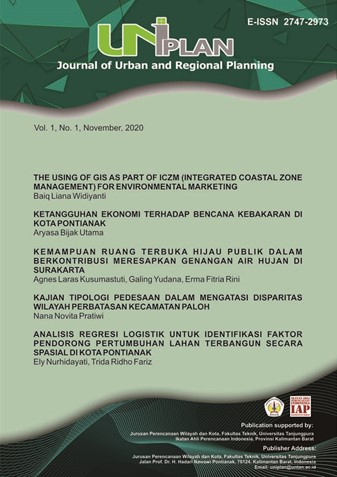
The Using of GIS as Part of ICZM (Integrated Coastal Zone Management) for Environmental Marketing
DOI:
https://doi.org/10.26418/uniplan.v1i1.43034Keywords:
Coastal, Environmental, GIS, ICZM, MarketingAbstract
Coastal areas are very complex areas, both in terms of the physical environment and socially humanity. This study aims to provide recommendations in theoretical spatial planning in coastal areas based on the ideality level in the concept of sustainable development by using geographic information systems (GIS). This research is a literature study by using data in the form of journals and books that discuss themes related to this. The results of the study are diagrams / schemes which are theoretical conceptual models regarding the handling of problems that occur in coastal areas and how spatial planning in the region should be.References
Aryanto, R., & Mardjuka, M. Y. (2005). Valuasi Ekonomi dengan Travel Cost Method pada Obyek Ekowisata
Pesisir. Jurnal Ilmiah Pariwisata, 10(1), 58–76.
Barbier, E. B. (2012). Progress and challenges in valuing coastal and marine ecosystem services. Review of
Environmental Economics and Policy, 6(1), 1–19.
Barbier, E. B., Hacker, S. D., Kennedy, C., Koch, E. W., Stier, A. C., & Silliman, B. R. (2011). The value of
estuarine and coastal ecosystem services. Ecological Monographs, 81(2), 169–193.
Blamey, R. K. (2001). Principles of ecotourism. The Encyclopedia of Ecotourism, 2001, 5–22.
Bonham-Carter, G. F. (2014). Geographic information systems for geoscientists: modelling with GIS (Vol.
. Elsevier.
Brown, K., & Tompkins, E. L. (2012). Making waves: integrating coastal conservation and development.
Routledge.
Brown, S., Nicholls, R. J., Hanson, S., Brundrit, G., Dearing, J. A., Dickson, M. E., … Hinkel, J. (2014). Shifting
perspectives on coastal impacts and adaptation. Nature Climate Change, 4(9), 752.
Carter, R. W. G. (2013). Coastal environments: an introduction to the physical, ecological, and cultural
systems of coastlines. Elsevier.
Cheong, S.-M., Silliman, B., Wong, P. P., Van Wesenbeeck, B., Kim, C.-K., & Guannel, G. (2013). Coastal
adaptation with ecological engineering. Nature Climate Change, 3(9), 787–791.
Choy, D. L., & Heilbron, M. (1997). Eco-tourism Planning: Lessons from South East Queensland Experience.
Planning Sustainable Tourism in Balancing Tourism and Natural Resources in Economic Development, 168–178.
Clark, J. R. (2018). Coastal zone management handbook. CRC press.
Davidson-Arnott, R., Bauer, B., & Houser, C. (2019). Introduction to coastal processes and geomorphology.
Cambridge University Press.
Diedrich, A., Tintoré, J., & Navinés, F. (2010). Balancing science and society through establishing indicators
for integrated coastal zone management in the Balearic Islands. Marine Policy, 34(4), 772–781.
Esaki, K. (2013). Prediction models for total customer satisfaction based on the ISO/IEC9126 System quality
model. American Journal of Operations Research, 3(04), 393.
Fennell, D. A. (2007). Ecotourism. Routledge.
Fotheringham, S., & Rogerson, P. (2013). Spatial analysis and GIS. CRC Press.
Garmendia, E., Gamboa, G., Franco, J., Garmendia, J. M., Liria, P., & Olazabal, M. (2010). Social multi-criteria
evaluation as a decision support tool for integrated coastal zone management. Ocean & Coastal
Management, 53(7), 385–403.
Hopkins, T. S., Bailly, D., & Støttrup, J. G. (2011). A systems approach framework for coastal zones. Ecology
and Society, 16(4).
Katrandjiev, H. (2016). Ecological marketing, green marketing, sustainable marketing: synonyms оr аn
evolution оf ideas. Economic Alternatives, 1(7), 71–82.
Kerski, J. J., Demirci, A., & Milson, A. J. (2013). The global landscape of GIS in secondary education. Journal
of Geography, 112(6), 232–247.
Kinoti, M. W. (2011). Green marketing intervention strategies and sustainable development: A conceptual
paper. International Journal of Business and Social Science, 2(23).
Klemas, V. (2011). Remote sensing techniques for studying coastal ecosystems: An overview. Journal of
Coastal Research, 27(1), 2–17.
Kotler, P. (2011). Philip Kotler’s contributions to marketing theory and practice. Review of Marketing
Research: Special Issue–Marketing Legends, 8, 87–120.
Kotler, P. (2012). Kotler on marketing. Simon and Schuster.
Kremer, J. N., & Nixon, S. W. (2012). A coastal marine ecosystem: simulation and analysis (Vol. 24). Springer
Science & Business Media.
Kron, W. (2013). Coasts: the high-risk areas of the world. Natural Hazards, 66(3), 1363–1382.
Kumar, T. S., Mahendra, R. S., Nayak, S., Radhakrishnan, K., & Sahu, K. C. (2010). Coastal vulnerability
assessment for Orissa State, east coast of India. Journal of Coastal Research, 523–534.
Litvin, S. W. (1996). Ecotourism: A study of purchase proclivity. Journal of Vacation Marketing, 3(1), 43–54.
Mason, P. (2015). Tourism impacts, planning and management. Routledge.
Mineur, F., Cook, E. J., Minchin, D., Bohn, K., MacLeod, A., & Maggs, C. A. (2012). Changing coasts: Marine
aliens and arti cial structures. In Oceanography and marine biology (pp. 198–243). CRC Press.
O’riordan, T. (2014). Environmental science for environmental management. Routledge.
Ottman, J. (2017). The new rules of green marketing: Strategies, tools, and inspiration for sustainable
branding. Routledge.
Peattie, K. (2016). Green marketing. In The marketing book (pp. 595–619). Routledge.
Polasky, S., Carpenter, S. R., Folke, C., & Keeler, B. (2011). Decision-making under great uncertainty:
environmental management in an era of global change. Trends in Ecology & Evolution, 26(8), 398–404.
Raymond, C. M., Fazey, I., Reed, M. S., Stringer, L. C., Robinson, G. M., & Evely, A. C. (2010). Integrating local
and scientific knowledge for environmental management. Journal of Environmental Management,
(8), 1766–1777.
Scherr, S. J., & Gregg, R. J. (2005). Johannesburg and beyond: the 2002 World Summit on Sustainable
Development and the rise of partnership. Geo. Int’l Envtl. L. Rev., 18, 425.
Singh, J., & Kaur, G. (2011). Customer satisfaction and universal banks: an empirical study. International
Journal of Commerce and Management.
Wheatley, D., & Gillings, M. (2013). Spatial technology and archaeology: the archaeological applications of
GIS. CRC Press.
Downloads
Published
Issue
Section
License
Authors who publish with "UNIPLAN: Journal of Urban and Regional Planning" agree to the following terms:- Authors transfer the copyright and grant the journal right of first publication with the work simultaneously licensed under a Creative Commons Attribution-ShareAlike 4.0 International License.. that allows others to share the work with an acknowledgment of the work's authorship and initial publication in this journal.
- Authors are able to enter into separate, additional contractual arrangements for the non-exclusive distribution of the journal's published version of the work (e.g., post it to an institutional repository or publish it in a book), with an acknowledgment of its initial publication in this journal.
- Authors are permitted and encouraged to post their work online (e.g., in institutional repositories or on their website) prior to and during the submission process, as it can lead to productive exchanges, as well as earlier and greater citation of published work (See The Effect of Open Access)
