
PENGARUH 3-AMINOPROPYLTRIETHOXYSILANE TERHADAP SIFAT DAN MORFOLOGI KOMPOSIT KARET ALAM-SELULOSA TANDAN KOSONG KELAPA SAWIT
Abstract
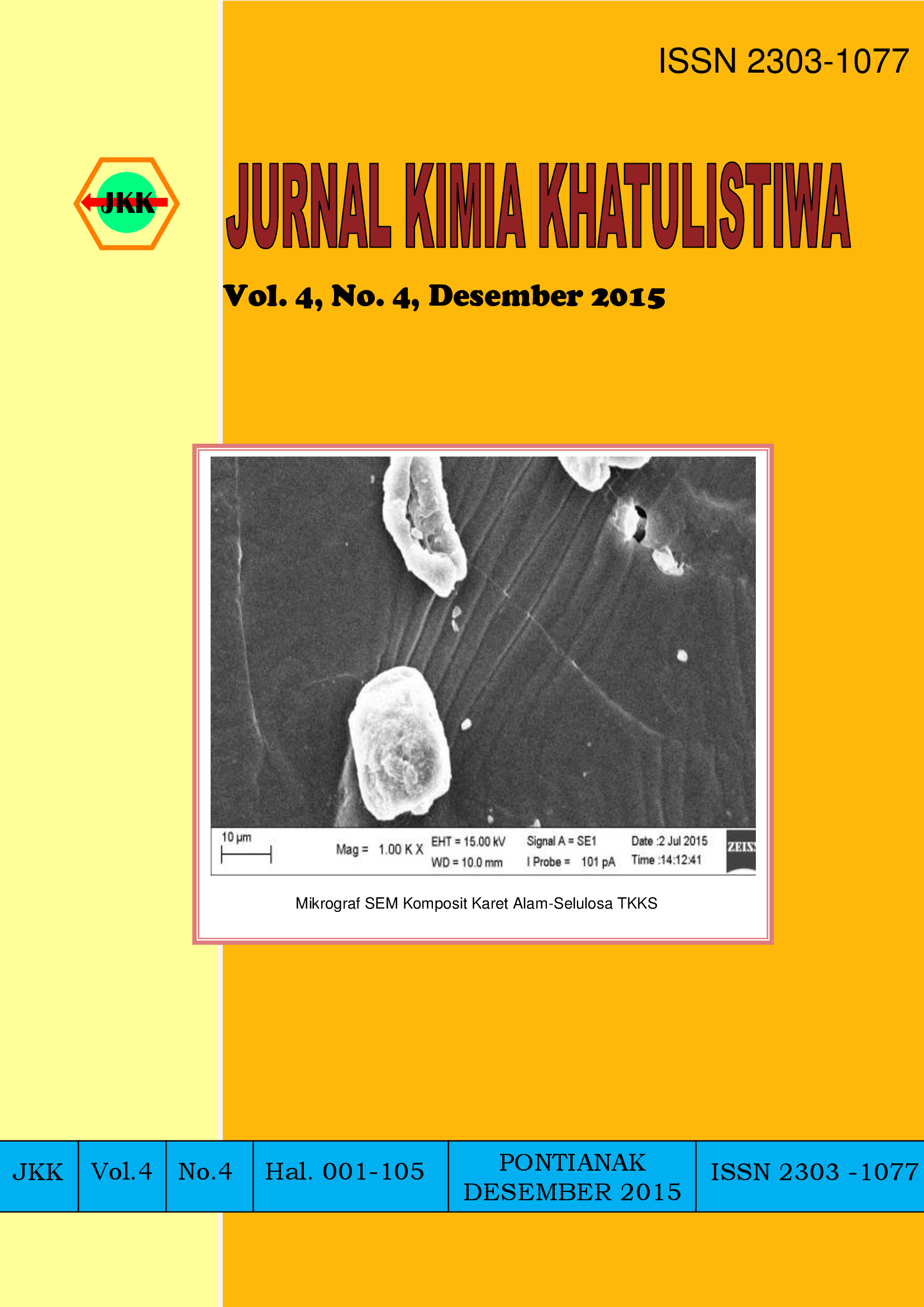
Penelitian ini bertujuan untuk mengetahui pengaruh 3-APTES (3-aminopropyltriethoxysilane) terhadap sifat dan morfologi komposit karet alam berpengisi selulosa dari tandan kosong kelapa sawit (TKKS). Variasi volume 3-APTES yang ditambahkan yaitu 0%, 2%, 3%, 4% dan 5%. Standar uji yang digunakan pada uji tarik komposit adalah ISO 37 tipe 2 serta ISO 289-1 untuk uji viskositas mooney. Berdasarkan hasil uji tarik, komposit dengan penambahan 3-APTES cenderung mengalami peningkatan kekuatan tarik, modulus elastisitas dan perpanjangan putus pada volume 5% 3-APTES. Nilai kekuatan tarik, modulus elastisitas dan perpanjangan putus sebesar 26,25 105 N/m2; 6,14 105 N/m2 dan 328%. Nilai viskositas mooney pada komposit sebelum dan setelah penambahan 3-APTES belum memenuhi standar ISO 289 sebesar 60-70 ML(1+4)100OC. Morfologi komposit berdasarkan hasil SEM menunjukkan bahwa penambahan 3-APTES menunjukkan kecenderungan kompatibilitas yang semakin baik antara filler dan matriks seiring meningkatnya kadar 3-APTES.
Kata kunci: karet alam, komposit, selulosa TKKS, 3-APTES
Published
Issue
Section
License
Authors who publish with this journal agree to the following terms:
- Authors retain copyright and grant the journal right of first publication with the work simultaneously licensed under a Creative Commons Attribution License that allows others to share the work with an acknowledgement of the work's authorship and initial publication in this journal.
- Authors are able to enter into separate, additional contractual arrangements for the non-exclusive distribution of the journal's published version of the work (e.g., post it to an institutional repository or publish it in a book), with an acknowledgement of its initial publication in this journal.
- Authors are permitted and encouraged to post their work online (e.g., in institutional repositories or on their website) prior to and during the submission process, as it can lead to productive exchanges, as well as earlier and greater citation of published work (See The Effect of Open Access).
