
AKTIVITAS ANTIBAKTERI GRAM POSITIF DAN NEGATIF DARI EKSTRAK DAN FRAKSI DAUN NIPAH (Nypa fruticans Wurmb.) ASAL PESISIR SUNGAI KAKAP KALIMANTAN BARAT
Abstract
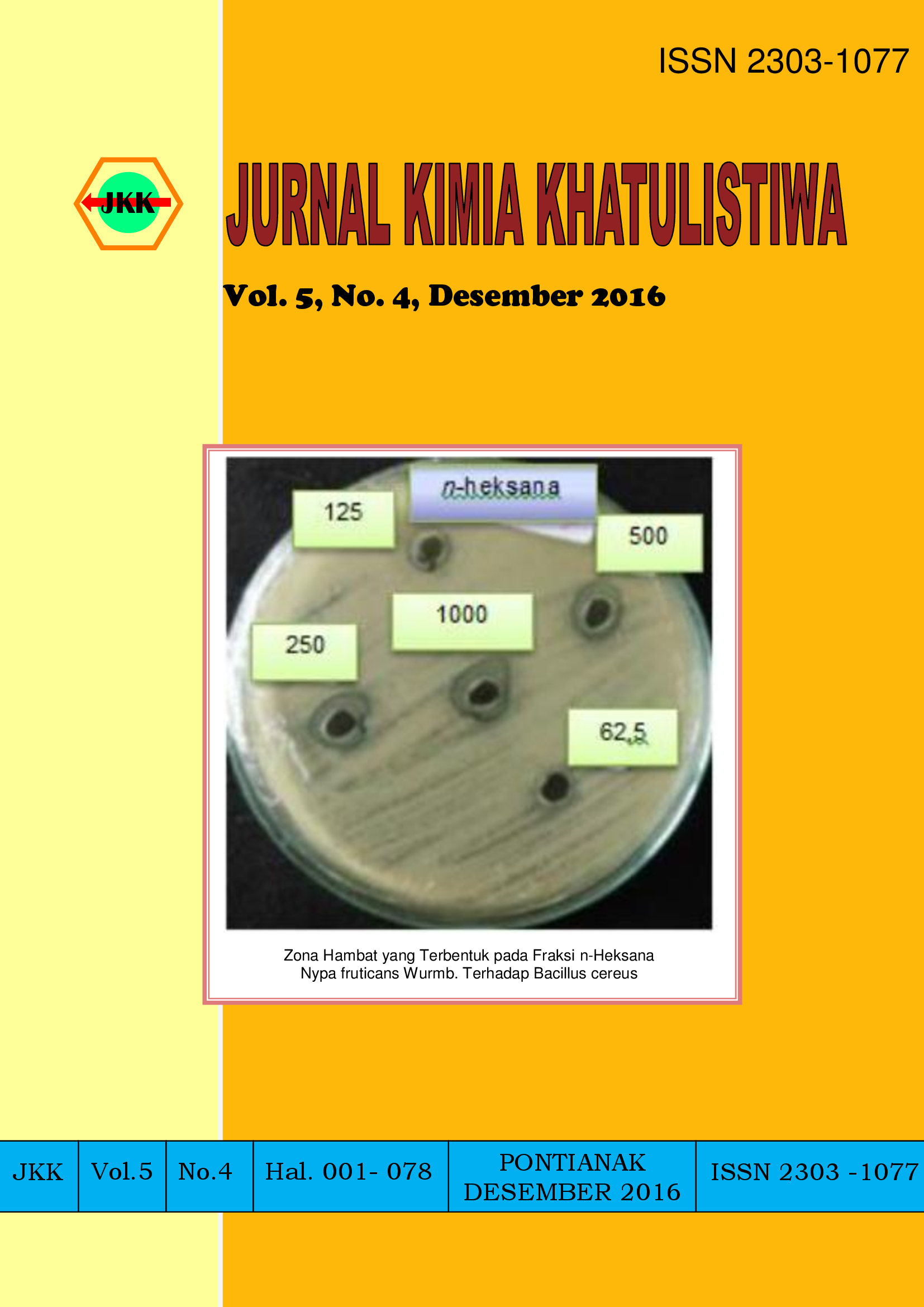
Secara empiris Nipah (Nypa fruticans Wurmb.) telah digunakan sebagai obat sakit gigi, sariawan dan diare. Aktivitas farmakologi Nipah tersebut berkaitan dengan kandungan senyawa metabolit sekunder Nipah. Penelitian ini bertujuan untuk mengetahui senyawa metabolit sekunder yang terkandung dalam ekstrak dan fraksi daun Nipah, serta aktivitas antibakteri Eschericia coli dan Bacillus cereus. Kandungan metabolit sekunder daun Nipah diketahui dari uji fitokimia. Ekstrak dan fraksi metanol, etil asetat dan n-heksana menunjukkan aktivitas antibakteri pada bakteri E. coli dan B. cereus dengan metode difusi sumuran (Well). Hasil uji fitokimia menunjukkan bahwa ekstrak metanol daun Nipah mengandung senyawa golongan polifenol, flavonoid, triterpenoid/ steroid, saponin dan alkaloid; fraksi metanol mengandung polifenol, flavonoid, saponin dan alkaloid; fraksi etil asetat dan fraksi n-heksana mengandung triterpenoid/ steroid. Aktivitas antibakteri E. coli oleh fraksi etil asetat ditunjukkan dari diameter zona hambat (dalam satuan mm) berdasarkan variasi konsentrasi etil asetat yang digunakan adalah sebagai berikut 9,387 (1000 ppm); 8,275 (500 ppm); 8,487 (250 ppm); 6,662 (125 ppm); 7,462 mm (62,5 ppm); dari fraksi n-heksana sebesar 9,012 (1000 ppm); 8,825 (500 ppm); 8,512 (250 ppm). Diameter zona hambat yang menunjukkan aktivitas antibakteri B. cereus oleh variasi konsentrasi fraksi etil asetat sebesar 9,512 (1000 ppm); 8,075 (500 ppm); 7,875 (250 ppm); dari fraksi n-heksana sebesar 11,250 (1000 ppm); 10,650 (500 ppm); 9,487 (250 ppm); 8,625 (125 ppm). Berdasarkan hasil penelitian, diketahui bahwa fraksi etil asetat dan n-heksana daun Nipah dengan konsentrasi 1000 ppm dapat menghambat bakteri B. cereus.
Kata kunci: aktivitas antibakteri, metabolit sekunder, Nypa fruticans Wurmb, E. coli, B. cereus
Published
Issue
Section
License
Authors who publish with this journal agree to the following terms:
- Authors retain copyright and grant the journal right of first publication with the work simultaneously licensed under a Creative Commons Attribution License that allows others to share the work with an acknowledgement of the work's authorship and initial publication in this journal.
- Authors are able to enter into separate, additional contractual arrangements for the non-exclusive distribution of the journal's published version of the work (e.g., post it to an institutional repository or publish it in a book), with an acknowledgement of its initial publication in this journal.
- Authors are permitted and encouraged to post their work online (e.g., in institutional repositories or on their website) prior to and during the submission process, as it can lead to productive exchanges, as well as earlier and greater citation of published work (See The Effect of Open Access).
