
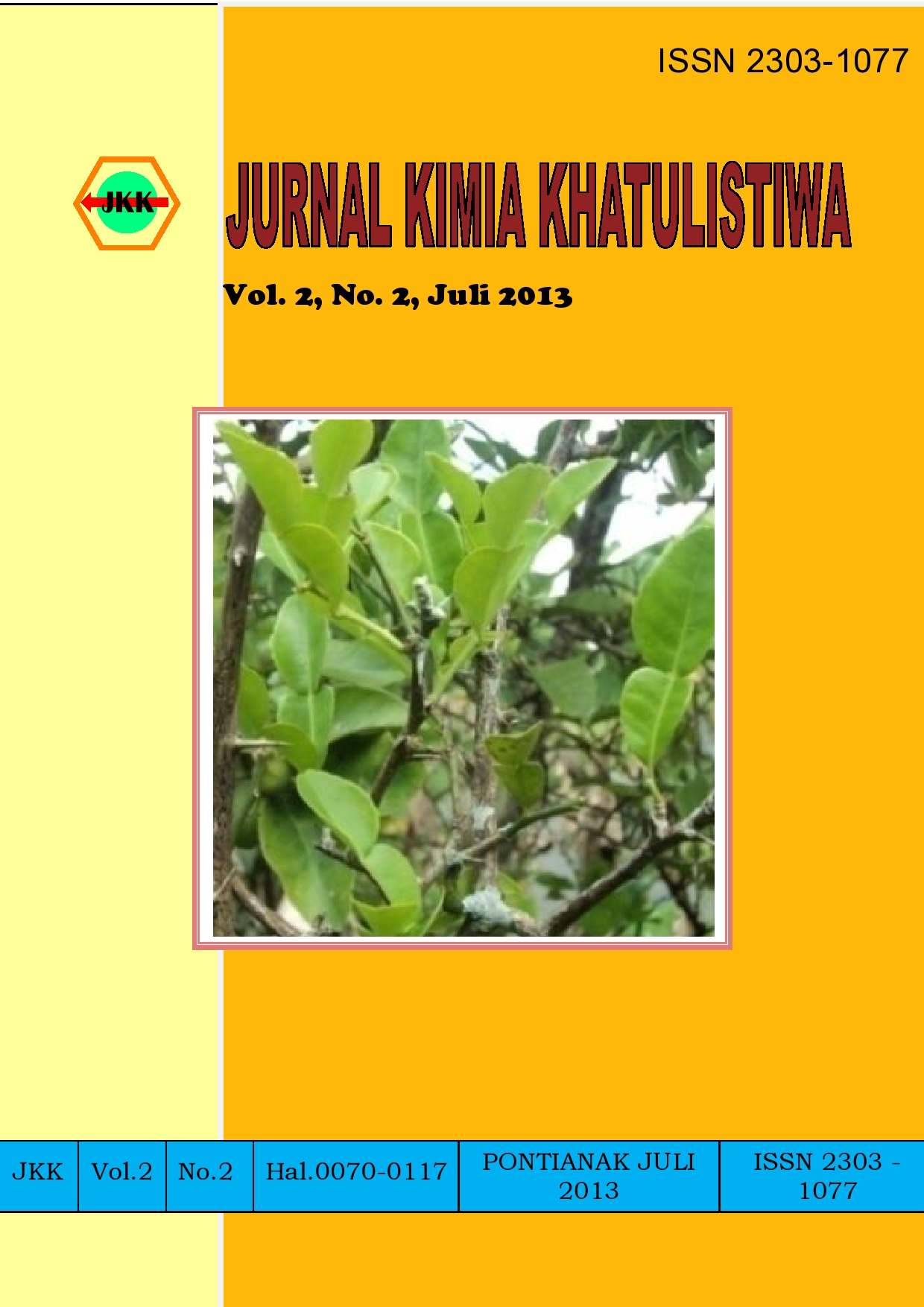
PENGARUH VARIASI WAKTU DAN UKURAN SAMPEL TERHADAP KOMPONEN MINYAK ATSIRI DARI DAUN JERUK PURUT(Citrus hystrix DC.)
Abstract
Daun jeruk purut berpotensi sebagai penghasil minyak atsiri. Salah satu metode untuk mendapatkan minyak atsiri yaitu menggunakan destilasi uap. Tujuan penelitian ini untuk mengetahui pengaruh variasi waktu dan ukuran sampel terhadap komponen senyawa minyak atsiri terkandung dalam daun jeruk purut asal Terentang dengan menggunakan metode detilasi uap. Ukuran sampel daun jeruk purut segar dalam keadaan utuh dan rajang, kemudian didestilasi selama 4 dan 8 jam dengan menggunakan metode destilasi uap. Randemen minyak atsiri daun jeruk purut yang tertinggi yaitu pada daun utuh selama 4 jam sebesar 0,88095%. Hasil uji statistik dengan ANAVA satu jalan dengan tingkat signifikan 0,05 dan dilanjutkan uji BNT (Beda Nyata Terkecil) diperoleh daun utuh 4 jam berbeda nyata terhadap daun utuh 8 jam, daun rajang 4 jam dan daun rajang 8 jam. Hasil dari analisis GC-MS menunjukkan kandungan senyawa pada daun utuh 4 jam yaitu sitronelal 39,65%, β-sitronelol 3,72%, isopulegol 3,47% dan geranil asetat 3,38%.
Kata kunci : Citrus hystrix, sitronelal, minyak atsiri, destilasi uap
Published
Issue
Section
License
Authors who publish with this journal agree to the following terms:
- Authors retain copyright and grant the journal right of first publication with the work simultaneously licensed under a Creative Commons Attribution License that allows others to share the work with an acknowledgement of the work's authorship and initial publication in this journal.
- Authors are able to enter into separate, additional contractual arrangements for the non-exclusive distribution of the journal's published version of the work (e.g., post it to an institutional repository or publish it in a book), with an acknowledgement of its initial publication in this journal.
- Authors are permitted and encouraged to post their work online (e.g., in institutional repositories or on their website) prior to and during the submission process, as it can lead to productive exchanges, as well as earlier and greater citation of published work (See The Effect of Open Access).
