
ACTIVATED CARBON PREPARATION FROM COCONUT LEAVES, FOR IRON(II) ADSORBENT IN SOLUTION
Abstract
Coconut leaves have a high cellulose content of 67.22%, so they have thepotential to be made into activated carbon. Activated carbon is made throughcarbonization at 425 °C for 2 hours and activated with H2SO4 for 24 hours withconcentrations of 0.5 M; 1.0 M and 1.5 M. The addition of H2SO4 in the activationstage caused an increase in the surface area of active charcoal from 10.1707 m2/g to 24.8988 m2/g; 81.5102 m2/g and 113.422 m2/g of active charcoal with H2SO4 concentrations of 0.5 M, 1.0 M, and 1.5 M respectively based on GSA analysis. The resulting activated charcoal was used for the absorption of iron(II) ions in solution, the quality of activated charcoal 1.5 M H2SO4 tested based on SNI No. 06-3730-19195 showed moisture content, ash content and iodine absorption respectively1.2689%, 8.12% and 867.1458 mg/g meet the quality standards of activatedcharcoal. The activated charcoal was used in the adsorption of iron(II) ions in aqueous solution, where the best adsorption conditions were pH 5 and contact time 120 min. Analysis of adsorption isotherms showed that the mechanism of iron(II) ion absorption tends to follow the Langmuir equation rather than Freundlich and BET. Based on the Langmuir equation, the maximum adsorption of iron(II) ions using coconut stick activated charcoal adsorbent was 9.479 mg/g.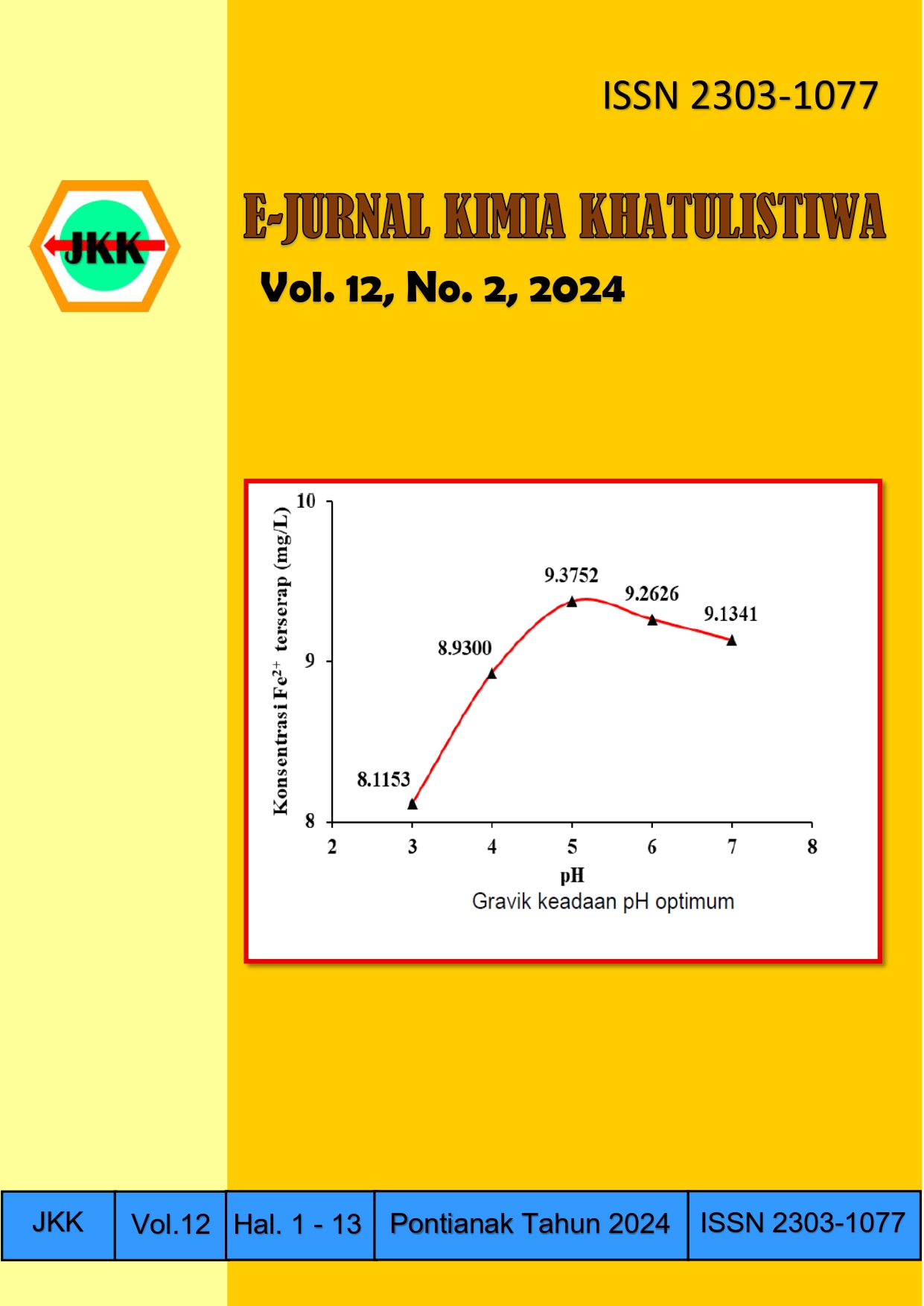
Downloads
Published
2026-04-06
Issue
Section
Articles
License
Copyright (c) 2026 Jurnal Kimia Khatulistiwa

This work is licensed under a Creative Commons Attribution-ShareAlike 4.0 International License.
Authors who publish with this journal agree to the following terms:
- Authors retain copyright and grant the journal right of first publication with the work simultaneously licensed under a Creative Commons Attribution License that allows others to share the work with an acknowledgement of the work's authorship and initial publication in this journal.
- Authors are able to enter into separate, additional contractual arrangements for the non-exclusive distribution of the journal's published version of the work (e.g., post it to an institutional repository or publish it in a book), with an acknowledgement of its initial publication in this journal.
- Authors are permitted and encouraged to post their work online (e.g., in institutional repositories or on their website) prior to and during the submission process, as it can lead to productive exchanges, as well as earlier and greater citation of published work (See The Effect of Open Access).
