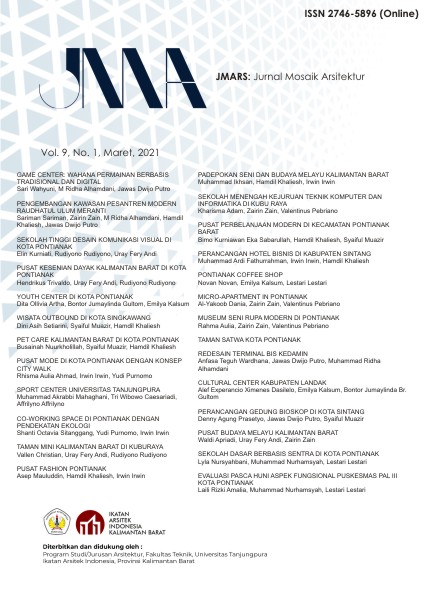
YOUTH CENTER DI KOTA PONTIANAK
DOI:
https://doi.org/10.26418/jmars.v9i1.44614Keywords:
Youth, Youth Character, Youth CenterAbstract
Adolescence is a period of development from children to adults. Adolescents have various characteristics in their development. Lack of facilities and guidance for adolescents causes juvenile delinquency behavior, while adolescence is a very important period because of the process of forming individual characters. Youth need a place that can nurture and develop their potential. Youth-oriented forum, namely the Youth Center. The design of the Youth Center must facilitate the function of the building while taking into account the characteristics of youth in Pontianak City. The design of the Youth Center used a descriptive method, namely the description of literature and theory. The stages in the design method begin with collecting data, then the data is analyzed to form a concept that produces a product in the form of a design image. The design of Youth Centers in Pontianak City has creative, reacreative and educational functions. The design location is at the intersection of A. Yani street and MT. Haryono street with an area of +5,877 m2. The building consists of four floors, the first floor consists of public spaces, the second floor contains a sports area, then on the third floor there is a play area, while the fourth floor consists of educational spaces. The results achieved were building design based on building functions based on the activities and characteristics of youth in Pontianak City.
References
Ahmadi, A., Uhbiyati, N. (2001). Ilmu Pendidikan. Jakarta: PT Rineka Cipta
Argiati, S.H.B. (2008). Perilaku Agresif Ditinjau dari Persepsi Pola Asuh Authoritarian, Asertivitas dan Tahap Perkembangan Remaja Pada Anak Binaan Lembaga Pemasyarakata Anak Kutoarjo, Jawa Tengah, Tesis, tidak diterbitkan, Yogyakarta: Pascasarjana UGM
Bappenas. (2013). Proyeksi Penduduk Indonesia Indonesia Population Projection 2010-2035. Jakarta: Bappenas
BNN Provinsi Kalimantan Barat. (2019, October 16). Data Penyimpangan yang terjadi pada Remaja Kota Pontianak. Retrieved from https://bnn.go.id/dosen-mahasiswa-kalimantan-barat-jadi-penggiat-anti-narkoba/
Gunarsa, S.D. (1982). Dasar dan Teori Perkembangan Anak. Jakarta: BPK Gunung Mulya
Gunarsa, S.D., Gunarsa, Y.S. (2001). Psikologi Praktis: Anak, Remaja dan Keluarga, hlm 77. Jakarta: BPK Gunung Mulia.
Hurlock, E. B. (1990). Psikologi Perkembangan: Suatu Pendekatan Sepanjang Rentang Kehidupan. Jakarta: Erlangga
Jatmika, S. (2010). Genk Remaja, Anak Haram Sejarah ataukah Korban Globalisasi?. hlm. 10-11. Yogyakarta: Kanisius
Kartono, K. (2006). Kenakalan Remaja. Jakarta: Raja Grafindo Persada
Kementerian Pemuda dan Olahraga Republik Indonesia. (1989). Pedoman Penyelenggaraan Gelanggang Remaja. Jakarta: Kementerian Pemuda dan Olahraga Republik Indonesia
Krori, S.D. (2011). Developmental Psycholog, dalam Homeopathic Journal : 4(3)
Lewin, K. (1946). “Behavior and development as a function of the total situationâ€Manual of Child Development L. Carmichael (ed.). New York: John Willey
Media Indonesia. (2018, May 6). Indonesia Diprediksi Jadi Kekuatan Ekonomi Terbesar Keempat pada 2050. Retrieved from https://mediaindonesia.com/ekonomi/159092/indonesia-diprediksi-jadi-kekuatan-ekonomi-terbesar-keempat-pada-2050
Pemerintah Daerah Kota Pontianak. (2013). Peraturan Daerah Kota Pontianak Nomor 2 Tahun tentang Rencana Tata Ruang Wilayah Kota Pontianak Tahun 2013-2033. Pontianak: Pemerintah Daerah Kota Pontianak
Pemerintah Daerah Kota Pontianak. (2018). Peraturan Daerah Kota Pontianak Nomor 3 Tahun 2018 Tentang Perubahan Atas Peraturan Daerah Nomor 12 Tahun 2009 Tentang Penyelenggaraan Pendidikan Di Kota Pontianak. Pontianak: Pemerintah Daerah Kota Pontianak
Sarwono, S.W. (2004). Psikologi Remaja. Jakarta: CV Rajawali
Suwarni, L. (2009). Monitoring Parental dan Perilaku Teman Sebaya Terhadap Perilaku Seksual Remaja SMA Di Kota Pontianak. Jurnal Promosi Kesehatan Indonesia Universitas Diponogoro
Tim Penyusun Kamus Pusat Bahasa. (1991). Kamus Lengkap Bahasa Indonesia, Jakarta: Balai Pustaka
Tim Penyusun Kamus Pusat Bahasa. (2008). Kamus Besar Bahasa Indonesia. Jakarta: Pusat Bahasa
World Health Organization. (1974). World Health Organization. Switzerland: AV. Appia, 1211 Geneva 27
Downloads
Additional Files
Published
Issue
Section
License

This work is licensed under a Creative Commons Attribution 4.0 International License.
You are free to:
- Share "” copy and redistribute the material in any medium or format
- Adapt "” remix, transform, and build upon the material for any purpose, even commercially
Under the following terms:
- Attribution "” You must give appropriate credit, provide a link to the license, and indicate if changes were made. You may do so in any reasonable manner, but not in any way that suggests the licensor endorses you or your use.
- No additional restrictions "” You may not apply legal terms or technological measures that legally restrict others from doing anything the license permits.
Notices:
- You do not have to comply with the license for elements of the material in the public domain or where your use is permitted by an applicable exception or limitation.
- No warranties are given. The license may not give you all of the permissions necessary for your intended use. For example, other rights such as publicity, privacy, or moral rights may limit how you use the material.
