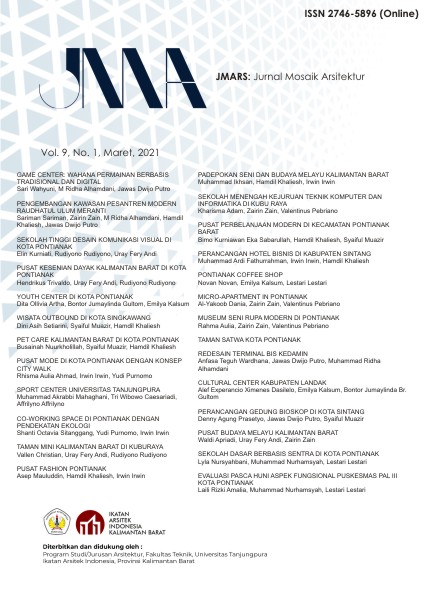
SPORT CENTER UNIVERSITAS TANJUNGPURA
DOI:
https://doi.org/10.26418/jmars.v9i1.44628Keywords:
sport, sport center, modernAbstract
Sports are activity carried out with the aim of getting physical and spiritual health. People of Pontianak, especially academic"™s civitas at Tanjungpura University, often do sports activities. There are various ways to develop sports activities, one of which is providing a container that can accommodate sports activities, such as the "Sport Center of Tanjungpura University" with the aim of being a place for matches and training. By applying with a modern architectural approach can generate buildings that emphasize function, relations with the surrounding environment, honesty in the use of materials and simplicity. The planning method used in this report is by collecting data through descriptive methods. This method describes systematically, explains factually and accurately about the facts, nature and relationship of design requirements and design provisions to planning and design. Based on the terms and conditions of the design, which will be searched for the required data. The data collected will be analyzed in order to get clear conclusions and limitations regarding the planning and design of the Tanjungpura University Sport Center area in stages from general problems to detailed problems. The method of discussion will be carried out with the idea step, the problem identification step, the data collection step, the data analysis step, the synthesis step, and the design step. The result of the design of the author's final project is a sports building which consists of 2 floors with the building mass divided into 2 parts, namely the training building and the competition building. The building is designed using a minipile as the foundation, reinforced concrete frame as the column and beam structure, and steel as the roof frame material.
References
Banham, R (1978). Age of The Master: A Personal View of Modern Architecture. London: Architectural Press
Jones, J.C. (1992). Design Method (Second Edition). New York: Van Nostrand Reinhold
Kementerian Riset, Teknologi, dan Pendidikan Tinggi Republik Indonesia. (2015). Peraturan Menteri Riset, Teknologi, dan Pendidikan Tinggi Republik Indonesia Nomor 44 Tahun 2015 Bab VII pasal 32 ayat 1. Jakarta: Kementerian Riset, Teknologi, dan Pendidikan Tinggi Republik Indonesia
Nazir, M. (1988). Metodologi Penelitian. Jakarta: Ghalia Indonesia
Perrin, G.A. (1981). Design for Sport. Butterworths Design Series. England. Hal 65 s/d 69.
Sekretariat Negara Republik Indonesia. (2005). Undang-Undang Sistem Keolahragaan Nasional Nomor 3 tahun 2005 Bab VI pasal 17. Jakarta: Sekretariat Negara Republik Indonesia
Septiani T., Fitria, N. Hubungan antara resiliensi dengan stres pada mahasiswa sekolah tinggi kedinasan. Jurnal Penelitian Psikologi. 2016; 7(2): 59-76
Singh, A., Uijtdewilligen, L., Twisk, J.W.R, Michelen, W.V., & Chinapaw, M.J.M. (2011). Physical Activity and Performance at School: A Systematic Review of the Literature Including a Methodological Quality Assessment. Amsterdam: Vrijie Universiteit
Downloads
Published
Issue
Section
License

This work is licensed under a Creative Commons Attribution 4.0 International License.
You are free to:
- Share "” copy and redistribute the material in any medium or format
- Adapt "” remix, transform, and build upon the material for any purpose, even commercially
Under the following terms:
- Attribution "” You must give appropriate credit, provide a link to the license, and indicate if changes were made. You may do so in any reasonable manner, but not in any way that suggests the licensor endorses you or your use.
- No additional restrictions "” You may not apply legal terms or technological measures that legally restrict others from doing anything the license permits.
Notices:
- You do not have to comply with the license for elements of the material in the public domain or where your use is permitted by an applicable exception or limitation.
- No warranties are given. The license may not give you all of the permissions necessary for your intended use. For example, other rights such as publicity, privacy, or moral rights may limit how you use the material.
