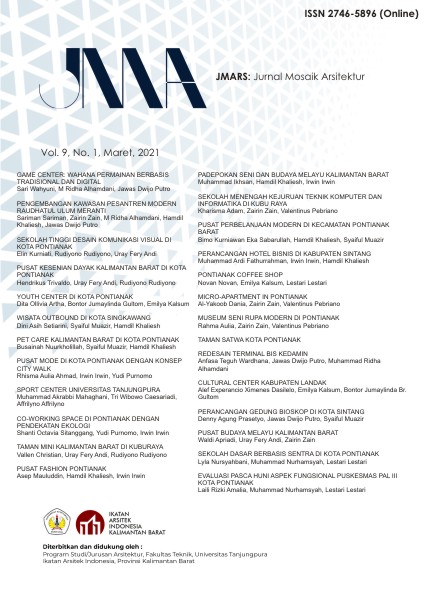
CO-WORKING SPACE DI PONTIANAK DENGAN PENDEKATAN EKOLOGI
DOI:
https://doi.org/10.26418/jmars.v9i1.44712Keywords:
Creative Economy, Co-working space, Ecology, Pontianak CityAbstract
Currently, there is an increase in workforce that start new independent businesses in the creative economy, either as entrepreneurs or freelancers, this because number of job is not comparable to the number of the workforce. The increase in workers in the creative economy is in line with the digital transformation in Indonesia. The government also responded well to this by making programs related to the creative economy, especially in the digital field. Pontianak City has the potential for development with an increase in the number of workers in the creative economy every year, but Pontianak City does not yet have space to accommodate workers' activities. Co-working space can accommodate workers in the creative economy so they can work in a productive and creative environment. In addition, the provision of supporting digital services in co-working spaces is expected to support entrepreneurs or freelancers in developing their business into the digital field. The co-working space design process uses an ecological approach. Ecological approach is an approach that is environmentally friendly. The Ecological Approach serves as a tool that are implemented towards designs that take into account the potential for the natural surroundings as well as the interrelationships between buildings, nature and people.
References
Badan Pusat Statistik. (2019). Statistik Ketenagakerjaan. Indonesia: Badan Pusat Statistik.
Cahyadi, A. (2014). Definisi Startup Company dan Indikator sebuah Perusahaan. Retrieved from https://agungcahyadi.com /definisi-startup-company-dan-indikator-sebuah-perusahaan-sudah-bukan-startup.
Departemen Perdagangan Republik Indonesia. (2007). Studi Industri Kreatif. Jakarta: Departemen Perdagangan Republik Indonesia
Jones, J.C. (1990). Developments in Design Methodology. New York: John Wiley & sons Ltd
Pemerintah Kota Pontianak (2013). Rencana Tata Ruang Wilayah Kota Pontianak Tahun 2013-2033. Pontianak: Pemerintah Kota Pontianak
Spreitzer, G., Bacevice, P.A., Garrett, L. (2015). Why People Thrive in Coworking Spaces. Retrieved from https://hbr.org/2015/05/why-people-thrive-in-coworking-spaces.
Suskiyatno, B. (2007). Dasar-dasar Arsitektur Ekologi. Yogyakarta: Kanisius
Downloads
Additional Files
Published
Issue
Section
License

This work is licensed under a Creative Commons Attribution 4.0 International License.
You are free to:
- Share "” copy and redistribute the material in any medium or format
- Adapt "” remix, transform, and build upon the material for any purpose, even commercially
Under the following terms:
- Attribution "” You must give appropriate credit, provide a link to the license, and indicate if changes were made. You may do so in any reasonable manner, but not in any way that suggests the licensor endorses you or your use.
- No additional restrictions "” You may not apply legal terms or technological measures that legally restrict others from doing anything the license permits.
Notices:
- You do not have to comply with the license for elements of the material in the public domain or where your use is permitted by an applicable exception or limitation.
- No warranties are given. The license may not give you all of the permissions necessary for your intended use. For example, other rights such as publicity, privacy, or moral rights may limit how you use the material.
