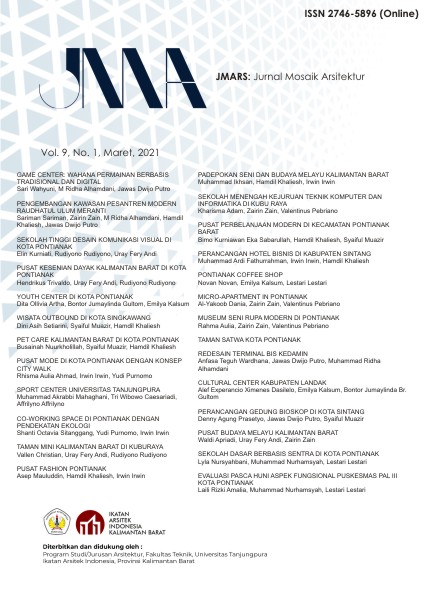
PUSAT PERBELANJAAN MODERN DI KECAMATAN PONTIANAK BARAT
DOI:
https://doi.org/10.26418/jmars.v9i1.45028Keywords:
Shopping center, Open mall, Sky bridgeAbstract
The increase in population and economic development in Pontianak City has increased every year, and it is also in one of the districts in Pontianak City, namely West Pontianak District, which has a fairly high level of trade and services. To follow up on this, we need a container or Modern Shopping Center in West Pontianak District by providing open spaces or (open malls) so that it can accommodate consumer needs as well as enjoy open spaces. There are secondary data that provide discussion of malls, mall classification, and theories related to modern centers. The Modern Shopping Center in West Pontianak District provides an attractive design by providing a solid facade with two masses of buildings served by a sky bridge. This Modern Shopping Center in West Pontianak District is located in a trade and service location. The design method is a systematic stage, the design method used is the J.C Jones method in the Architectural Design Methods book. The stages used are the stages of ideas, information, analysis, synthesis, evaluation, and optimization. The purpose of the design is to produce a design for a Modern Shopping Center in West Pontianak District, which is able to accommodate the community in West Pontianak District by providing recreational and entertainment areas with the concept of Open Mall and providing spaces for mall visitors such as clothing and accessories retail, culinary retail, educational retail, toy retail, plant retail, sports retail, indoor activities, and outdoor activities and other supporting functions.
References
Badan Pusat Statistik Kota Pontianak. (2018). Kecamatan Pontianak Barat Dalam Angka 2018. Pontianak: Badan Pusat Statistik Kota Pontianak
Fairchild, H.P. (1994). Dictionary Of Sosiology, Philosophical Library. Paterson, New Jersey: Littlefield, Adam & Co
Haryono, W. (1978). Pariwisata Rekreasi dan Entertaiment. Bandung: Ilmu Publisher
Kementerian Pekerjaan Umum Republik Indonesia. (2020, August 15). Peraturan Menteri Pekerjaan Umum Nomor 29 Tahun 2006 Tentang Persyaratan Teknis Bangunan dan Gedung. Retrieved from https://pustaka.pu.go.id/biblio/peraturan-menteri-pekerjaan-umum-nomor-29prtm2006-tentang-pedoman-persyaratan-teknis-bangunan-gedung/547DL
Maitland, B. (1985). Shopping Malls-Planing Design. New York: Langman Grup, Limited
Marlina, E. (2008). Panduan Perancangan Bangunan Komersial. Yogyakarta: PT. ANDI offset
Neufert, E. (1992). Data Arsitek Jilid Pertama. Jakarta: Penerbit Erlangga
Nuraini, C. (2010). Metode Perancangan Arsitektur. Bandung: Karya Putra Darwati
Rubenstain, H. M. (1978). Central City Mall. New York: A Willey-Interscience Publication
Sekretariat Negara Republik Indonesia. (2020, August 10). Peraturan Presiden Republik Indonesia Nomor 29 Tahun 2007 Tentang Penataan Dan Pembinaan Pasar Tradisional Pusat Perbelanjaan Dan Toko Modern. Retrieved from https://peraturan.bpk.go.id/Home/Details/42157/perpres-no-112-tahun-2007
Downloads
Additional Files
Published
Issue
Section
License

This work is licensed under a Creative Commons Attribution 4.0 International License.
You are free to:
- Share "” copy and redistribute the material in any medium or format
- Adapt "” remix, transform, and build upon the material for any purpose, even commercially
Under the following terms:
- Attribution "” You must give appropriate credit, provide a link to the license, and indicate if changes were made. You may do so in any reasonable manner, but not in any way that suggests the licensor endorses you or your use.
- No additional restrictions "” You may not apply legal terms or technological measures that legally restrict others from doing anything the license permits.
Notices:
- You do not have to comply with the license for elements of the material in the public domain or where your use is permitted by an applicable exception or limitation.
- No warranties are given. The license may not give you all of the permissions necessary for your intended use. For example, other rights such as publicity, privacy, or moral rights may limit how you use the material.
