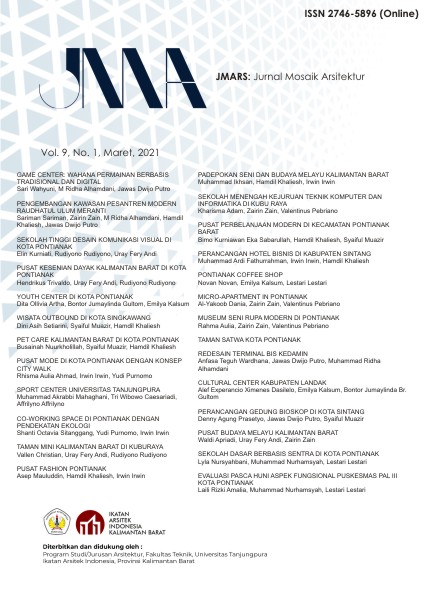
SEKOLAH DASAR BERBASIS SENTRA DI KOTA PONTIANAK
DOI:
https://doi.org/10.26418/jmars.v9i1.45548Keywords:
Elementary School, BCCT Method, ChildrenAbstract
Children are the future successors of the nation, so their growth and development must be maximized, especially for children in the childhood phase. Therefore, it is hoped that all parties can support the creation of a good and child-friendly environment for their development. Indonesia has a target for all regions to become a Child Friendly City/ District (KLA) by 2030. One of the KLA indicators is Child Friendly Schools (SRA), which is manifested in the implementation of a child-friendly learning process. Schools must be able to use the right learning approach for optimal child development. One method that is considered appropriate for the child's development stage is the Beyond Centers and Circle Time (BCCT) method, which in Indonesia is known as senling or short for centers and circles. The BCCT method is a learning method that is applied based on certain areas and is centered on children as learners. This method aim is to develop all aspects of multiple intelligence in early childhood through directed play by moving classes. The purpose of this is to find out how to design a BCCT based primary school using design method by J.C. Jones. The concept of space is formulated by applying textures, colors, flexible spaces and individual spaces that can support children's development.
References
Ahmadi, A., & Uhbiyati, N. (2001). Interaksi Belajar Mengajar. Bandung, Indonesia: Remaja Karya
Center for Citizenship Education Foundation. (2016). Physical and Architectural Learning Environments. Retrieved from http://www.eduspaces.eu/p/guidebooks.html
Direktorat Pembinaan Pendidikan Anak Usia Dini. (2011). Pedoman Teknis Penyelenggaraan Kelompok Bermain. Retrieved from http://paud.kemdikbud.go.id
Hanafi, M. Z. (2014). Implementasi Metode Sentra Dalam Pengembangan Kecerdasan Majemuk Anak Usia Dini. Jakarta, Indonesia: Deepublish
Kementerian Pemberdayaan Perempuan dan Perlindungan Anak RI. (2015). Panduan Sekolah Ramah Anak. Retrieved from https://sekolahramahanak.files.wordpress.com
Kementerian Pendidikan Nasional Republik Indonesia. (2007). Peraturan Menteri Pendidikan Nasional Republik Indonesia Nomor 24 Tahun 2007 tentang Standar Sarana dan Prasarana untuk Sekolah Dasar/Madrasah Ibtidaiyah (SD/MI), Sekolah Menengah Pertama/Madrasah Tsanawiyah (SMP/MTS), dan Sekolah Menengah Atas/Madrasah Aliyah (SMA/MA). Retrieved from http://repositori.kemdikbud.go.id/18715/1/Permendiknas-No.-24-tahun-2007.pdf
National Association for the Education of Young Children. (1992). Developmentally Appropriate Practice In Early Childhood Programs, Serving Children from Birth to Age 8. Washington DC, United States: NAEYC
Noorlaila, I. (2010). Panduan Lengkap Mengajar PAUD. Yogyakarta, Indonesia: Pinus Book Publisher
Nuraini, C. (2010). Metode Perancangan Arsitektur. Bandung, Indonesia: Karya Putra Darwanti
Nurihsan, J. (2007). Buku Materi Pokok Perkembangan Peserta Didik. Bandung, Indonesia: UPI
Purwoko, A. (2001). Panduan Penelitian PTK. Semarang, Indonesia: Unnes Press
Sumantri, M. S. (2005). Pengembangan Keterampilan Motorik Anak Usia Dini. Jakarta, Indonesia: Dinas Pendidikan
Supriyanto, D. (2014). Meningkatkan Proses Pembelajaran melalui Moving Class. Jurnal Program Studi PGMI, 1, 1-14
Downloads
Additional Files
Published
Issue
Section
License

This work is licensed under a Creative Commons Attribution 4.0 International License.
You are free to:
- Share "” copy and redistribute the material in any medium or format
- Adapt "” remix, transform, and build upon the material for any purpose, even commercially
Under the following terms:
- Attribution "” You must give appropriate credit, provide a link to the license, and indicate if changes were made. You may do so in any reasonable manner, but not in any way that suggests the licensor endorses you or your use.
- No additional restrictions "” You may not apply legal terms or technological measures that legally restrict others from doing anything the license permits.
Notices:
- You do not have to comply with the license for elements of the material in the public domain or where your use is permitted by an applicable exception or limitation.
- No warranties are given. The license may not give you all of the permissions necessary for your intended use. For example, other rights such as publicity, privacy, or moral rights may limit how you use the material.
