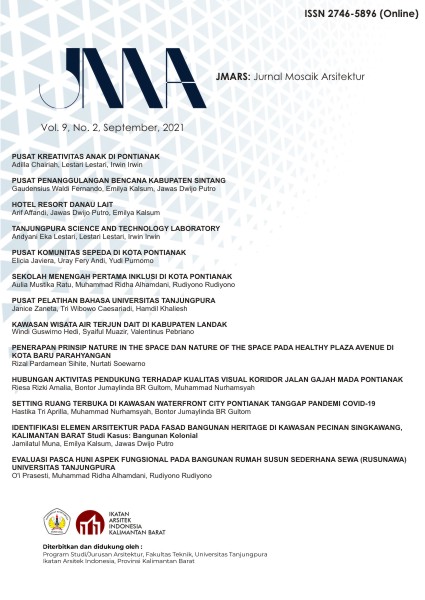
PUSAT PELATIHAN BAHASA UNIVERSITAS TANJUNGPURA
DOI:
https://doi.org/10.26418/jmars.v9i2.48666Keywords:
Training, Language Centre, Universitas TanjungpuraAbstract
Mastery of foreign languages is an important skill to compete in the international world in the future. The Language Unit of Universitas Tanjungpura also supports the mastery of foreign languages and has a vision and mission to become a center for international language education and services in West Kalimantan. With the development of Universitas Tanjungpura, Universitas Tanjungpura currently has BLU status, so educational facilities need to provide commercial areas to fulfill this BLU status. Therefore, an Universitas Tanjungpura Language Training Center is needed that can support foreign language learning and there is a commercial area. The design location is located on Daya National Street, Sea Bansir, Southeast Pontianak Subdistrict, Pontianak City, West Kalimantan, with an area of ±11,000 m2. The design uses a comparison method between the results of site observations, existing buildings, literature studies, with training center standards, as well as analyzing internal and external aspects of the site. The basic idea of interior and exterior spatial planning is to support foreign language learning and attract visitors to have activities at the Universitas Tanjungpura Language Training Center. This is realized by designing an educational space that meets the criteria for a training room, a commercial space that has a selling value, and a public zone that is free to be visited by the public. The appeal of the idea of a design building is a triangle which is the hallmark of the Universitas Tanjungpura building form. The building is covered with secondary skin with a typical pattern of the Universitas Tanjungpura.References
Hamalik, O. (2007). Manajemen Pelatihan Ketenagakerjaan Pendekatan Terpadu. Jakarta: Bumi Aksara
Kementerian Keuangan Republik Indonesia. (2017). Keputusan Menteri Keuangan Republik Indonesia no 830/KMK.05/2017. Jakarta: Kementerian Keuangan Republik Indonesia
Noe, R. A. (2002). Employee Training and Development. Second Edition. New York:McGraw-Hill Companies
Pemerintah Kota Pontianak. (2017). Peraturan Daerah Kota Pontianak Nomor 2 Tahun 2013 Tentang Rencana Tata Ruang Wilayah Kota Pontianak Tahun 2013-2033. Retrieved from Jaringan Dokumentasi dan Informasi Hukum Pemerintah Kota Pontianak: https://jdih.pontianakkota.go.id/peraturan/peraturan-daerah-kota-pontianak-nomor-2-tahun-2013-tentang-rencana-tata-ruang-wilayah
Pemerintah Republik Indonesia. (2012). Peraturan Pemerintah Republik Indonesia Nomor 74 Tahun 2012 Tentang Perubahan Atas Peraturan Pemerintah Nomor 23 Tahun 2005 Tentang Pengelolaan Keuangan Badan Layanan Umum. Jakarta: Pemerintah Republik Indonesia
Rivai, V., & Sagala, E. J. (2011). Manajemen Sumber Daya Manusia untuk Perusahaan. Jakarta: Rajawali Pers
Snyder, C. J., & Catanese, A. J., (1989). Perencanaan Kota. Jakarta: Erlangga
Sugiyono. (2002). Manajemen Diklat. Bandung: Alfabeta
Suherman, A. (2011). Pembelajaran Bahasa Asing. Bandung: Universitas Pendidikan Indonesia
UPT Teknologi Informasi dan Komunikasi. (n.d.). Universitas Tanjungpura. Retrieved from https://www.untan.ac.id/menuju-blu-untan-bahas-susunan-standar-pelayanan-publik/
Downloads
Additional Files
Published
Issue
Section
License

This work is licensed under a Creative Commons Attribution 4.0 International License.
You are free to:
- Share "” copy and redistribute the material in any medium or format
- Adapt "” remix, transform, and build upon the material for any purpose, even commercially
Under the following terms:
- Attribution "” You must give appropriate credit, provide a link to the license, and indicate if changes were made. You may do so in any reasonable manner, but not in any way that suggests the licensor endorses you or your use.
- No additional restrictions "” You may not apply legal terms or technological measures that legally restrict others from doing anything the license permits.
Notices:
- You do not have to comply with the license for elements of the material in the public domain or where your use is permitted by an applicable exception or limitation.
- No warranties are given. The license may not give you all of the permissions necessary for your intended use. For example, other rights such as publicity, privacy, or moral rights may limit how you use the material.
