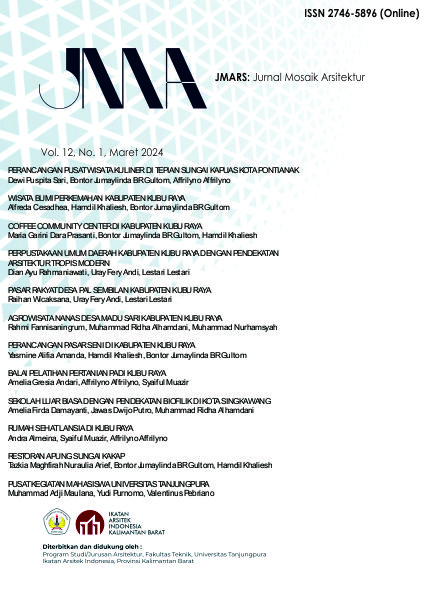
SEKOLAH LUAR BIASA DENGAN PENDEKATAN BIOFILIK DI KOTA SINGKAWANG
DOI:
https://doi.org/10.26418/jmars.v12i1.62339Keywords:
Biophilic architecture, Differently abled, Special needs schoolsAbstract
Education is essential to every citizen's existence. It does not exclude those with impairments (differently abled). Article 5 of The Law of the Republic of Indonesia Number 20 of 2003 states, "Citizens with physical, emotional, mental, intellectual, and/or social disabilities shall have the right to special education." Special education is an education reserved entirely for pupils with disabilities (differently abled), including people who are blind, people who are deaf, people with quadriplegia, or people with psychiatric disabilities (mentally disabled). Certainly, every location contains individuals with disabilities. In order to fulfil the mandate of Article 5 of Law No. 20 of the Republic of Indonesia from 2003, people with disabilities deserve an education infrastructure that meets their needs. Due to this, special needs schools must be specifically constructed to provide teaching-learning activities that can aid in the development of the student's potential. The biophilic concept is one of a number of concepts that can be used to generate the aforementioned situation. Biophilic is an architectural idea that fosters a harmonious link between humans and nature. The objective of biophilic design is to create an environment that is conducive to the physical and mental growth of humans. Biophilic is employed because it may establish tranquility and calm through the building's connection to nature, and the application of this design is anticipated to improve the quality of education for students.
References
Badan Pusat Statistik Kota Singkawang. (2022). Kota Singkawang Dalam Angka 2021. Singkawang: Badan Pusat Statistik Kota Singkawang
Browning, W. D., Ryan, C. O., & Clancy, J. O. (2014). 14 Patterns of Biophilic Design Terrapin. Terrapin Bright Green, 1, 4–64
Dapodik. (2021). Data Pokok Pendidikan Dasar dan Menengah. Retrieved from http://dapo.dikdasmen.kemdikbud.go.id/
Downton, P., Jones, D., Zeunert, J., & Roös, P. (2017). Biophilic Design Applications: Putting Theory and Patterns into Built Environment Practice. KnE Engineering, 2(2), 59. Retrieved from https://doi.org/10.18502/keg.v2i2.596
Kellert, S. (2008). Dimensions, elements, and attributes of biophilic design. Biophilic Design, 3–20
Kementerian Pendidikan Nasional Republik Indonesia. (2008). Peraturan Menteri Pendidikan Nasional Republik Indonesia Nomor 33 Tahun 2008 Tentang Standar Sarana dan Prasarana untuk Sekolah Dasar Luar Biasa (SDLB), Sekolah Menengah Pertama Luar Biasa (SMPLB), dan Sekolah Menengah Atas Luar Biasa (SMALB). Jakarta: Kementerian Pendidikan Nasional Republik Indonesia
Presiden Republik Indonesia. (2016). Undang - Undang Republik Indonesia Nomor 8 Tahun 2016 Tentang Penyandang Disabilitas. Retrieved from https://peraturan.bpk.go.id/Download/26352/UU Nomor 8 Tahun 2016.pdf
Sumartono, S. (2015). Prinsip-prinsip Desain Biofilik. In PRODUCTUM Jurnal Desain Produk (Pengetahuan dan Perancangan Produk) (Vol. 1, Issue 1, p. 15). https://doi.org/10.24821/productum.v1i1.1515
Downloads
Additional Files
Published
Issue
Section
License

This work is licensed under a Creative Commons Attribution 4.0 International License.
You are free to:
- Share "” copy and redistribute the material in any medium or format
- Adapt "” remix, transform, and build upon the material for any purpose, even commercially
Under the following terms:
- Attribution "” You must give appropriate credit, provide a link to the license, and indicate if changes were made. You may do so in any reasonable manner, but not in any way that suggests the licensor endorses you or your use.
- No additional restrictions "” You may not apply legal terms or technological measures that legally restrict others from doing anything the license permits.
Notices:
- You do not have to comply with the license for elements of the material in the public domain or where your use is permitted by an applicable exception or limitation.
- No warranties are given. The license may not give you all of the permissions necessary for your intended use. For example, other rights such as publicity, privacy, or moral rights may limit how you use the material.
