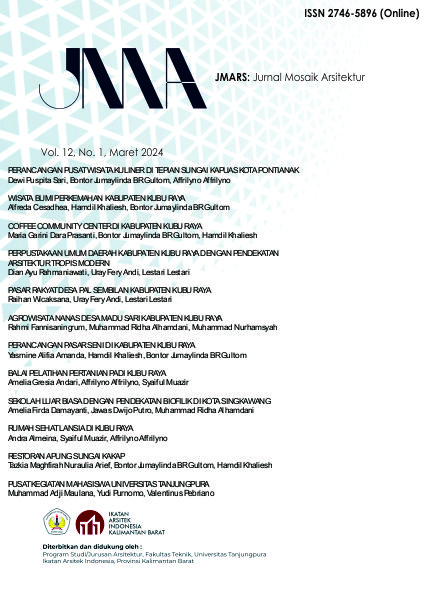
RESTORAN APUNG SUNGAI KAKAP
DOI:
https://doi.org/10.26418/jmars.v12i1.68831Keywords:
Sungai Kakap, Restoran ApungAbstract
Sungai Kakap Village is a coastal village located at the mouth of the Kapuas River. Sungai Kakap Village offers coastal culinary delights such as seafood and coastal environments often used as photo spots for the enchanting sunrise and sunset. The potential of this coastal area is applied to the design of a floating restaurant. There are four methods used in designing the floating restaurant. Firstly, the design object is the "Sungai Kakap Floating Restaurant." Secondly, the types of data and data collection techniques used include collecting primary and secondary data through observation, documentation, interviews, and literature sources. Thirdly, there are analysis techniques, divided into technical analysis and synthesis techniques that produce conceptual conclusions from site analysis such as zoning and circulation. The fourth stage is the design stage, which is the final stage. Based on the explanation, the potential of Sungai Kakap Village can be developed into an attractive restaurant. The attraction of the restaurant lies in utilizing the coastal potential, where the potential of the coastal area is applied to the design of a floating restaurant. The applied floating concept includes the building's image as a restaurant, the building being open and environmentally friendly, and the building having outward orientation and inviting the public.
References
Denny, H. M.,& Cahyani, M. T. (2019). Buku Ajar Kesehatan dan Keselamatan Kerja Pesisir. Semarang: FKM UNDIP PRESS
Fallahnda, B. (2023). Profil Sungai Kapuas Beserta Data Panjang, Letak, Daerah Aliran. Diakses Februari 2023. Retrieved from https://tirto.id/profil-sungai-kapuas-beserta-data-panjang-letak-daerah-aliran-gBEn
Kementerian Pariwisata dan Ekonomi Kreatif Republik Indonesia. (2014). Peraturan Menteri Pariwisata dan Ekonomi Kreatif Republik Indonesia Nomor 11 Tahun 2014 Tentang Standar Usaha Restoran. Jakarta: Kementerian Pariwisata dan Ekonomi Kreatif Republik Indonesia
Neufert, E. (2002). Data Arsitek Jilid 2 Ed.33. Jakarta: Erlangga
Pemerintah Daerah Kabupaten Kubu Raya. (2016). Peraturan Daerah Kabupaten Kubu Raya Nomor 7 Tahun 2016 Tentang Rencana Tata Ruang Wilayah Kabupaten Kubu Raya Tahun 2016-2036. Kubu Raya: Pemerintah Daerah Kabupaten Kubu Raya
Pemerintah Republik Indonesia. (2007). Undang-Undang Republik Indonesia Nomor 27 Tahun 2007 Tentang Pengelolaan Wilayah Pesisir dan Pulau-pulau Kecil. Jakarta: Pemerintah Republik Indonesia
Pemerintah Republik Indonesia. (2009). Undang-Undang Republik Indonesia Nomor 10 Tahun 2009 Tentang Kepariwisataan. Jakarta: Pemerintah Republik Indonesia
Protokol dan Komunikasi Pimpinan Kabupaten Kubu Raya. (2022). Potensi Alam Sungai Kakap. Diakses Agustus 2023. Retrieved from https://www.prokopim.kuburayakab.go.id/artikel/potensi/potensi-alam-sungai-kakap
Saidah, M. (2017). Perencanaan Sistem Distribusi Air Bersih dan Pembuangan Air Limbah Baobab Hotel Resort and Convention Taman Safari II. Skripsi. Malang: Universitas Muhamadiyah Malang
Sari, A. M. (2017). Restoran Apupng di Pantai Marina Semarang dengan Konsep Arsitektur Neo Vernakular. Institutional Repository (UNDIP-IR). Semarang: Universitas Diponegoro
Septaliana, S. (2017). Tugas Akhir Restoran Tepian Sungai di Kota Pontianak. Tugas Akhir Program Studi Arsitektur. Pontianak: Universitas Tanjungpura
Susilo, V. F. (2014). Tugas Akhir Perancangan Interior Restoran dengan Penerapan Cerita Rakyat di Blitar. Tugas Akhir Perancangan Interior. Surabaya: Universitas Kristen Petra
Downloads
Additional Files
Published
Issue
Section
License

This work is licensed under a Creative Commons Attribution 4.0 International License.
You are free to:
- Share "” copy and redistribute the material in any medium or format
- Adapt "” remix, transform, and build upon the material for any purpose, even commercially
Under the following terms:
- Attribution "” You must give appropriate credit, provide a link to the license, and indicate if changes were made. You may do so in any reasonable manner, but not in any way that suggests the licensor endorses you or your use.
- No additional restrictions "” You may not apply legal terms or technological measures that legally restrict others from doing anything the license permits.
Notices:
- You do not have to comply with the license for elements of the material in the public domain or where your use is permitted by an applicable exception or limitation.
- No warranties are given. The license may not give you all of the permissions necessary for your intended use. For example, other rights such as publicity, privacy, or moral rights may limit how you use the material.
