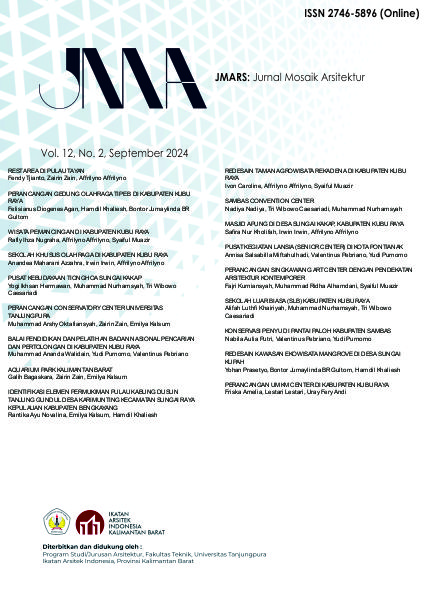
REDESAIN KAWASAN EKOWISATA MANGROVE DI DESA SUNGAI KUPAH
DOI:
https://doi.org/10.26418/jmars.v12i2.76531Keywords:
Coastal Area, Mangrove, Ecotourism, Kubu Raya DistrictAbstract
Coastal areas are one of the forest ecosystems that have abundant resources because it is a combination of rich marine ecosystems and terrestrial ecosystems. One of the most important ecosystems in coastal areas with resources, ecosystems and the environment is the mangrove forest area. Mangrove forest is a coastal resource that has a high carrying capacity for life, especially from the functions it contains such as the ecosystem contained therein, natural resources and economic use. In addition to being a meeting place for marine and terrestrial ecosystems, mangrove forests can also be used as a place of conservation, tourism and education. Sungai Kakap is a sub-district in Kubu raya that has a coastal area one of which is in Sungai Kupah Village. The mangrove forest area in Sungai Kupah Village has become one of the tourist icons in Sungai Kupah Village. existing mangrove ecotourism contains beautiful mangrove forests and their ecosystems in the mangrove forest, but as a mangrove ecotourism area it lacks ideal and optimal infrastructure and supporting spaces for recreational, educational, conservative tourism and the area becomes monotonous. The development of mangrove ecotourism areas in Sungai Kupah village must be carried out with the design of the area to restore ecotourism functions and develop the potential that exists in the mangrove ecotourism area in Sungai Kupah Village.
References
Undang-Undang Nomor 26 (2007) tentang Pengelolaan Wilayah Pesisir dan Pulau-Pulau Kecil.
Undang-Undang Nomor 10 (2009) tentang Kepariwisataan.
Peraturan Menteri Pariwisata (Permenpar) 2018 Peraturan Menteri Pariwisata Republik Indonesia Nomor 3 Tahun 2018 Tentang Petunjuk Operasional Pengelolaan Dana Alokasi Khusus Fisik Bidang Pariwisata.
Borror, D. J., N. F. Johnson and C. A. Triplehorn. 1992. Pengenalan Pelajaran Serangga, edisi ke enam. ( Soetiyono: Terjemahan). Yogyakarta: Gadjah Mada University Press.
Cooper, Chriss. (2005). Worldwide Destination: The Geography of Travel and Tourism (fourth edition). Oxford: Elisevier Butterworth Heinemann.
Mahdayani, Wiwik. (2009) Panduan Dasar Pelaksanaan Ekowisata. UNESCO: Jakarta.
Majid, I., Muhdar, M. H. I .A, Rohman, F., Syamsuri, I. (2016). Konservasi hutan Mangrove Di Pesisir Pantaikota Ternate Terintegrasi Dengan Kurikulum Sekolah. Jurnal BIOedukasi. Vol. 4 (2): 2301-4678.
Shirvani, Hamid. (1985). The Urban Design Process. New York: Van Nostrand Reinhold Company.
Snyder, J. C., & Catanese, A. J. (1989). Pengantar Arsitektur. (Hendro Sangkoyo, Terjemahan). Jakarta: Erlangga.
Winarno, D.G., & Harianto, S.P. (2017). Ekowisata. Bandar Lampung : Pusaka Media.
Downloads
Additional Files
Published
Issue
Section
License

This work is licensed under a Creative Commons Attribution 4.0 International License.
You are free to:
- Share "” copy and redistribute the material in any medium or format
- Adapt "” remix, transform, and build upon the material for any purpose, even commercially
Under the following terms:
- Attribution "” You must give appropriate credit, provide a link to the license, and indicate if changes were made. You may do so in any reasonable manner, but not in any way that suggests the licensor endorses you or your use.
- No additional restrictions "” You may not apply legal terms or technological measures that legally restrict others from doing anything the license permits.
Notices:
- You do not have to comply with the license for elements of the material in the public domain or where your use is permitted by an applicable exception or limitation.
- No warranties are given. The license may not give you all of the permissions necessary for your intended use. For example, other rights such as publicity, privacy, or moral rights may limit how you use the material.
