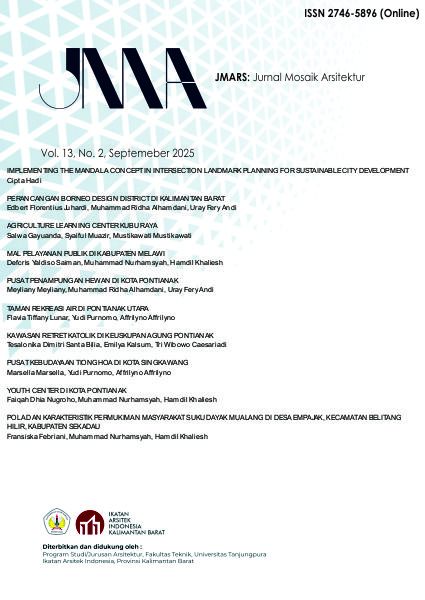
PERANCANGAN BORNEO DESIGN DISTRICT DI KALIMANTAN BARAT
DOI:
https://doi.org/10.26418/jmars.v13i2.88678Keywords:
Borneo Design District, West KalimantanAbstract
Architects, interior designers, and contractors are key professionals in the construction industry who play a vital role in Indonesia's development. In the design process, designers must consider a wide range of building materials and furniture options, which are constantly evolving. Design District facilities serve as a platform for construction industry players to select appropriate materials based on their specific needs and preferences. One notable example is the Indonesia Design District (IDD), one of the country's largest design and lifestyle expo centers, spanning 12.1 hectares. It features a shopping center that acts as a primary destination for design inspiration and high-quality materials. The Borneo Design District is an innovative initiative aimed at responding to shifts in architectural design and form. It focuses on becoming a central hub for finishing materials and home furnishings, with the goal of consolidating building design needs within a single, integrated area. The project also seeks to enhance the potential of local materials in West Kalimantan. The design approach follows R. Whittaker's five-step method, which includes the stages of introduction, definition, preparation, analysis and synthesis, and evaluation. The outcome of this process is the Borneo Design District building design, developed under the Mixed-Use District theme and incorporating a Contemporary Architectural approach. This includes sustainable design, the use of innovative materials, and an emphasis on user experience. This serves as a solution to the challenge of attracting visitors to shop, enjoy recreational activities, work, and collaborate.References
Cahyono, R. N. (2003). Peranan Buku dalam Perkembangan Anak. Visipustaka: Majalah Jaringan Informasi Antar Perpustakaan, 5(1), 19–21.
DeGuzman, G. V., & Tang, A. I. (2011). Working in the unoffice: A guide to coworking for indie workers, small businesses, and nonprofits. Night Owls Press LLC.
Finsa. (2024). What is a materials library? Connections by Finsa. Retrieved from https://www.connectionsbyfinsa.com/what-is-a-materials-library/?lang=en
Frew, S. (2023). What is a Design District and How Has Their Rise Transformed Our Cities. Architizer. Retrieved from https://architizer.com/blog/inspiration/stories/design-district-transform-cities/
Ghaisani, T. (2024). Melihat Bintaro Design District 2024 Dari Kacamata Mahasiswa Arsitektur. Whiteboard Journal. Retrieved from https://www.whiteboardjournal.com/ideas/design/melihat-bintaro-design-district-2024-dari-kacamata-mahasiswa-arsitektur/
Himayah, H. (2013). Layanan dan Pelayanan Perpustakaan: Menjawab Tantangan Era Teknologi Informasi. Khizanah al-Hikmah: Jurnal Ilmu Perpustakaan, Informasi, dan Kearsipan, 1(1), 1-6.
Husna, N. (2018). Perbedaan Antara Perpustakaan Konvensional, Digital, Hibrida Dan Bookless. Al-Kuttab: Jurnal Perpustakaan dan Informasi, 5(1), 15-28.
Kesrul, M. (2004). Meetting, Incetive Trip, Conference, Exhibition (1st ed.). Yogyakarta: Graha Ilmu.
Komarudin. (2024). Indonesia design district PIK 2: Pusat Design dan Furnitur Terbesar di Indonesia. Pantaipedia News. Retrieved from https://news.pantaipedia.com/indonesia-design-district-pik-2/
Leforestier, A. (2009). The co-working space concept CINE Term project. Indian Institute of Management (IIMAHD): Ahmedabad, India.
Maulana, R. A., & Wasisto, J. (2019). Peran Sentra Advokasi Perempuan Difabel dan Anak Terhadap Kaum Difabel dalam Pemenuhan Aksesibilitas Informasi. Jurnal Ilmu Perpustakaan, 8(3), 272–281. Retrieved from https://ejournal3.undip.ac.id/index.php/jip/article/view/26851
Oktavia, S. P., Sawiji, H., & Winarno. (2023). Analisis Coworking Space di EL Samara Surakarta. Jikap: Jurnal Informasi Dan Komunikasi Administrasi Perkantoran, 7(2), 163–170. Retrieved from https://doi.org//10.20961/jikap.v7i2.61942
Pawit. M. (2010). Fungsi Perpustakaan Khusus. Jakarta: Kencana.
Poernomowati, S. (2010). Bimbingan Teknis Perpustakaan Khusus. Jakarta: Perpustakaan Nasional Republik Indonesia.
Sekar, P. (2023). Optimalisasi Penataan Koleksi untuk Mempermudah Temu Kembali Koleksi di Perpustakaan Khusus Badan Pengembangan Sumber Daya Manusia Daerah Provinsi Lampung. Lampung: Universitas Lampung.
Snyder, J. C., & Catanese, A. J. (1985). Pengantar Arsitektur. Jakarta: Erlangga
Sulistyo, B. (1992). Pengantar Ilmu Perpustakaan. Jakarta: Universitas Terbuka.
Sutarno, N. S. (2003). Perpustakaan dan masyarakat. Jakarta: Yayasan Obor Indonesia.
Sutjipto. (2004). Perpustakaan Khusus. Jakarta: Maju Bersama.
Vidal, F. (2019). What Is A Marketplace? Our Understanding of Multi-Seller Businesses. Shopery. Retrieved from https://www.shopery.com/insights/what-is-a-marketplace
Downloads
Published
Issue
Section
License

This work is licensed under a Creative Commons Attribution 4.0 International License.
You are free to:
- Share "” copy and redistribute the material in any medium or format
- Adapt "” remix, transform, and build upon the material for any purpose, even commercially
Under the following terms:
- Attribution "” You must give appropriate credit, provide a link to the license, and indicate if changes were made. You may do so in any reasonable manner, but not in any way that suggests the licensor endorses you or your use.
- No additional restrictions "” You may not apply legal terms or technological measures that legally restrict others from doing anything the license permits.
Notices:
- You do not have to comply with the license for elements of the material in the public domain or where your use is permitted by an applicable exception or limitation.
- No warranties are given. The license may not give you all of the permissions necessary for your intended use. For example, other rights such as publicity, privacy, or moral rights may limit how you use the material.
