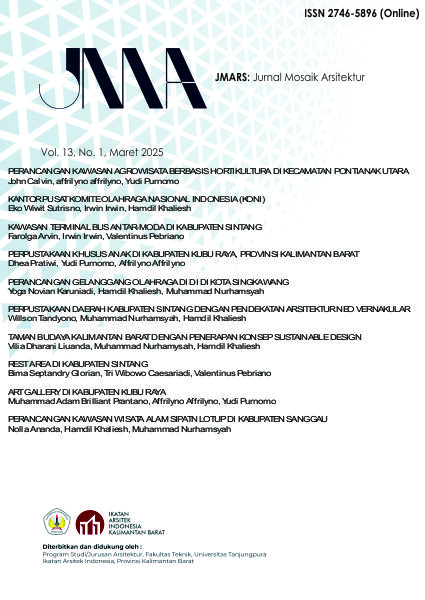
PERANCANGAN KAWASAN WISATA ALAM SIPATN LOTUP DI KABUPATEN SANGGAU
DOI:
https://doi.org/10.26418/jmars.v13i1.90578Keywords:
nature tourism, hot springs, contextual architectureAbstract
Tourism is an important sector for national revenue, and West Kalimantan holds significant potential, particularly in Sanggau Regency, which features the flagship destination of Sipatn Lotup Hot Springs the only natural hot spring in the province. Strategically located on the border with Sarawak, Malaysia, this site has strong potential to attract both domestic and international tourists. However, inadequate management and a lack of supporting infrastructure have hindered its development. To address these issues, a landscape design approach based on Contextual Architecture is proposed, focusing on environmental harmony and sustainable development. The proposed solution involves dividing the area into six functional zones: reception, management, tourism, commercial, accommodation, and supporting facilities. The design process consists of four main stages: identification of the design object, data collection, analysis and synthesis, and final design development. The objective is to create a tourist area that is comfortable, functional, and sustainable, while maximizing its natural potential. This approach is expected to enhance the quality of the destination and provide long-term benefits to the tourism sector in Sanggau Regency.References
Dantrivani, R., Hardiyati, H., & Sumaryoto, S. (2021). Penerapan Arsitektur Kontekstual Pada Community Learning Center Untuk Anak Putus Sekolah Di Kapuk, Jakarta Selatan. Senthong, 4(1) . Retrieved from https://jurnal.ft.uns.ac.id/index.php/senthong/article/view/1269
Efendi, Y., Rifanjani, S. dan Siahaan, S., Penilaian Daya Tarik Wisata Ai Sipatn Lotup Peruntan di Desa Sape Kabupaten Sanggau. Jurnal Hutan Lestari. Retrieved from https://jurnal.untan.ac.id/index.php/jmfkh/article/view/31961
Fandeli, C. (2001). Basics of Tourism Management of Natural (Dasar-dasar Managemen Kepariwisataan Alam). Yogyakarta: Liberty. Retrieved from https://lib.ui.ac.id/detail.jsp?id=142180
Purwono, R., & Ningtias, N. P. (2022). Perencanaan Lanskap Kawasan Wisata Alam Pemandian Air Panas Tirta Sayaga, Kabupaten Bogor. Retrieved from http://repository.istn.ac.id/3255/1/Jurnal%20Rudi%20Trave%202022.pdf
Sakti, S. H. (2012). Perencanaan Pariwisata Perdesaan Berbasis Masyarakat. Yogyakarta: Graha Ilmu. Retrieved from http://grahailmu.co.id/previewpdf/978-979-756-894-8-914.pdf
Sedarmayanti, Sastrayuda, G. S., Afriza, L. (2018). Pembangunan dan Pengembangan Parwisata. Bandung: Pt Refika Aditama. Retrieved from https://perpus.tasikmalayakab.go.id/opac/detail-opac?id=19151
Sekretariat Negara Republik Indonesia. (2009). Undang-Undang Nomor 10 tahun 2009 tentang Kepariwisataan. Jakarta: Sekretariat Negara Republik Indonesia
Setiarini, D. A., Muazir, S., & Khaliesh, H. Wisata Outbond di Kota Singkawang. JMARS: Jurnal Mosaik Arsitektur, 9(1), 84-98. Retrieved from https://jurnal.untan.ac.id/index.php/jmarsitek/article/view/44609
Suryadana, M. L. & Octavia, V. (2015). Pengantar Pemasaran Pariwisata. Bandung: Alfabeta. Retrieved from https://elibrary.bsi.ac.id/readbook/206421/pengantar-pemasaran-pariwisata
Suyitno. (2001). Perencanaan Wisata. Yogyakarta: Kanisius. Retrieved from https://books.google.co.id/books?id=5SVWDwAAQBAJ&printsec=frontcover
Downloads
Additional Files
Published
Issue
Section
License

This work is licensed under a Creative Commons Attribution 4.0 International License.
You are free to:
- Share "” copy and redistribute the material in any medium or format
- Adapt "” remix, transform, and build upon the material for any purpose, even commercially
Under the following terms:
- Attribution "” You must give appropriate credit, provide a link to the license, and indicate if changes were made. You may do so in any reasonable manner, but not in any way that suggests the licensor endorses you or your use.
- No additional restrictions "” You may not apply legal terms or technological measures that legally restrict others from doing anything the license permits.
Notices:
- You do not have to comply with the license for elements of the material in the public domain or where your use is permitted by an applicable exception or limitation.
- No warranties are given. The license may not give you all of the permissions necessary for your intended use. For example, other rights such as publicity, privacy, or moral rights may limit how you use the material.
