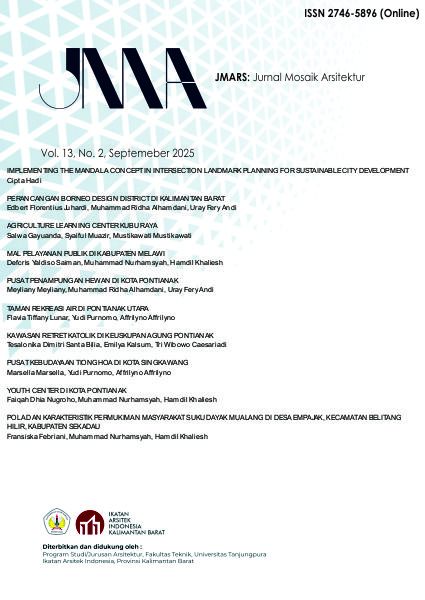
YOUTH CENTER DI KOTA PONTIANAK
DOI:
https://doi.org/10.26418/jmars.v13i2.95140Keywords:
Youth Center, Teenagers, Pontianak CityAbstract
Technological developments in the era of globalization influence the mindset, behavior, and lifestyle of adolescents, including in Pontianak City. The number of adolescents in Pontianak City has the potential for achievement, interests, and talents but also faces challenges such as delinquency, sexual violence, and unemployment. Available facilities are inadequate to support their self-development, creativity, and mental health. This study designs a Youth Center as a place for education, creation, and recreation with a social architecture approach that emphasizes openness and connectivity. The design method refers to the systematic J.C. Jones (1972) through the stages of ideas, information, analysis, synthesis, and evaluation. The design is realized through an open, connected, and interactive architectural design. The building is designed with a clear main mass, an amphitheater as a meeting center for adolescents with various characters in watching performances and green open areas and recreation/sports areas integrated with the site. The application of social architecture principles is reflected in the transparent facade, depicting adolescents and localistic, flexible public spaces, and circulation that connects zones harmoniously, thus forming a spatial identity that supports creativity, collaboration, and adolescent growthReferences
Air Combat Command. (n.d.). Youth Center Standard and Facilities Guide.
Badan Pusat Statistik Kota Pontianak. (2023). Kota Pontianak dalam Angka 2023. Pontianak: Badan Pusat Statistik.
Chiara, J., John H. (1980). Time Saver Sandard Building Types. Singapore, Singapore: National Printers Ltd.
Dinas Kepemudaan, Olahraga Dan Pariwisata Kota Pontianak (2020). Perubahan Kedua Rencana Strategis (Renstra). Pontianak: Dinas Kepemudaan, Olahraga, dan Pariwisata Kota Pontianak.
Gehl, J. (2010). Cities for people. Washington, United States of America: Island Press.
Jones, J. C. (1970). Design Methods: Seeds of Human Future. New York, United States of America: Wiley.
Kementerian Pemuda dan Olahraga Republik Indonesia. (1989). Pedoman Penyelenggaraan Gelanggang Remaja. Jakarta: Kementerian Pemuda dan Olahraga Republik Indonesia
Kementerian Pemuda dan Olahraga Republik Indonesia. (2009). Peraturan Menteri Pemuda dan Olahraga Republik Indonesia Nomor 40 Tahun 2009 tentang Kepemudaan. Jakarta: Kementerian Pemuda dan Olahraga Republik Indonesia.
Kementerian Pemuda dan Olahraga Republik Indonesia. (2020). Rencana Strategis Deputi Bidang Pengembangan Pemuda tahun 2020-2024. Jakarta: Kementerian Pemuda dan Olahraga Republik Indonesia.
Neufert, E. (1980). Ernest Neufert Architect’s Data Second Edition. Oxford, England: Blackwell Science.
Panero, J., & Zelnik, M. (1979) Human Dimension & Interior Space. New york, United states of America: Watson Guptill
Pemerintah Kota Pontianak (2018). Peraturan Daerah (Perda) Kota Pontianak Nomor 3 Tahun 2018 tentang Perubahan Atas Peraturan Daerah Nomor 12 Tahun 2009 Tentang Penyelenggaraan Pendidikan Di Kota Pontianak. Pontianak: Pemerintah Kota Pontianak
Pemerintah Kota Pontianak. (2021). Peraturan Walikota (Perwali) Kota Pontianak Nomor 30 Tahun 2021 Tentang Rencana Detail Tata Ruang Kota Pontianak Tahun 2021-2041. Pontianak: Pemerintah Kota Pontianak.
Pemerintah Kota Pontianak (2023). Peraturan Walikota Pontianak Nomor 5 Tahun 2023 tentang Rencana Rencana Pembangunan Daerah Kota Pontianak 2024-2026. Pontianak: Pemerintah Kota Pontianak.
Pemerintah Provinsi Kalimantan Barat. (2023). Rencana Pembangunan Daerah 2024-2026: Strategi, Arah Kebijakan dan Program Prioritas Daerah. Kalimantan Barat: Pemerintah Provinsi Kalimantan Barat.
Downloads
Additional Files
Published
Issue
Section
License

This work is licensed under a Creative Commons Attribution 4.0 International License.
You are free to:
- Share "” copy and redistribute the material in any medium or format
- Adapt "” remix, transform, and build upon the material for any purpose, even commercially
Under the following terms:
- Attribution "” You must give appropriate credit, provide a link to the license, and indicate if changes were made. You may do so in any reasonable manner, but not in any way that suggests the licensor endorses you or your use.
- No additional restrictions "” You may not apply legal terms or technological measures that legally restrict others from doing anything the license permits.
Notices:
- You do not have to comply with the license for elements of the material in the public domain or where your use is permitted by an applicable exception or limitation.
- No warranties are given. The license may not give you all of the permissions necessary for your intended use. For example, other rights such as publicity, privacy, or moral rights may limit how you use the material.
