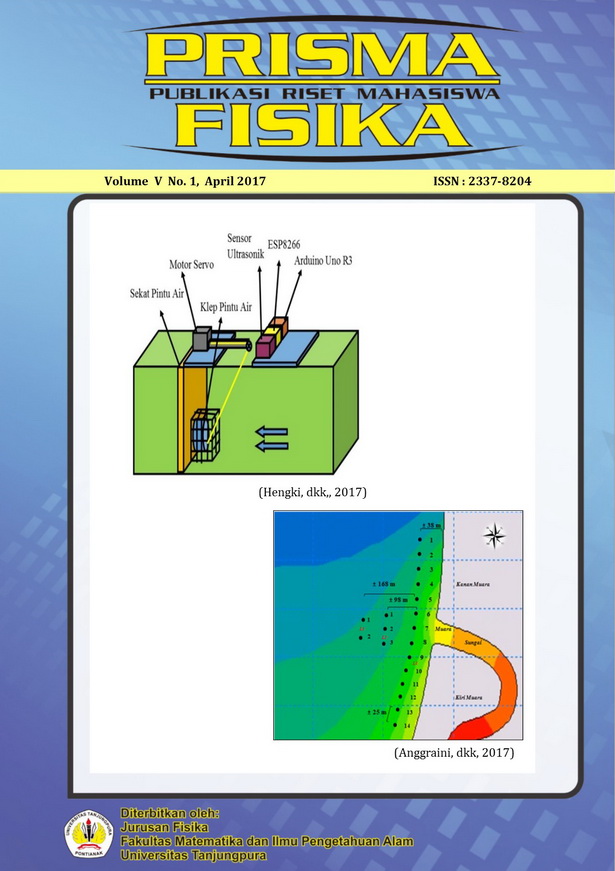
Prototipe Sistem Telemetri Tinggi Muka Air dan Kontrol Pintu Air Otomatis Berbasis Mikrokontroler ATMega328P dan ESP8266
DOI:
https://doi.org/10.26418/pf.v5i1.19748Abstract
Telah dibuat sebuah prototipe instrumen untuk mengukur tinggi permukaan air sungai dan kontrol pintu air berdasarkan prinsip kerja dari gelombang ultrasonik. Sistem terdiri dari mikrokontroler ATMega328P, sensor Ultrasonik HC-SR04, modul ESP8266, dan Motor Servo. Gelombang ultrasonik yang dipancarkan oleh sensor akan memantul kemudian dikonversi menjadi jarak dan diterima oleh rangkaian penerima ultrasonik. Dari hasil pengujian, alat memiliki nilai rata-rata akurasi sebesar 95,47% dalam pengukuran ketinggian air. Nilai yang terbaca oleh sensor Ultrasonik dapat ditampilkan melalui LCD maupun secara online pada tampilan Web Server. Tinggi maksimum yang dapat terbaca oleh sistem sebesar 0,34 m untuk wadah dengan tinggi 0,4 m. Alat ini dapat digunakan untuk mengukur ketinggian permukaan air dan kontrol pintu air secara otomatis pada prototipe pintu air sungai yang telah dibuat.
References
Agung IRA. Rancang Bangun Prototipe Alat Ukur Ketinggian Air Terpadu Berbasis Mikrokontroler AT89S52. Teknologi Elektro. 2011; 10: p. 13-20.
Arief, UM. Pengujian Sensor Ultrasonik PING untuk Pengukuran Level Ketinggian dan Level Air. Elektrikal Enjiniring. 2011; 09: p. 72-77.
Lindawati. Sensor Ultrasonik Sebagai Pengontrol Jarak Aman Pada Kendaraan Roda Empat. TEKNOMATIKA. 2012 Januari; 2: p. 17-20.
Prawiroredjo K & Asteria N. Detektor Jarak dengan Sensor Ultrasonik Berbasis Mikrokontroler. Jetri. 2008 Februari; 07: p. 41-52.
Danel. G & Wildian. Otomatisasi Keran Dispenser Berbasis Mikrokontroler AT89S52 Menggunakan Sensor Fotodioda dan Sensor Ultrasonik PING. Fisika Unand. 2012; Oktober; 01: p. 60-65.
Nataliana D, Syamsu I & Giantara G. Sistem Monitoring Parkir Mobil menggunakan Sensor Infrared Berbasis RASPBERRY PI. ELKOMIKA. 2014; 02: p. 68-84.
Downloads
Published
Issue
Section
License
Copyright Notice using Creative Commons License for an Online Journal
The online journal Prisma Fisika operates under a Creative Commons Attribution-NonCommercial-ShareAlike 4.0 International License (CC BY-NC-SA 4.0). This copyright notice serves to inform authors, readers, and users of the terms and conditions regarding the use and distribution of the journal's content. By submitting or accessing the content, you agree to the following:
1. Content License:
a. All articles, images, and supplementary materials published in Prisma Fisika are licensed under the Creative Commons Attribution-NonCommercial-ShareAlike 4.0 International License.
b. This license permits users to copy, distribute, and adapt the content for non-commercial purposes, provided appropriate credit is given to the original authors and the journal.
c. If you remix, transform, or build upon the content, you must distribute your contributions under the same license as the original.
2. Attribution:
a. When using or sharing content from Prisma Fisika, you must properly attribute the original authors and the journal.
b. Include the title of the article, the names of all authors, Prisma Fisika, the year of publication, the volume/issue number, and the specific page numbers.
c. Provide a hyperlink to the original article on Prisma Fisika's website, if applicable.
3. Non-Commercial Use:
a. The content published in Prisma Fisika may not be used for commercial purposes without obtaining explicit permission from the copyright holders.
b. Commercial use includes, but is not limited to, reproduction or distribution of the content for financial gain, selling or licensing the content, or using the content in products or services that are sold or monetized.
4. ShareAlike:
a. If you adapt or remix the content from Prisma Fisika, you must distribute your derivative work under the same Creative Commons Attribution-NonCommercial-ShareAlike 4.0 International License.
b. This provision ensures that any modifications, adaptations, or remixes of the content maintain the same open licensing framework.
5. Disclaimer:
a. The views expressed in articles published in Prisma Fisika are solely those of the authors and do not necessarily reflect the opinions or policies of the journal, its editorial board, or affiliated institutions.
b. Prisma Fisika and its editors are not liable for any errors, omissions, or damages arising from the use or interpretation of the published content.
Please note that this Copyright Notice does not supersede any additional permissions or restrictions that may be granted by individual authors or copyright holders for their specific content within Prisma Fisika. For any questions or requests regarding the use of the journal's content, please contact the editorial team at prismafisika@physics.untan.ac.id.
By accessing or contributing to Prisma Fisika, you agree to comply with the terms of this Creative Commons license. Violation of these terms may result in legal consequences as governed by applicable copyright laws.
Date: 24-05-2023
Prisma Fisika
Email: prismafisika@physics.untan.ac.id
