IDENTIFIKASI JENIS GAMBUT BERDASARKAN STRUKTUR PORINYA DENGAN MENGGUNAKAN GEOMETRI FRAKTAL
DOI:
https://doi.org/10.26418/pf.v5i2.20709Abstract
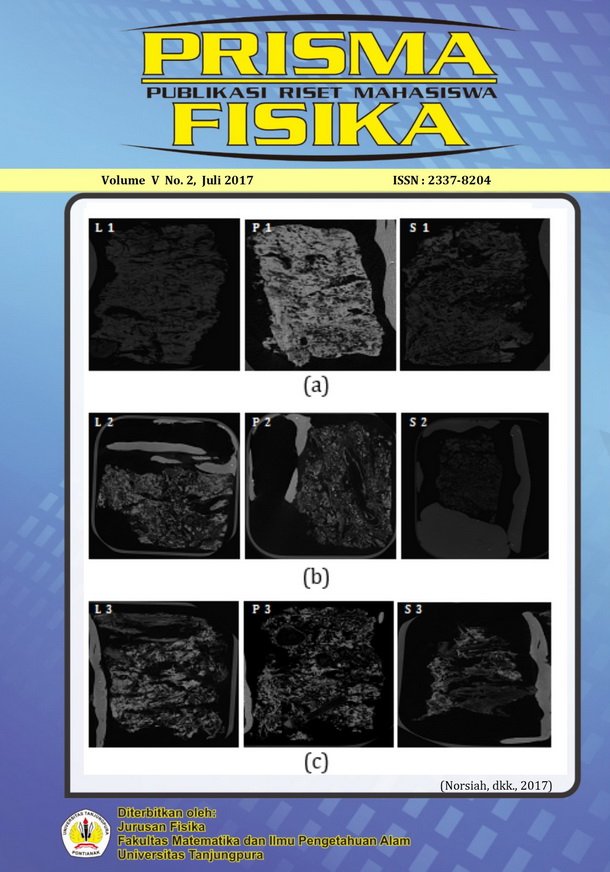
Telah dilakukan analisis terhadap tingkat kompleksitas struktur mikroskopik dari berbagai jenis gambut untuk mengetahui pola keteraturan struktur porinya. Data yang digunakan berjumlah 9 buah sampel gambut yang terdiri dari 3 buah saprik, 3 buah hemik, dan 3 buah fibrik. Analisis sampeldilakukan dengan cara makroskopik dan mikroskopik. Secara makroskopik, sifat fisik tanah yang dianalisis adalah porositas. Sedangkan secara mikroskopik, sifat fisik tanah gambut dianalisis dengan cara sampel dipindai dengan Micro-CT Scanner untuk menghasilkan citra 3D. Hasil dari pemindaian tersebut diolah dan dianalisis dengan metode fraktal. Hasil perhitungan dimensi fraktal yang dilakukan dengan metode box-counting menunjukkan bahwa dimensi fraktal saprik 1,7196 sampai dengan 1,7989, hemik 1,6149 sampai dengan 1,7322, dan fibrik 1,5271 sampai dengan 1,6817. Rentang nilai dimensi tersebut menunjukkan tingkat keteraturan struktur pori pada tiap jenis gambut yang bervariasi. Tingkat keteraturan struktur pori pada tiap jenis gambut dari yang paling teratur hingga tak teratur secara berturut-turut adalah gambut saprik, hemik, dan fibrik.
Kata Kunci :Gambut, Dimensi Fraktal, Box-Counting, Struktur Mikroskopik
References
Nurida, N.L., Anny,M., Fahmuddin Agus. 2011.Pengolahan Lahan Gambut Berkelanjutan. Bogor : Balai Penelitian Tanah.
Nugroho, U., 2008. Stabilisasi Tanah Gambut Rawapening Dengan Menggunakan Campuran Portland Cement dan Gypsum Sintesis (CaSO42H2O) Ditinjau Dari Nilai California Bearing Ratio (RCB). Jurnal teknik sipil dan perencanaan, Vol.10, N0.2, Hlm. 161-170.
Wibowo, H., 2010.Laju Infiltari Pada Lahan Gambut yang Dipengaruhi Air Tanah (Study Kasus Sei Raya Dalam Kecamatan Sei Raya Kabupaten Kubu Raya), Jurnal Belian,Vol.9, No.1, Hlm. 90-103.
Pokja Sanitasi Kota Pontianak. Buku Putih Sanitasi Kota Pontianak.Pontianak: Pemerintahan Kota Pontianak, 2010.
Rakhma, Y.E., 2002.Nilai Faktor Konversi C-Organik Ke Bahan Organik Pada Beberapa Jenis Tanah. Bogor: Jurusan Ilmu Tanah Fakultas Pertanian Institut Pertanian Bogor. (Skripsi)
Hanafiah, K.A., 2007. Dasar- Dasar Ilmu Tanah. Jakarta: PT. Raja Grafindo Persada.
Tyler, S.W., dan S.W., Wheatcraft, 1992.Fractal scalling of soil particle– size distribution: Analysis and limitations. Soil Sci. Soc.Am. J. 56. p. 362 – 369.
Sampurno, J., Azrul, A., Fourier, D. E. L., dan Wahyu, S., 2013.Analisis Fraktal Tekstur Tanah Gambut Dengan Menggunakan Metode Minkowski-Bouligand, Prosiding Seminar Kontribusi Fisika, Hlm. 187-192, Bandung.
"Pontianak", 0o01'32.26"S and 109o21'44.23"E, Google Earth, 31 Desember 2016.
Sundema, G., 2010.Studi Beberapa Fisika Tanah Gambut Pasca Kebakaran Lahan di Desa Kuala Dua Kecamatan Sungai Raya
Kabupaten Kubu Raya. Pontianak : Fakultas Pertanian Universitas Tanjungpura. (Skripsi)
Nabella,W.M., Joko Sampurno, Nurhasanah, 2013,"Analisis Citra Sinar-X Tulang Tangan Menggunakan Metode Thresholding Otsu." Positron, Vol. III, No. 1, Hlm. 12-15.
Schindelin J.,et al.,"Fiji: an open-source platform for biological-image Analysis", Nature Methods, pp. 676-82, 2012.
Supriyo, A., dan E. Maftu’ah, 2009, "Teknologi Rehabilitasi Lahan Gambut Bongkor." Jurnal Ilmu Tanah dan Lingkungan Vol.9, No.1, Hlm.58-67.
Suswati, D., Bambang, H.S., Dja’far Shiddieq, Didik, I., 2011, "Identifikasi Sifat Fisik Lahan Gambut Rasau Jaya III Kabupaten Kubu Raya
Untuk Pengembangan Jagung." Jurnal Tek. Perkebunan dan PSDL, Vol.1, No.2, Hlm. 31- 40.
Downloads
Published
Issue
Section
License
Copyright Notice using Creative Commons License for an Online Journal
The online journal Prisma Fisika operates under a Creative Commons Attribution-NonCommercial-ShareAlike 4.0 International License (CC BY-NC-SA 4.0). This copyright notice serves to inform authors, readers, and users of the terms and conditions regarding the use and distribution of the journal's content. By submitting or accessing the content, you agree to the following:
1. Content License:
a. All articles, images, and supplementary materials published in Prisma Fisika are licensed under the Creative Commons Attribution-NonCommercial-ShareAlike 4.0 International License.
b. This license permits users to copy, distribute, and adapt the content for non-commercial purposes, provided appropriate credit is given to the original authors and the journal.
c. If you remix, transform, or build upon the content, you must distribute your contributions under the same license as the original.
2. Attribution:
a. When using or sharing content from Prisma Fisika, you must properly attribute the original authors and the journal.
b. Include the title of the article, the names of all authors, Prisma Fisika, the year of publication, the volume/issue number, and the specific page numbers.
c. Provide a hyperlink to the original article on Prisma Fisika's website, if applicable.
3. Non-Commercial Use:
a. The content published in Prisma Fisika may not be used for commercial purposes without obtaining explicit permission from the copyright holders.
b. Commercial use includes, but is not limited to, reproduction or distribution of the content for financial gain, selling or licensing the content, or using the content in products or services that are sold or monetized.
4. ShareAlike:
a. If you adapt or remix the content from Prisma Fisika, you must distribute your derivative work under the same Creative Commons Attribution-NonCommercial-ShareAlike 4.0 International License.
b. This provision ensures that any modifications, adaptations, or remixes of the content maintain the same open licensing framework.
5. Disclaimer:
a. The views expressed in articles published in Prisma Fisika are solely those of the authors and do not necessarily reflect the opinions or policies of the journal, its editorial board, or affiliated institutions.
b. Prisma Fisika and its editors are not liable for any errors, omissions, or damages arising from the use or interpretation of the published content.
Please note that this Copyright Notice does not supersede any additional permissions or restrictions that may be granted by individual authors or copyright holders for their specific content within Prisma Fisika. For any questions or requests regarding the use of the journal's content, please contact the editorial team at prismafisika@physics.untan.ac.id.
By accessing or contributing to Prisma Fisika, you agree to comply with the terms of this Creative Commons license. Violation of these terms may result in legal consequences as governed by applicable copyright laws.
Date: 24-05-2023
Prisma Fisika
Email: prismafisika@physics.untan.ac.id
