Pengaruh Transpor Uap Air Terhadap Kejadian Hujan Ekstrem di Supadio Kalimantan Barat
DOI:
https://doi.org/10.26418/pf.v12i1.67679Abstract
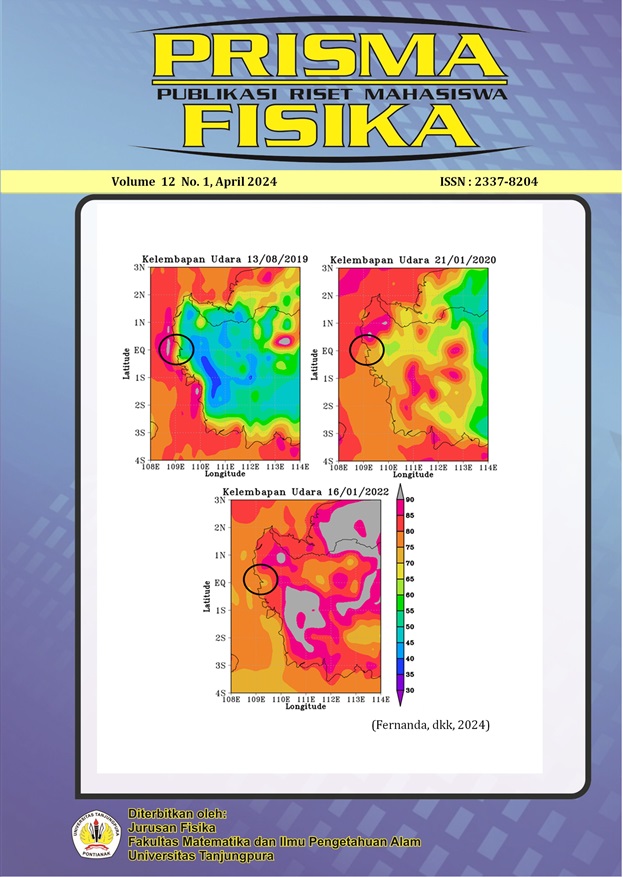
Cuaca ekstrem merupakan keadaan atau fenomena fisik atmosfer pada waktu tertentu, berskala jangka pendek dan bersifat ekstrem. Hujan ekstrem terjadi karena suhu permukaan air laut meningkat sehingga mempercepat terjadinya penguapan yang membentuk awan hujan. Penelitian ini dilakukan bertujuan untuk mengetahui pengaruh transpor uap air terhadap kejadian hujan ekstrem di Supadio yang didukung dengan keterkaitan berdasarkan nilai korelasi antara uap air dan curah hujan bulanan pada saat hujan ekstrem di Kalimantan Barat. Data yang digunakan adalah data online Badan Meteorologi Klimatologi Geofisika (BMKG) dan European Centre for Medium-Range Weather Forecasts (ECMWF) ERA-5 yang divisualisasikan dengan kejadian hujan ekstrem, pola angin, transpor uap air, dan analisis korelasi uap air pada saat curah hujan ekstrem di Kalimantan Barat melalui perangkat lunak The Grid Analysis and Display System (GrADS). Hasil dari analisis transpor uap air menunjukkan pengaruh transpor uap air pada saat kejadian hujan ekstrem disebabkan adanya pola pergerakan angin yang membawa uap air cukup basah sebesar 400-800 kg/(ms). Hasil analisis korelasi uap air dan curah hujan bulanan pada saat hujan ekstrem dominan berkorelasi positif. Uap air sangat berpengaruh terhadap curah hujan di Kalimantan Barat yang cenderung memiliki nilai koefisien korelasi sebesar 0.2-0.8 dengan tingkat hubungan tinggi.
Kata Kunci : Kejadian hujan ekstrem, Pola angin, Transpor uap air, Korelasi uap air dan curah hujan
References
Aldrian, E. and Susanto D., Identification of Three Dominant Rainfall Regions Within Indonesia and Their Relationship to Sea Surface Temperature, International Journal of Climatology, 2003.
Tjasyono, B. Meteorologi Indonesia 2 Bandung: Badan Meteorologi dan Geofisika; 2006.
Wulandari, A., Muliadi, dan Apriansyah., Pengaruh Sebaran Uap Air terhadap Curah Hujan di Kalimantan Barat, Prisma Fisika, 6(3): 160-166, 2018.
Badan Meteorologi Klimatologi dan Geofisika (BMKG), Prosedur Standar Operasional Pelaksanaan Peringatan Dini, Pelaporan, dan Desiminasi Informasi Cuaca Ekstrim, Indonesia, KEP.009,2010.
Siregar, D.C., Ardah, V.P., dan Navitri, A.M., Analisis Kondisi Atmosfer terkait Siklon Tinggi Gelombang di Perairan Kepulauan Riau, Jurnal Tunas Geografi, 8(2):111-122,2019.
Xiaoxia, Z., Yihui, D., and Panxing, W., Moisture Transport in the Asian Summer Monsoon Region and Its Relationship with Summer Precipitation in China, Acta Meteorologica Sinca, 24:31-42, 2009.
Riadi, E., Statistika Penelitian Analisis Manual dan IBM SPSS, Yogyakarta, 2016.
Misbahuddin dan Hassan, I., Analisis Data Penelitian dengan Statistik, Jakarta, Bumi Aksara, 2014.
Fitriyawita, M., Jurmarang, M. I., Apriansyah, Sulistya, W. dan Saepudin, M., Hubungan Pola Garis Arus Angin (Streamline) dengan Distribusi Hujan di Kalimantan Barat, Prisma Fisika, 8(2):135-146, 2020.
Fitri, N., Muliadi, dan Adriat, R., Analisis Dampak Siklon Tropis Pabuk Terhadap Unsur Cuaca di Kalimantan Barat, Prisma Fisika, 10(1):14-18, 2022.
Downloads
Published
Issue
Section
License
Copyright Notice using Creative Commons License for an Online Journal
The online journal Prisma Fisika operates under a Creative Commons Attribution-NonCommercial-ShareAlike 4.0 International License (CC BY-NC-SA 4.0). This copyright notice serves to inform authors, readers, and users of the terms and conditions regarding the use and distribution of the journal's content. By submitting or accessing the content, you agree to the following:
1. Content License:
a. All articles, images, and supplementary materials published in Prisma Fisika are licensed under the Creative Commons Attribution-NonCommercial-ShareAlike 4.0 International License.
b. This license permits users to copy, distribute, and adapt the content for non-commercial purposes, provided appropriate credit is given to the original authors and the journal.
c. If you remix, transform, or build upon the content, you must distribute your contributions under the same license as the original.
2. Attribution:
a. When using or sharing content from Prisma Fisika, you must properly attribute the original authors and the journal.
b. Include the title of the article, the names of all authors, Prisma Fisika, the year of publication, the volume/issue number, and the specific page numbers.
c. Provide a hyperlink to the original article on Prisma Fisika's website, if applicable.
3. Non-Commercial Use:
a. The content published in Prisma Fisika may not be used for commercial purposes without obtaining explicit permission from the copyright holders.
b. Commercial use includes, but is not limited to, reproduction or distribution of the content for financial gain, selling or licensing the content, or using the content in products or services that are sold or monetized.
4. ShareAlike:
a. If you adapt or remix the content from Prisma Fisika, you must distribute your derivative work under the same Creative Commons Attribution-NonCommercial-ShareAlike 4.0 International License.
b. This provision ensures that any modifications, adaptations, or remixes of the content maintain the same open licensing framework.
5. Disclaimer:
a. The views expressed in articles published in Prisma Fisika are solely those of the authors and do not necessarily reflect the opinions or policies of the journal, its editorial board, or affiliated institutions.
b. Prisma Fisika and its editors are not liable for any errors, omissions, or damages arising from the use or interpretation of the published content.
Please note that this Copyright Notice does not supersede any additional permissions or restrictions that may be granted by individual authors or copyright holders for their specific content within Prisma Fisika. For any questions or requests regarding the use of the journal's content, please contact the editorial team at prismafisika@physics.untan.ac.id.
By accessing or contributing to Prisma Fisika, you agree to comply with the terms of this Creative Commons license. Violation of these terms may result in legal consequences as governed by applicable copyright laws.
Date: 24-05-2023
Prisma Fisika
Email: prismafisika@physics.untan.ac.id
