Analisis Indeks Stabilitas Udara pada Saat Kejadian Angin Puting Beliung di Kota Pontianak
DOI:
https://doi.org/10.26418/pf.v12i1.75550Keywords:
Indeks Stabilitas, Parameter Cuaca, Angin Puting BeliungAbstract
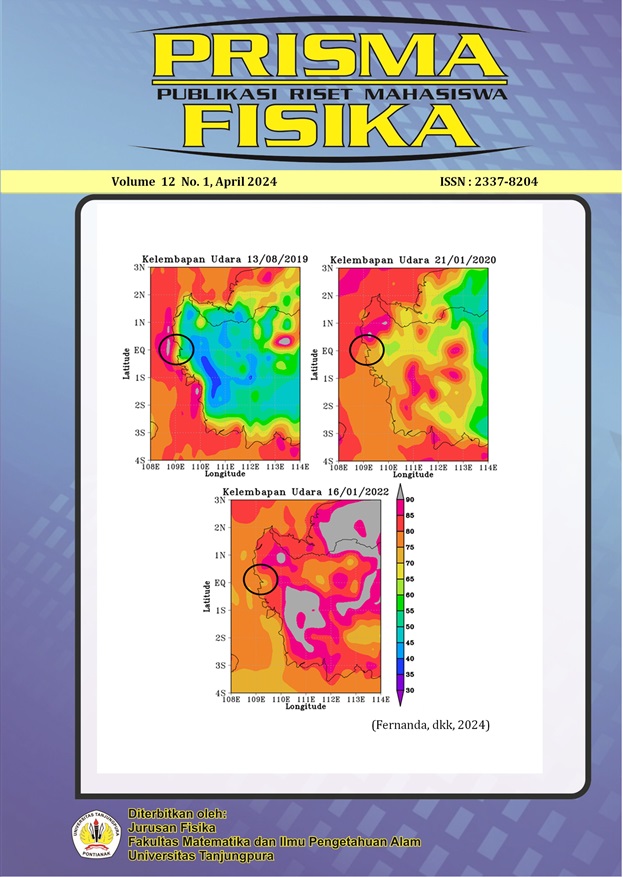
Kota Pontianak merupakan salah satu wilayah yang sering terjadi bencana ekstrem, salah satunya adalah kejadian angin puting beliung. Tujuan penelitian ini adalah untuk menganalisis kondisi cuaca, indeks stabilitas udara, dan suhu puncak awan saat kejadian angin puting beliung di Kota Pontianak pada tanggal 13 Agustus 2019, 21 Januari 2020, dan 16 Januari 2022. Metode yang digunakan pada analisis kondisi cuaca adalah menggunakan analisis spasial dan temporal. Sedangkan, metode analisis indeks stabilitas udara menggunakan analisis nilai indeks stabilitas seperti KI, LI, SI, TT, SWEAT, CAPE, dan CIN. Pada analisis suhu puncak awan akan menggunakan analisis spasial. Hasil penelitian kondisi cuaca menunjukkan suhu udara mengalami penurunan pada tiga kejadian angin puting beliung, yaitu sekitar 27,6ËšC sampai 31,3ËšC. Kelembapan udara mengalami peningkatan pada setiap tiga kejadian angin puting beliung, yaitu sekitar 54% sampai 73,5%. Sedangkan, arah angin saat kejadian angin puting beliung tanggal 13 Agustus 2019 bergerak dari selatan kemudian dibelokkan ke arah timur dan dua kejadian lainnya dari arah utara kemudian dibelokkan ke arah tenggara dengan kecepatan angin pada tiga kejadian angin puting beliung adalah sekitar 1,45 m/s sampai 3,45 m/s. Parameter-parameter cuaca tersebut menunjukkan kondisi yang berpotensi menyebabkan terjadi angin puting beliung. Berdasarkan klasifikasi indeks stabilitas hasil yang diperoleh adalah indeks LI, CAPE dan CIN menunjukkan atmosfer tidak stabil. Indeks SWEAT menunjukkan kondisi cuaca buruk. Indeks KI, SI, dan TT menunjukkan potensi terjadi thunderstorm. Hasil analisis suhu puncak awan pada tiga kejadian angin puting beliung, yaitu sekitar -25ËšC sampai -70ËšC yang merupakan awan dingin (cumulonimbus) yang memicu terjadi angin puting beliung.
References
Sariana, M. I. Jumarang, and R. Adriat, “Kajian Pola Angin Permukaan di Bandara Supadio Pontianak,†Prism. Fis., vol. VI, no. 2, pp. 108–116, 2018.
Badan Pusat Statistik, “Badan Pusat Statistik Kota Pontianak,†2023. https://pontianakkota.bps.go.id/subject/151/iklim.html#subjekViewTab3 (accessed Jan. 24, 2022).
Badan Perencanaan dan Pembangunan Daerah Kalimantan Barat, Profil Pembangunan Kalbar 2019. 2019. [Online]. Available: https://bappeda.kalbarprov.go.id/wp-content/uploads/2020/01/PROFIL-KALBAR-2019-OKE.pdf
M. R. Amri et al., Risiko Bencana Indonesia (Disasters Risk of Indonesia). Jakarta, 2016. [Online]. Available: https://doi.org/10.1007/s13753-018-0186-5
Peraturan Kepala Badan Nasional Penanggulangan Bencana No. 02 Tahun 2012, “Pedoman Umum Pengkajian Risiko Bencana.†2012.
Y. A. Wibowo, R. P. Dewi, L. Ronggowulan, R. Y. Anjarsari, and Y. Miftakhunisa, “Penguatan Literasi Mitigasi Bencana Angin Puting Beliung untuk Peningkatan Kapasitas Masyarakat Desa Munggur, Kabupaten Boyolali, Jawa Tengah,†J. War. LPM, vol. 23, no. 2, pp. 165–179, 2020, doi: 10.23917/warta.v23i2.10571.
Undang-Undang No. 24 Tahun, “Penanggulangan Bencana.†Jakarta, 2007. [Online]. Available: http://digilib.unila.ac.id/4949/15/BAB II.pdf
BNPB, “Geoportal Data Bencana Indonesia,†2022. https://gis.bnpb.go.id/ (accessed Dec. 15, 2022).
A. K. Silitonga, I. J. A. Saragin, and R. W. Saragih, “Deskripsi Parameter Cuaca Dan Stabilitas Udara Terkait Kejadian Angin Puting Beliung Pontianak (Studi Kasus 30 Agustus 2016),†J. Pros. Semin. Nas. Fis., vol. VI, pp. SNF2017-EPA-23-SNF2017-EPA-30, 2017, doi: 10.21009/03.snf2017.02.epa.04.
R. W. S. Saragih, A. S. Asmita, and A. R. Widayana, “Analisis Kondisi Atmosfer, Indeks Labilitas, dan Citra Satelit Saat Kejadian Puting Beliung di Pontianak Kalimantan Barat (Studi Kasus 17 Juli 2020),†J. Fis., vol. 10, no. 2, pp. 62–71, 2020, doi: 10.15294/jf.v10i2.26927.
I. N. W. W. Utama, D. Palguna, R. Mahubessy, P. Aditya, and P. A. Winarso, “Kajian Kondisi Atmosfer Saat Kejadian Puting Beliung,†Pros. SNFA, no. April, pp. 141–149, 2018.
P. D. Suryana, “Metodologi Penelitian : Metodologi Penelitian Model Prakatis Penelitian Kuantitatif dan Kualitatif,†Univ. Pendidik. Indones., pp. 1–243, 2012, doi: 10.1007/s13398-014-0173-7.2.
O. S. Hakim, “Prakiraan Kejadian Hujan Berdasarkan K-Index, Lifted Index, dan Showalter Index,†J. Sains Teknol. Atmos., vol. 1, no. 1, 2021, [Online]. Available: https://juanda.jatim.bmkg.go.id/home/data/buletin/JURNAL I.pdf
A. A. Azani and N. Kusumawardani, “Kajian Indeks Stabilitas Atmoster Terhadap Kejadian Hujan Lebat Di Kota Bitung (Studi Kasus tahun 2020-2021),†J. Widya Climago, vol. 4, 2022, [Online]. Available: https://e-journal.pusdiklat.bmkg.go.id/index.php/climago/article/view/71
F. Febrianti, “Prediksi bencana alam angin puting beliung di wilayah Cilacap Jawa Tengah dengan menggunakan Adaptive Neighborhood Modified Backpropagation (ANMBP),†Universitas Islam Negeri Sunan Ampel Surabaya, 2018.
K. Arora, K. Ray, S. Ram, and R. Mehajan, “The Role of Instability Indices in Forecasting Thunderstorm and Non-Thunderstorm Days across Six Cities in India,†Climate, vol. 11, no. 1, pp. 1–18, 2023, doi: 10.3390/cli11010014.
J. Haby, “Skew-T Parameters,†The Universal Rawinsonde Observation Program. http://www.theweatherprediction.com/thermo/parameters/ (accessed Sep. 13, 2023).
I. K. M. Satriyabawa and W. N. Pratama, “Analisis Kejadian Puting Beliung Di Stasiun Meteorologi Juanda Surabaya Menggunakan Citra Radar Cuaca Dan Model Wrf - Arw ( Studi Kasus Tanggal 4 Februari 2016 ),†Pros. SNSA 2016, pp. 89–97, 2016.
A. Fishwaranta, D. A. K. Wida, and M. Fachrurrozi, “Pemanfaatan Data Model Global, Citra Satelit, Dan Data Obsrevasi Udara Atas Untuk Identifikasi Kejadian Puting Beliung Dan Waterspout Di Kupang–NTT (Studi Kasus Tanggal 14 Januari 2011 Dan 18 Januari 2012),†J. Meteorol. Klimatologi dan Geofis., vol. 4, no. 2, pp. 1–6, 2017.
A. Raechan Anam and S. Amri, “Analisis Kejadian Angin Puting Beliung Menggunakan Citra Satelit Himawari-8 (Studi Kasus Kota Bogor, Jawa Barat 21 September 2021),†J. Ilm. Indones., vol. 3, no. 2, p. 6, 2021.
B. D. Pertiwi, “Analisis Karakteristik Awan Cumulonimbus Menggunakan Citra Satelit dan Data Cuaca Permukaan Wilayah Banyuwangi,†Universitas Negeri Yogyakarta, 2018.
N. National Weather Service, “Env Parameters and Indices.†https://www.weather.gov/lmk/indices (accessed Sep. 15, 2023).
D. Derubertis, “Recent trends in four common stability indices derived from U.S. radiosonde observations,†J. Clim., vol. 19, no. 3, pp. 309–323, 2006, doi: 10.1175/JCLI3626.1.
Y. Ilhamsyah, “Kajian Pendahuluan Analisis Peramalan Thunderstorm Untuk Penyusunan Indeks Dasar Adaptasi Kegiatan Pertambakan ( Suatu Tinjauan Meteorologi di Jakarta ),†vol. 1, no. April, pp. 53–60, 2012.
A. Agricultural Weather Center, “Stability of the Atmosphere.†http://weather.uky.edu/about_cin.html (accessed Sep. 15, 2023).
N. Okstrifiani, “Prediksi Puting Beliung Di Kabupaten Toraja Utara,†Universitas Hasanuddin Makassar, 2013.
Nurasniyati, Muliadi, and R. Adriat, “Estimasi Curah Hujan Di Kota Pontianak Berdasarkan Suhu, Ketebalan dan Tekanan Puncak Awan,†Prism. Fis., vol. 6, no. 3, pp. 184–189, 2018, [Online]. Available: www.giovanni.gsfc.nasa.gov/giovaanni.
Downloads
Published
Issue
Section
License
Copyright Notice using Creative Commons License for an Online Journal
The online journal Prisma Fisika operates under a Creative Commons Attribution-NonCommercial-ShareAlike 4.0 International License (CC BY-NC-SA 4.0). This copyright notice serves to inform authors, readers, and users of the terms and conditions regarding the use and distribution of the journal's content. By submitting or accessing the content, you agree to the following:
1. Content License:
a. All articles, images, and supplementary materials published in Prisma Fisika are licensed under the Creative Commons Attribution-NonCommercial-ShareAlike 4.0 International License.
b. This license permits users to copy, distribute, and adapt the content for non-commercial purposes, provided appropriate credit is given to the original authors and the journal.
c. If you remix, transform, or build upon the content, you must distribute your contributions under the same license as the original.
2. Attribution:
a. When using or sharing content from Prisma Fisika, you must properly attribute the original authors and the journal.
b. Include the title of the article, the names of all authors, Prisma Fisika, the year of publication, the volume/issue number, and the specific page numbers.
c. Provide a hyperlink to the original article on Prisma Fisika's website, if applicable.
3. Non-Commercial Use:
a. The content published in Prisma Fisika may not be used for commercial purposes without obtaining explicit permission from the copyright holders.
b. Commercial use includes, but is not limited to, reproduction or distribution of the content for financial gain, selling or licensing the content, or using the content in products or services that are sold or monetized.
4. ShareAlike:
a. If you adapt or remix the content from Prisma Fisika, you must distribute your derivative work under the same Creative Commons Attribution-NonCommercial-ShareAlike 4.0 International License.
b. This provision ensures that any modifications, adaptations, or remixes of the content maintain the same open licensing framework.
5. Disclaimer:
a. The views expressed in articles published in Prisma Fisika are solely those of the authors and do not necessarily reflect the opinions or policies of the journal, its editorial board, or affiliated institutions.
b. Prisma Fisika and its editors are not liable for any errors, omissions, or damages arising from the use or interpretation of the published content.
Please note that this Copyright Notice does not supersede any additional permissions or restrictions that may be granted by individual authors or copyright holders for their specific content within Prisma Fisika. For any questions or requests regarding the use of the journal's content, please contact the editorial team at prismafisika@physics.untan.ac.id.
By accessing or contributing to Prisma Fisika, you agree to comply with the terms of this Creative Commons license. Violation of these terms may result in legal consequences as governed by applicable copyright laws.
Date: 24-05-2023
Prisma Fisika
Email: prismafisika@physics.untan.ac.id
